How Google AI Overviews Decide What to Show: 6 Safe Checks
Quick Answer: Google AI Overviews are not something a business can force into place. As of 2026, Google describes AI Overviews and AI Mode as generative AI features in Search that help people understand a topic, ask follow-up questions, and open links to the web. The practical baseline for visibility is familiar SEO: pages need to be crawlable, indexed, snippet-eligible, and genuinely useful for the query. Site owners can manage some participation settings and snippet controls, but Google does not promise inclusion, citations, impressions, traffic, leads, or timing for any individual page.
For owners and marketing leads, the important shift is not that traditional SEO stopped mattering. It is that Google’s AI search experiences depend on the same foundations while changing how people encounter answers. A page that cannot be crawled, is not indexed, is blocked from snippets, or does not clearly answer a real search need is starting from a weak position. A page that is technically accessible, well-structured, and useful has a better eligibility foundation, but eligibility is still not the same as being selected.
This guide separates what Google documents from what site owners often observe. It also explains what to check in Search Console, how to think about AI Mode, why helpful content matters, and when an AI search readiness audit makes sense before chasing AI visibility.
What Google AI Overviews use as a starting point
Google says its AI features in Search are designed to help people get information, explore sources, and continue searching. The clearest documented starting point for site owners is Google’s own guidance: pages should follow Search fundamentals, be accessible to Google, and allow appropriate preview content when the owner wants visibility in these experiences. Google Search Central’s AI features documentation explains that site owners can use standard preview controls and that search appearance depends on normal Search systems and policies.
That means a business should not treat AI visibility as a separate shortcut. A page still needs a real URL, crawlable links, indexable content, a clear topic, useful information, and enough context for Google to understand the page. If those basics are weak, AI search work becomes guesswork.
There are three practical layers to understand:
- Eligibility: whether a page is technically available and allowed to appear in relevant Search experiences.
- Selection: whether Google’s systems choose to use or link to a page for a specific query.
- Measurement: whether the business can observe impressions, clicks, citations, or related search behavior without assuming every AI answer is trackable in the same way.
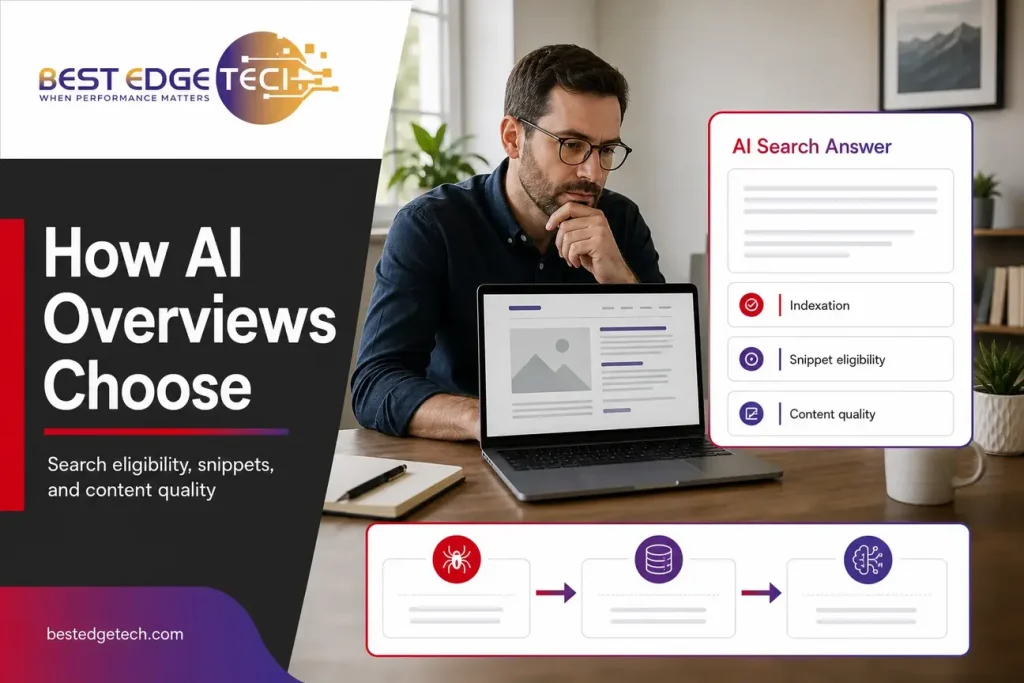
Owners often want to skip straight to selection. The safer order is eligibility first, then quality, then measurement. No agency or platform can promise AI citations, but a business can remove many avoidable barriers that make participation less likely.
What Google documents about AI Overviews and AI Mode
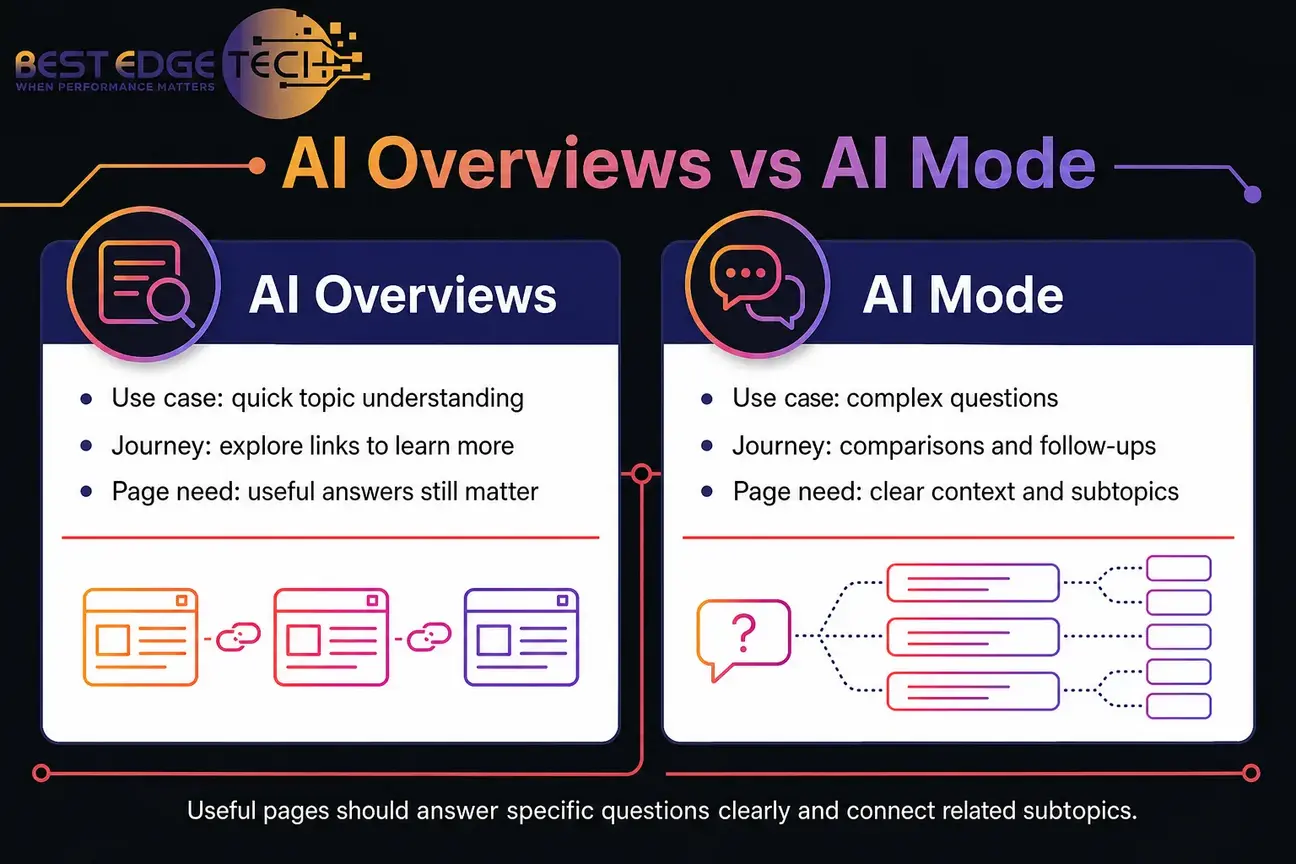
As of 2026, Google’s public materials describe AI Overviews as a way for Search users to get a quick understanding of a topic and explore links to learn more. Google describes AI Mode as a more exploratory Search experience for complex questions, comparisons, follow-up queries, and deeper reasoning. Google Search Help’s AI Mode documentation frames the experience around asking questions and continuing the search journey.
For businesses, the key point is that AI Mode does not replace the need for useful pages. It increases the need for pages that can answer specific questions clearly, provide context, and connect related subtopics in a way people and systems can follow. AI Mode may surface web links, but Google does not give site owners a setting that forces a specific URL to be used for a specific prompt.
The distinction matters when a marketing lead asks, “Can we optimize for AI?” The answer is yes, if optimization means improving crawlability, indexing, content usefulness, structured information, internal linking, and entity clarity. The answer is no, if optimization means trying to buy or force placement inside an AI response.
AI Mode also changes how teams should plan content. Short, thin pages that only repeat keywords are unlikely to be enough for complex research behavior. A better page answers the primary question, explains important conditions, defines terms, links to related resources, and makes the business’s expertise easy to verify. That is not a trick for AI Mode. It is sound search strategy.
What site owners can control in Search Console
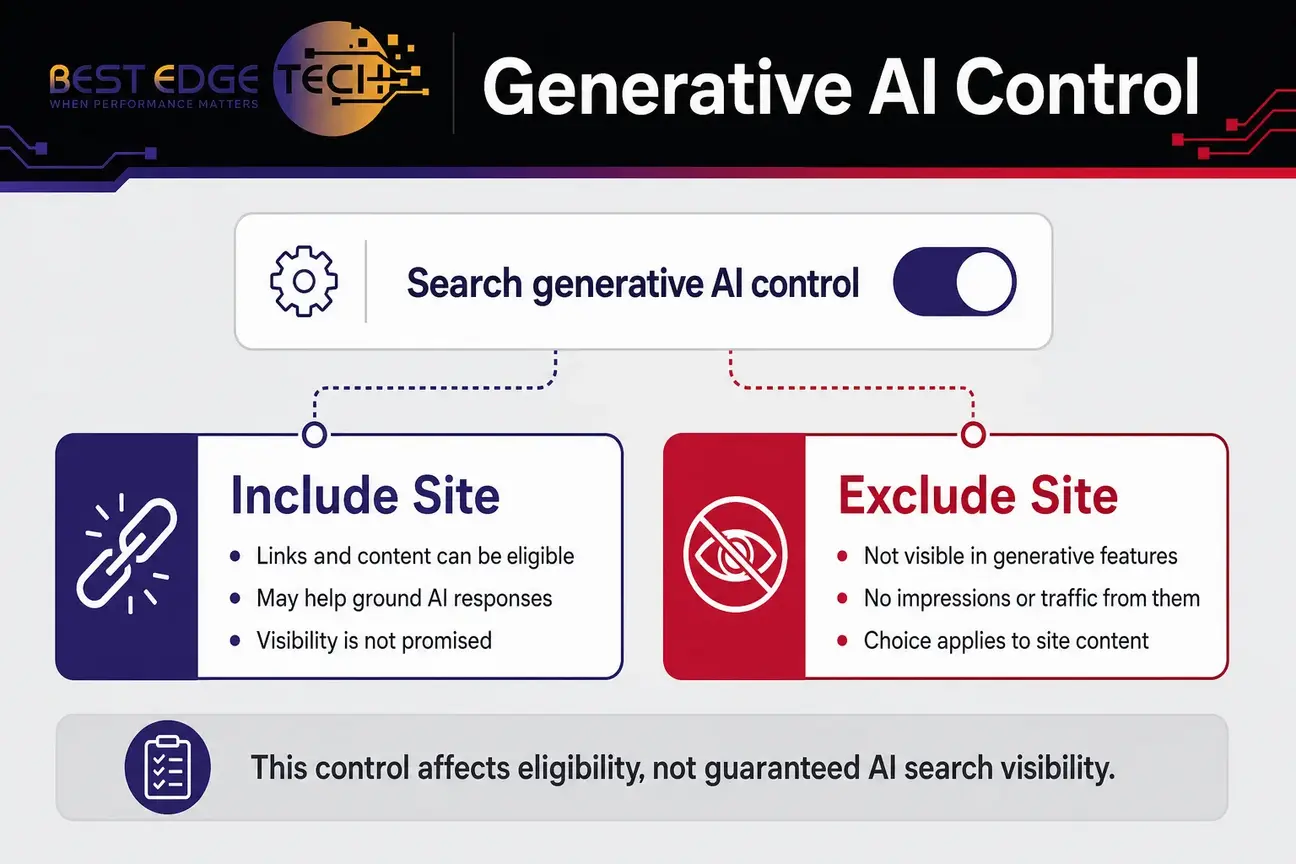
Google has introduced a Search generative AI control in Search Console. Google’s wording is direct: “Use the Search generative AI control.” The setting is available under Search Console settings and lets a verified site owner include or exclude the site’s links and content from generative AI Search features. Google Search Console Help’s Search generative AI control page says included sites “can appear as links and helping to ground AI responses,” while excluded sites will not be visible in those features and will not receive impressions or traffic from them.
This is a real control, but it is not a promise of visibility. Including a site makes it eligible for those generative AI Search features under Google’s documented control. It does not mean Google will use every page, cite every brand, or send measurable traffic from every relevant query.
Google also states that the control “will not be used as a ranking signal” for search results outside generative AI Search features. That language matters because opting in or out should not be treated as a shortcut for improving normal organic rankings. It is a participation control for generative AI Search features, not a ranking lever for the rest of Search.
A practical owner-level workflow looks like this:
- Confirm that the correct property is verified in Search Console.
- Open the settings area and review the Search generative AI control.
- Decide whether the site should be included or excluded from generative AI Search features.
- Document who made the decision and why.
- Recheck the setting after ownership changes, redesigns, migrations, or agency handoffs.
For most lead-generation businesses, inclusion is usually the starting assumption because AI search experiences can include links and may generate impressions or traffic. However, certain publishers, regulated organizations, or sensitive content owners may have reasons to evaluate exclusion. That decision should be made deliberately, not by accident.
If you work in healthcare, law, or medical tourism marketing, keep the decision in the marketing and search lane. Confirm advertising, privacy, and professional responsibility questions with your own counsel or compliance team before changing how sensitive content is exposed.
Search eligibility starts with crawlability and snippets
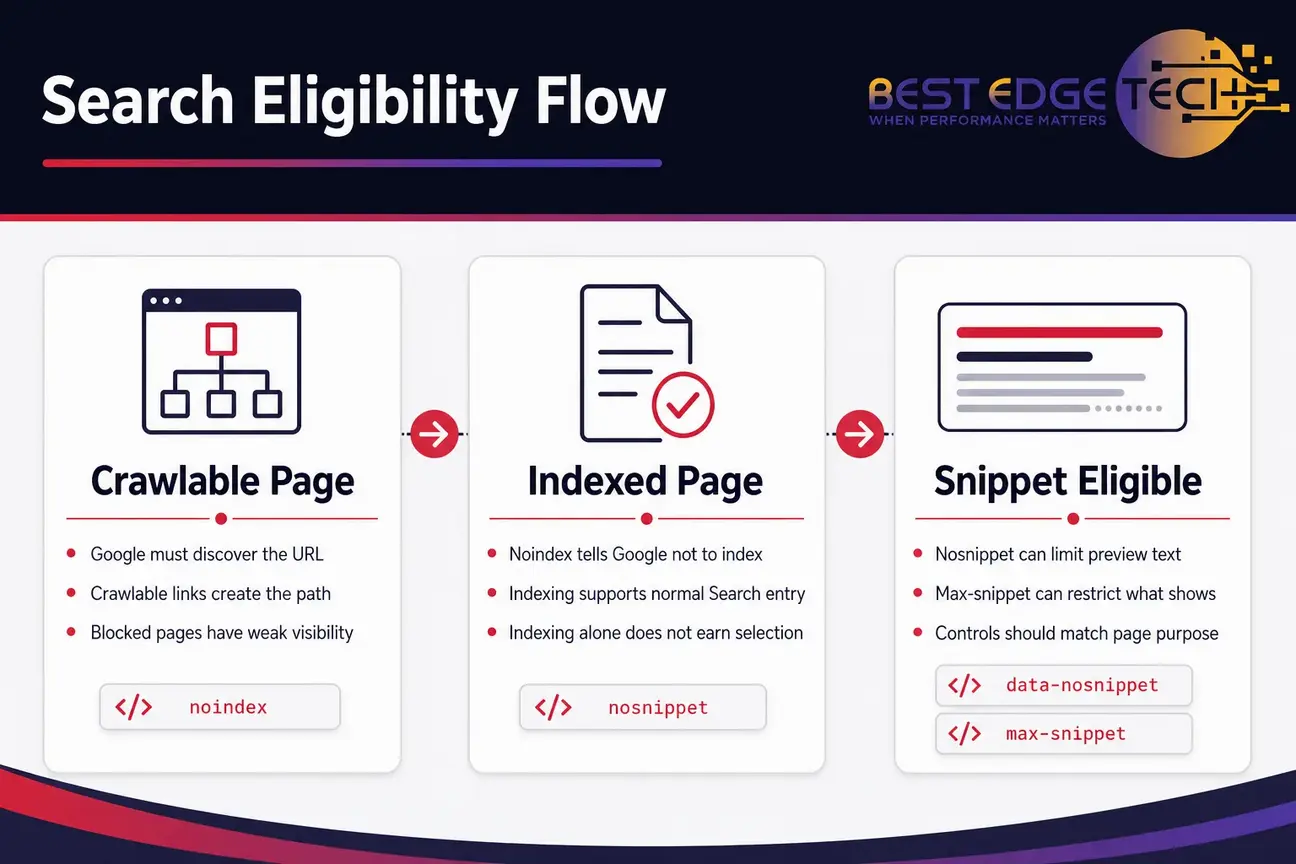
Search eligibility is the practical gate before any AI visibility discussion. If Google cannot discover or crawl a page, the page has a weak path into Search. If Google can crawl the page but is told not to index it, the page generally should not be expected to appear in normal Search results. If the page is blocked from snippets, the page may limit what Google can show from it in Search features.
Google’s AI features documentation says site owners can limit information shown from pages by using controls such as nosnippet, data-nosnippet, max-snippet, and noindex. That “can limit the information shown” language matters. These controls are not decorations. They are instructions that can affect how much of a page Google may use in Search appearances.
Here is the business translation:
| Control or condition | What it means | AI visibility implication | What to check |
|---|---|---|---|
| Blocked crawling | Googlebot may not be able to access the page. | The page may not be available for normal Search consideration. | Robots rules, server errors, login walls, crawl reports. |
| Noindex | The page tells Google not to index it. | Do not expect the page to appear as an indexed Search result. | Page source, CMS SEO settings, Search Console inspection. |
| Nosnippet | The page limits snippet display. | Preview content may be restricted in Search features. | Robots meta tags and page-level directives. |
| Max-snippet | The page limits snippet length. | Google may have less preview text available. | Robots meta tag values and template defaults. |
| Thin or unclear content | The page lacks useful context for the query. | Eligibility may exist, but usefulness is weak. | Content quality, headings, answer depth, internal links. |
Do not remove snippet controls blindly. Some sites intentionally restrict previews for legal, paid-content, privacy, or business reasons. The decision should be based on the purpose of the page. A public service page designed to win qualified leads usually needs a different preview strategy than a private portal page, gated report, or sensitive internal document.
A useful technical check is to run an XML sitemap audit and compare sitemap URLs against pages that are actually indexable. Sitemaps do not force indexing, but they help you see whether your important pages are being submitted consistently. Internal links matter too; an internal linking audit can reveal whether valuable pages are buried, orphaned, or disconnected from related topics.
Indexed pages are only the entry point
Indexed pages are necessary for most organic visibility, but indexing alone is not proof that a page deserves to be selected for an AI answer. Google’s Search Console Page indexing report helps site owners see which URLs are indexed and which are not. Google’s Page indexing report documentation explains how the report shows indexing status and reasons pages may not be indexed.
For an owner, indexed pages should be reviewed in groups, not just one URL at a time. Start with pages that matter commercially: service pages, location pages, high-value blog guides, comparison resources, FAQs, and pages that answer questions prospects ask before contacting you. Then verify whether those pages are indexed, internally linked, current, and useful.
A simple indexed pages review should ask:
- Are the priority service and educational pages indexed?
- Are important URLs excluded because of noindex, canonical tags, redirects, or crawl issues?
- Are outdated pages still indexed even though they no longer represent the business accurately?
- Do multiple pages compete for the same intent with weaker versions of the same answer?
- Are pages with sensitive or private information accidentally indexable?
Indexing is a gate, not a finish line. A page can be indexed and still fail to earn meaningful search visibility because it does not answer the query well, is too generic, lacks trust signals, or sits on a site with technical problems. That is why AI search readiness should combine technical SEO, content strategy, and measurement rather than focusing on one dashboard metric.
For businesses that need help prioritizing what to fix first, Best Edge Tech’s AI SEO and GEO services focus on the search foundations behind AI visibility: technical access, structured information, helpful content, entity clarity, and practical measurement. The work cannot promise AI inclusion, but it can reduce avoidable barriers.
Why helpful content remains the practical baseline
Helpful content is not a slogan for this topic. It is the difference between a page that simply exists and a page that deserves consideration for a real user’s question. Google’s guidance on creating people-first content asks site owners to evaluate whether content is useful, reliable, and made primarily for people rather than search engines. Google Search Central’s helpful content guidance encourages self-assessment around originality, completeness, expertise, and whether visitors would leave satisfied.
For AI search, helpful content means the page can support an answer. It should define terms, address the main question early, cover important conditions, and give enough detail that a user can make a better decision. A service page can still be persuasive, but it should not be only a sales pitch. A blog post can still support conversion, but it should solve the informational need first.
For example, a healthcare practice writing about a procedure should stay in the marketing and search lane, avoid giving clinical advice beyond its role, and ensure claims are accurate and reviewable by the practice’s own compliance process. A law firm should avoid unsupported promises and confirm advertising rules with counsel. An agency publishing on behalf of a client should document sources, scope, and quality checks.
Helpful content also supports entity understanding. An entity is a clearly identifiable thing: a business, person, service, location, condition, product, or concept. Search systems need context to understand which entity a page is about and how it relates to other entities. Clear page titles, descriptive headings, consistent business information, structured data where appropriate, and strong internal links all help reduce ambiguity.
Structured data does not force AI inclusion, but it can help Google understand page information when implemented correctly. If your site uses schema markup, a schema markup audit can check whether the markup matches visible content, avoids unsupported claims, and follows Google’s structured data policies.
How snippet controls affect helpful content visibility
There is a tension many businesses miss: the same controls that protect content can also reduce how much content is available for Search previews. A page may contain excellent helpful content, but if the template applies nosnippet across the entire section, Google may have less ability to show preview text from that page. If a page uses noindex, the page is telling Google not to index it.
That does not mean every page should be wide open. It means the controls should match the page’s purpose. Public educational pages, evergreen service guides, and high-intent FAQ resources often benefit from being crawlable, indexable, and snippet-eligible. Internal policy pages, private portals, duplicate landing pages, and sensitive documents may need stricter controls.
Use this decision process:
- Classify the page: lead-generation page, educational resource, internal page, paid content, duplicate page, or sensitive content.
- Check the directive: look for noindex, canonical, nosnippet, max-snippet, data-nosnippet, and robots restrictions.
- Compare directive to purpose: if the page is meant to earn organic visibility, make sure the directive does not contradict that goal.
- Validate in Search Console: inspect the URL and confirm the current indexing state.
- Monitor after changes: watch indexing, impressions, and query behavior without expecting immediate or assured AI inclusion.
This is also where content and technical teams need to talk. A developer may add a global directive for a good reason, while the marketing team may not realize that important pages are affected. A content manager may publish a strong article, while the site architecture makes it hard for Google to discover. AI search readiness depends on these disciplines working together.
What businesses cannot control or promise
Businesses cannot control which specific pages Google selects for AI Overviews or AI Mode. They cannot require a citation for a brand, force a link into an answer, or promise traffic from a generative Search feature. They also cannot reliably infer every AI search behavior from a single test prompt, because Search experiences can vary by query, user context, location, device, language, and product changes.
That uncertainty does not make the work pointless. It means the work should be framed correctly. The goal is to improve eligibility, clarity, usefulness, and measurement. The goal is not to sell a fixed AI placement.
Be cautious with any promise that sounds too certain. Phrases like “we will get you cited in AI answers” or “we can promise AI traffic” go beyond what Google documents. A more honest statement is that a business can improve the foundations that make pages more accessible, understandable, and useful in search systems.
Observed behavior can still be useful. If your team repeatedly sees competitors, directories, or informational sources appearing for your important topics, that may reveal content gaps. But treat those observations as diagnostic inputs, not proof of a fixed formula. Google documents eligibility concepts and controls; it does not publish a checklist that ensures inclusion for every query.
How to audit AI search eligibility before chasing visibility
An AI search audit should not start with screenshots of AI answers. It should start with the pages that should be eligible to support those answers. The following process gives a business owner or marketing lead a practical order of operations.
1. Identify the queries that matter
List the questions prospects ask before they contact you. Include service definitions, comparison questions, cost-driver questions without publishing unsupported prices, risk questions, process questions, and location-specific questions where relevant. For agencies, separate client-facing questions from white-label fulfillment questions.
Map each question to an existing page. If there is no strong page, that is a content gap. If there are too many similar pages, that may be a consolidation or cannibalization issue.
2. Verify crawlability and index status
Use Search Console to inspect priority URLs. Confirm whether the page is indexed, whether Google can fetch it, and whether the canonical selected by Google matches your intended URL. Indexed pages should then be reviewed for quality and internal linking, not assumed to be done.
If a page is not indexed, look for obvious causes: noindex tags, canonical conflicts, redirects, blocked resources, server errors, duplicate content, thin content, or weak internal discovery. Fix the cause first, then request indexing only when the page is ready.
3. Check snippet and preview controls
Review page-level robots meta tags and template-level rules. If a page is intended to support organic search, make sure snippet controls are intentional. If the business needs preview restrictions, document the tradeoff.
This step is especially important after redesigns, CMS migrations, or theme changes. A template decision can affect hundreds of URLs at once.
4. Evaluate helpful content depth
Ask whether the page actually answers the query. A helpful page should state the answer early, define unfamiliar terms, address common objections, explain conditions, and point to the next useful resource. It should not hide the answer behind vague marketing language.
For AI Mode-style exploratory searches, a page that covers related subquestions may be more useful than a narrow page that only targets one exact phrase. That does not mean making every article long. It means making the page complete enough for the intent.
5. Strengthen entity and trust signals
Make sure the page clearly identifies the business, service, audience, location relevance when appropriate, and source of information. Use consistent naming across the site. Link related service, blog, and resource pages together. Avoid exaggerated claims, unsupported statistics, and vague authority language.
For local businesses, trust signals may also include accurate Google Business Profile information and review practices that follow platform guidelines. Do not use fake addresses, keyword-stuffed business names, or review incentives.
6. Measure without assuming inclusion
Measurement should combine Search Console data, landing page performance, query patterns, referral behavior where available, and manual observation of AI search experiences. An AI search visibility tracking process can help organize observations, but it should not pretend that every AI interaction is fully visible in analytics.
If a business sees incorrect or outdated brand information appearing in AI tools or search experiences, it should document the issue, check first-party pages, correct inconsistent public information where it controls the source, and build clearer entity signals. This is an adjacent problem to AI visibility because search systems and answer systems need consistent, accurate information to understand a business.
Where AI citation work fits
AI citation optimization is not a magic placement service. It is the practice of making useful, verifiable, well-structured information easier for search and answer systems to understand and reference. That may involve stronger content, clearer topical coverage, internal links, structured data, consistent entity information, and better technical access.
For example, if a page explains a service but never answers the common decision questions around eligibility, process, limitations, or next steps, it may be less useful for exploratory search. If a page has strong content but is buried five clicks deep with no contextual internal links, discovery may suffer. If a page uses structured data that contradicts visible content, trust can be weakened.
A practical AI citation optimization effort should start with the pages already closest to search demand. Improve the answer quality. Clarify who the page is for. Remove unsupported claims. Add related internal links. Confirm that the page is indexed and snippet-eligible. Then track whether search visibility changes over time.
This approach is slower than a promise, but it is safer. It respects the difference between what a site owner controls and what Google’s systems decide query by query.
When to involve an SEO or GEO partner
Many businesses can do the first pass themselves: check Search Console, inspect priority pages, review indexing, and identify obvious content gaps. A partner becomes useful when the site has technical debt, a large content library, multiple locations, regulated subject matter, a redesign on the calendar, or agency clients that need repeatable fulfillment.
Scope depends on site size, competition, number of locations, content volume, technical issues, CMS limitations, and how much reporting the team needs. Best Edge Tech does not need to quote a one-size-fits-all package to explain the work. A practical engagement starts with the website URL, goals, markets served, priority services, recent site changes, and what the team is trying to learn from Search Console.
If you want help evaluating AI search readiness, you can contact Best Edge Tech or call 252-303-0074. Share your website URL, target services, markets served, current concerns, recent redesign or migration history, and whether you are considering AI SEO, GEO, technical SEO, or content support.
Practical takeaways for owners and marketing leads
The practical answer is simple but not effortless: make important pages crawlable, indexable, snippet-eligible, and useful. Then measure carefully. Google’s AI search features may change how answers are presented, but they do not remove the need for strong search fundamentals.
For Google AI Overviews, the safest planning model is eligibility before expectations. Confirm the Search generative AI control. Check indexed pages. Review snippet directives. Improve helpful content. Connect related resources with internal links. Track search visibility without assuming every AI answer will be visible in your analytics.
The same logic applies to AI Mode. People use AI Mode for deeper exploration, so pages should answer the primary question and support the follow-up questions that naturally come next. If your content cannot help a real buyer, patient, client, or agency partner make sense of a topic, it is probably not ready for AI search either.
Search engines and AI products change often. Check current platform documentation before acting, and treat any result as dependent on your site, market and competition.
Frequently Asked Questions
What is the difference between AI Overviews and AI Mode?
AI Overviews are AI-generated summaries in Google Search that can help users get a quick understanding of a topic and explore links. AI Mode is a more exploratory Search experience for deeper questions, comparisons, and follow-up searches. Both depend on Google’s systems, and neither gives site owners a way to force a specific page to appear.
Can a site owner force Google to show a page in AI Overviews?
No. A site owner can improve eligibility by making pages crawlable, indexed, snippet-eligible, and useful, but Google does not provide an inclusion switch for a specific page, query, or citation.
What does the Search generative AI control actually do?
The Search generative AI control in Search Console lets a verified site owner include or exclude the site’s links and content from Google’s generative AI Search features. Inclusion means the site can be considered for those features; it does not promise selection.
Does opting out affect normal Google rankings?
Google documents the control as specific to generative AI Search features and states that it “will not be used as a ranking signal” for search results outside those features. That means opting out should not be treated as a normal ranking tactic; it is a participation decision for generative AI Search features.
What page qualities matter most for search eligibility?
The practical baseline is crawlability, indexing, snippet eligibility, clear content, strong internal links, and usefulness for the query. Pages should answer real questions, avoid unsupported claims, and provide enough context for users to make informed next decisions.
How do noindex and snippet controls affect AI features?
A noindex directive tells Google not to index a page. Snippet controls such as nosnippet, data-nosnippet, and max-snippet can limit how much information Google may show from a page. These controls should match the page’s purpose.
Can Google or an SEO agency promise AI citations or traffic?
No. Google does not promise AI citations, impressions, traffic, leads, or timing for any individual page. An SEO or GEO partner can help improve technical access, content usefulness, entity clarity, and measurement, but outcomes depend on the site, market, competition, and Google’s systems.
How should a business measure AI search visibility?
Use a mix of Search Console trends, landing page performance, query research, manual observations, and documented tracking of AI search appearances. Treat observations as directional, because not every AI interaction is visible in standard analytics.