
Technical SEO Audit: Practical Checks to Avoid Risk
A technical SEO audit checks whether search engines can discover your important pages, crawl them without avoidable friction, understand the preferred version of each URL, and evaluate the content for potential inclusion in search results. For a small or midsized business, the point is not to collect every warning a tool can produce. The point is to separate real search visibility risks from low-impact noise, then turn useful findings into prioritized fixes. A strong audit reviews crawling, indexing, XML sitemaps, canonicals, redirects, internal links, structured data, page experience, and recent site changes as one connected system.
Quick Answer
A technical site review looks at discovery, access, interpretation, index eligibility, rendering, and architecture. It should tell you which pages matter most, what is blocking or confusing search engines, what is intentional, and which fixes should be handled first. It should not promise rankings, traffic, leads, revenue, or AI citations, because results depend on site history, competition, implementation, content quality, and market demand.
What a technical SEO audit is—and is not
A technical SEO audit is an integrated diagnostic process. It is not the same as running a crawler, exporting a list of “errors,” and forwarding the spreadsheet to a developer. Automated tools are useful, but they do not know which pages produce qualified leads, which exclusions are intentional, which redirects preserve a migration, or which template problem affects the largest business-critical section of the site.
For a healthcare practice, a law firm, a local service business, or an agency managing a client site, a useful audit starts with the business model. Which pages should be discoverable? Which services, locations, resources, or contact paths matter? Has the site recently changed domains, redesigned templates, added new content, merged pages, or switched CMS platforms? Without that context, the audit may be technically accurate but commercially unhelpful.
A good audit also avoids false certainty. A URL can be crawlable and still not be indexed. A valid sitemap does not assure indexing. Structured data can help interpretation and eligibility for certain search features, but it does not promise enhanced display. A canonical tag is a signal, not an absolute command. Technical fixes can remove barriers, but no one can promise search outcomes.
If you want professional help interpreting what matters, Best Edge Tech offers SEO audit services that focus on diagnosis, prioritization, and practical next actions rather than isolated tool scores.
SEO audit checklist: 10 checks for scope, crawlability, indexing, and action
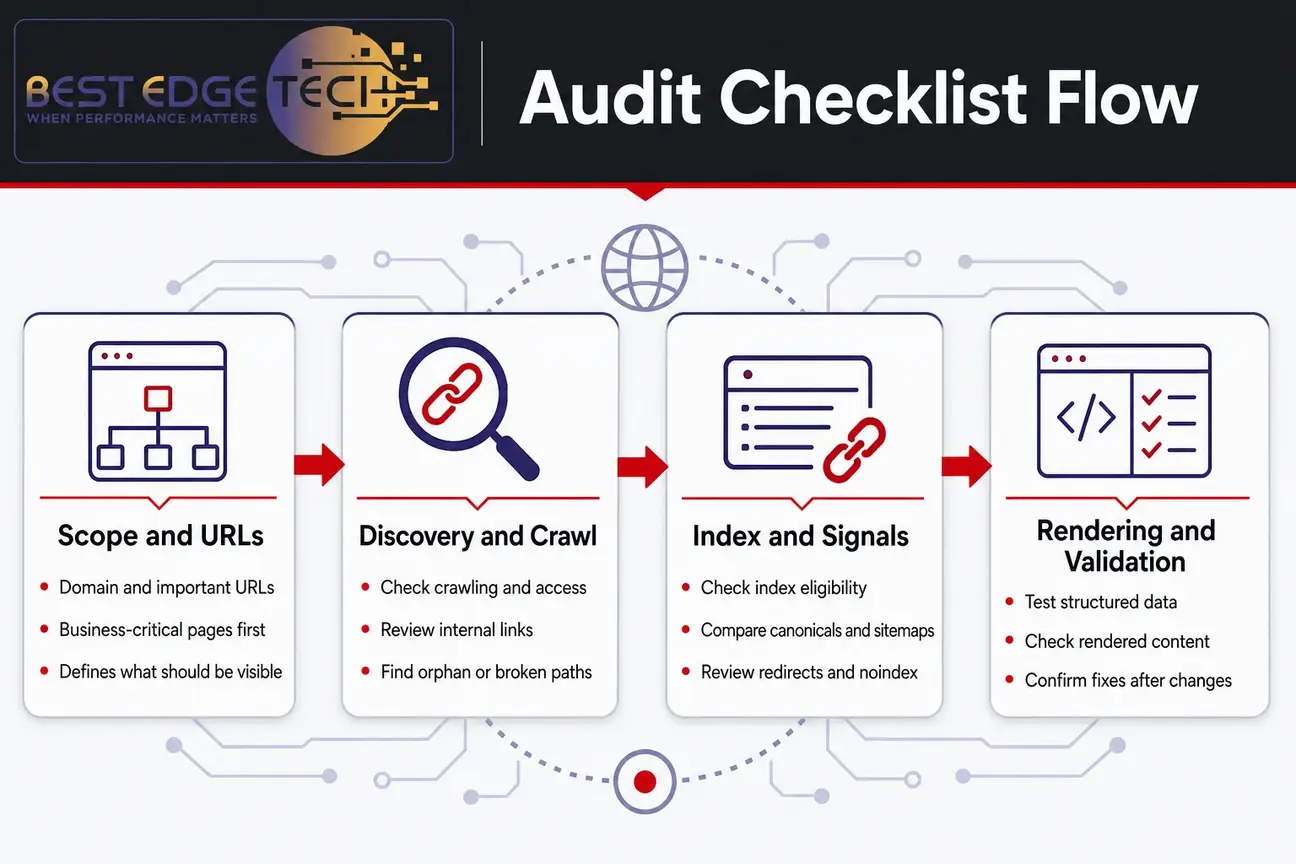
An effective SEO audit checklist should follow the way search systems encounter a site: first the domain and important URLs, then discovery, crawling, index eligibility, canonical signals, redirects, internal links, structured data, rendering, page experience, and validation. The order matters because later findings often depend on earlier signals. For example, a structured-data warning matters less if the page is blocked from indexing, and a sitemap entry is less useful if it points to a redirected or canonicalized URL.
Use the SEO audit checklist below as an integrated diagnostic map, not as a rigid scoring formula. Your SEO audit priorities should still depend on business value, technical risk, implementation effort, and whether the issue is intentional. The same SEO audit checklist can produce different action plans for two sites because the risk profile, content model, and recent changes are different.
| Audit area | What to check | What a problem looks like | How to confirm |
|---|---|---|---|
| Scope | Primary domain, variants, key pages, recent changes | The audit ignores lead-generating pages or recent migrations | Compare crawl data with the intended URL set |
| Crawlability | Robots rules, crawlable links, response codes, server access | Important pages are unreachable or blocked | Run a representative crawl and inspect affected URLs |
| Indexing | Noindex tags, canonical targets, exclusions, Search Console reports | Business-critical pages are excluded unexpectedly | Compare directives with Search Console status |
| Sitemaps | Included URLs, status codes, canonical consistency, freshness | Sitemaps list redirected, blocked, duplicate, or missing URLs | Validate sitemap URLs against crawl and index data |
| Canonicals | Preferred URL signals, duplicates, protocol, hostname, parameters | Conflicting signals point to different versions | Review page source, headers, internal links, and sitemap entries |
| Redirects | Chains, loops, migration maps, destination relevance | Old URLs redirect through multiple hops or to weak replacements | Test old and current URLs, then update internal links |
| Internal links | Navigation, contextual links, orphan pages, anchor clarity | Important pages are weakly connected or linked through redirects | Compare crawl depth and link paths with site architecture |
| Structured data | Type, syntax, policy fit, visible-content match | Markup conflicts with visible page content or duplicates entities | Validate markup and inspect templates |
| Page experience | Performance, mobile rendering, stability, interactivity | A shared template slows or disrupts many important pages | Compare field data, lab diagnostics, and template behavior |
| Validation | Recrawls, inspections, Search Console monitoring, owner signoff | Recommendations are marked done without proof | Confirm the specific URLs, patterns, and reports named in the audit |
Start with scope and business-critical URLs
Before diagnosing crawlability issues or indexing problems, the audit should define what the site is trying to make visible. For most small and midsized businesses, that means the homepage, primary service pages, location pages where appropriate, high-value informational pages, contact or booking paths, and any content that supports buying decisions. For agencies, it may also include client-approved landing pages, reporting URLs, and migration history.
This is where an SEO audit checklist becomes more than a crawler export. It should identify the intended URL set before the team starts deciding whether crawlability issues or indexing problems matter. If the audit does not know which pages are supposed to perform a business function, it cannot rank SEO audit priorities in a useful order.
The audit should confirm the preferred protocol and hostname: for example, HTTPS versus HTTP and www versus non-www. It should identify duplicate hostnames, staging environments that are accidentally public, old subdomains, and legacy paths left behind by redesigns. It should also determine whether Google Search Console properties cover the relevant versions of the site. Missing property coverage can make the audit less reliable because important diagnostics may not be visible.
Recent changes matter. A redesign, CMS migration, domain change, navigation rewrite, template update, or content consolidation can create patterns that do not appear in a generic crawl. If your team recently launched a redesign, the audit should include URL mapping, redirects, canonicals, sitemap updates, internal-link updates, and monitoring. Best Edge Tech’s website redesign SEO checklist is a useful companion when the audit is tied to a launch or migration.
How crawlability issues show up in an audit
Crawlability issues are conditions that make it harder for search engines to discover, fetch, or follow URLs. They do not always mean a page is “bad.” Some pages should not be crawled heavily or indexed, such as internal search results, duplicate parameter URLs, or administrative pages. The audit question is whether search engines can reach the pages that matter and whether low-value URLs are consuming attention unnecessarily.
A crawlability review usually checks robots.txt accessibility, robots directives, HTTP response codes, server errors, timeouts, crawlable links, JavaScript-dependent navigation, orphan pages, duplicate URL patterns, and unusually large URL sets. The audit should also examine whether important pages are linked from navigation or relevant body content. Google’s documentation on crawlable links explains that Google can follow links when they use proper HTML anchor elements with resolvable href attributes, so the audit should compare the site’s real link paths with its intended architecture.
Common crawlability issues include service pages reachable only through forms, location pages hidden behind scripts, important URLs blocked by robots.txt, internal links pointing to redirected URLs, and filters creating many low-value URL combinations. A crawler may flag thousands of URLs, but a strategist should ask which patterns affect priority pages, which are intentional, and which require development work.
Group crawlability issues by pattern before assigning urgency. A one-off broken link is different from a navigation template that hides every service page behind uncrawlable interaction. The first may be a quick editorial fix; the second may become one of the top SEO audit priorities because it affects discovery across a large section of the site.
To confirm a crawlability problem, inspect representative URLs rather than trusting totals alone. Check whether the URL returns a successful response, whether it is linked from crawlable HTML, whether a directive blocks access, and whether the page is part of the intended architecture. If the issue affects templates, navigation, or a large section of the site, it may deserve earlier attention than a one-off broken URL.
How indexing problems should be interpreted
Indexing problems are different from crawling problems. Crawling concerns discovery and access. Indexing concerns whether a page is eligible to be stored and shown in search results. A page can be accessible, linked, and technically valid while still being excluded because of canonicalization, duplication, noindex directives, redirects, quality signals, access restrictions, or other factors.
The Google Search Console Page indexing report groups URLs by whether they can be indexed or why they could not be indexed. In an audit, that report should be treated as a diagnostic source, not as a scoreboard where every excluded page is automatically a defect. Some excluded URLs are expected. Examples include duplicate pages, redirected old URLs, thank-you pages, internal search pages, or URLs intentionally marked noindex.
Real indexing problems occur when the reported status conflicts with the intended URL set. A primary service page excluded by noindex is a high-priority issue. A canonical pointing from a lead-generating page to a weaker duplicate may deserve immediate review. A sitemap full of URLs marked “Duplicate, Google chose different canonical” may indicate inconsistent signals. A sudden drop in indexed pages after a redesign should be investigated against the migration map and sitemap changes.
The most useful list of indexing problems explains intent. If a thank-you page is excluded, that may be acceptable. If a service page, location page, or major resource is unexpectedly excluded, the same status becomes more serious. This is why indexing problems should be compared with business-critical URLs before the team decides what to fix.
The SEO audit checklist should document the evidence for each indexing issue: affected URLs, Search Console status, page-level directives, canonical target, HTTP status, sitemap inclusion, and whether the exclusion is intentional. That context prevents teams from wasting time “fixing” pages that should remain excluded while missing pages that matter commercially.
XML sitemaps: useful signal, not an indexing promise
An XML sitemap helps search engines discover URLs that the site owner wants considered for search. It should not be treated as a magic submission file. Google’s sitemap documentation explains that sitemaps can help Google discover URLs, but inclusion in a sitemap does not by itself assure that a page will be indexed or ranked.
A sitemap review should check whether the sitemap is accessible, whether it is submitted in Search Console where appropriate, whether sitemap index files are structured correctly, and whether submitted URLs return successful responses. It should also compare sitemap URLs with canonical tags, redirects, robots directives, noindex tags, and the site’s preferred protocol and hostname.
Common sitemap problems include listing redirected URLs, including canonicalized duplicates, omitting important pages, retaining old URLs after a migration, mixing HTTP and HTTPS versions, or including low-value pages that the business does not want surfaced in search. A sitemap can also expose deeper governance problems: if the CMS automatically adds every published URL, the sitemap may include thin pages, outdated content, private landing pages, or parameter-based duplicates.
Sitemap findings often connect crawlability issues with indexing problems. A sitemap that lists blocked URLs creates mixed signals. A sitemap that omits priority pages may make discovery harder, especially if internal links are weak. A sitemap that lists non-canonical URLs can feed indexing problems by pointing search engines toward versions the site does not actually prefer.
If your audit finds sitemap inconsistency, the fix is usually not “submit again.” The better sequence is to correct the source of the sitemap, align canonical and indexability signals, remove outdated or non-preferred URLs, add missing priority pages, then validate the updated file. For a deeper single-issue review, see Best Edge Tech’s XML sitemap audit.
Canonical checks: choosing the preferred version of duplicate URLs
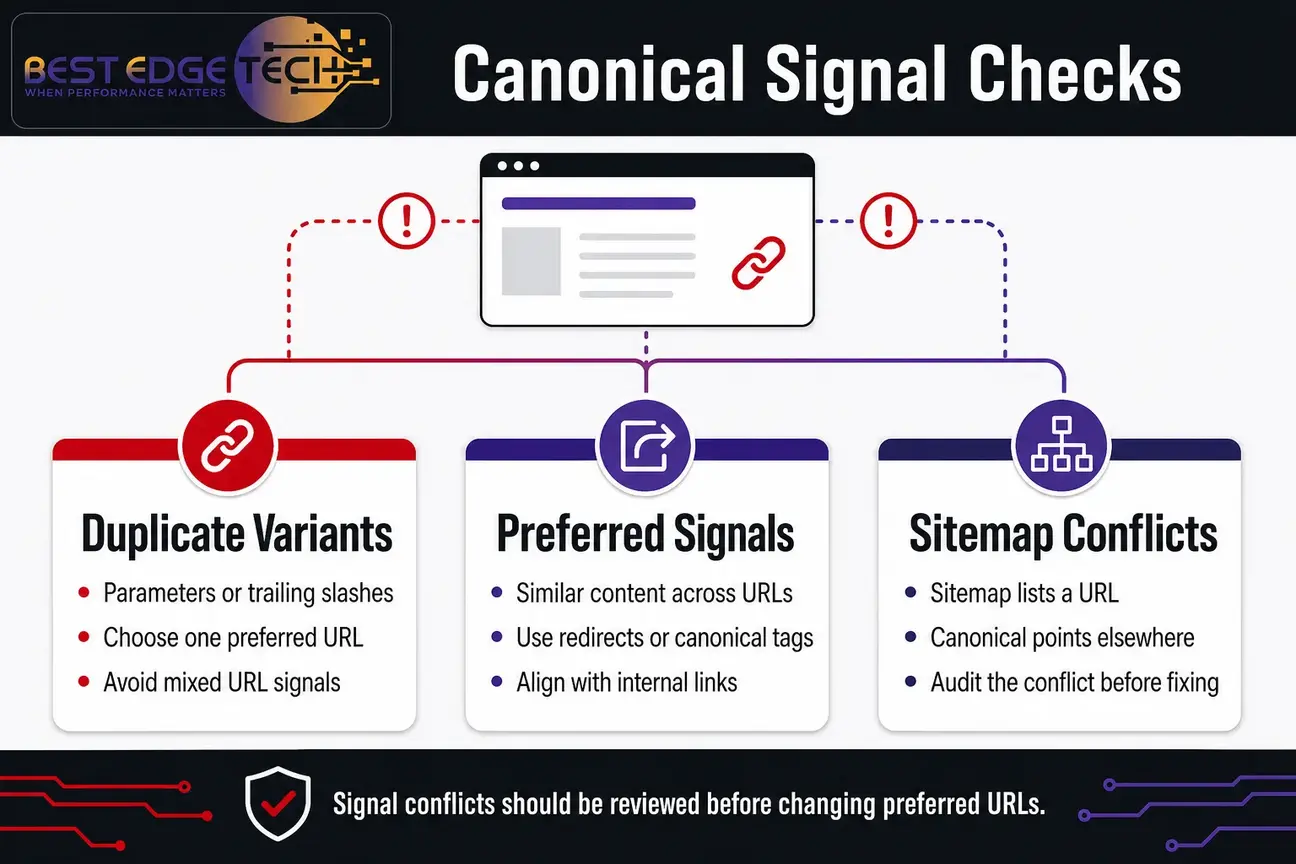
Canonicalization tells search engines which URL you prefer when the same or substantially similar content is available through multiple URLs. This matters when a page can be reached with parameters, alternate hostnames, trailing slash variants, print versions, HTTP and HTTPS versions, or outdated paths. A canonical tag should not be used casually; it is part of a larger signal set that includes redirects, internal links, sitemap entries, and content similarity.
Google’s canonicalization documentation explains several ways to indicate a preferred URL, including redirects, rel=”canonical”, and sitemap inclusion. An audit should therefore look for signal conflicts. If the sitemap lists one URL, internal links point to another, the canonical tag points to a third, and redirects resolve elsewhere, search engines may choose a canonical that does not match the business’s preference.
A practical example: the preferred page may be /service-a/, while an outdated campaign URL exists at /service-a?source=campaign. The audit question is not merely whether both URLs load. The question is whether the duplicate is intentionally handled, whether the preferred page is linked internally, whether the sitemap lists the preferred URL, and whether canonical signals consistently support the preferred version.
Canonical conflicts frequently create indexing problems because the wrong URL may be selected, or the intended page may be treated as a duplicate. They can also create crawlability issues when internal links repeatedly send crawlers through non-preferred URL patterns. For that reason, canonical review often becomes one of the central SEO audit priorities for ecommerce, service-area, publishing, and migrated sites.
To fix canonical issues, decide which URL should represent the content, update internal links, correct canonical tags, remove non-preferred sitemap entries, and use redirects where appropriate for deprecated duplicate pages. Confirm the fix by recrawling the affected pattern and reviewing Search Console after Google processes the changes.
Redirects and migration risk deserve more than a status-code count
Redirects are normal. They become risky when they are irrelevant, chained, looping, inconsistent, or disconnected from the site’s old-to-new URL relationships. An audit should not simply report “you have redirects.” It should determine whether those redirects support the current architecture and preserve clear paths for users and crawlers.
Important redirect checks include HTTP-to-HTTPS handling, www and non-www consistency, old URLs from prior site versions, one-hop redirects, redirect chains, loops, redirects that end in errors, and internal links that still point to redirected URLs. Google’s redirect documentation explains how permanent and temporary redirects are used to send users and Google Search to a different URL, so the audit should evaluate both the status code and the destination. For a redesign or migration, the audit should compare old URLs with their closest equivalent new URLs. Redirecting every old page to the homepage is usually a weak solution when closer matches exist.
Redirect-related crawlability issues can be subtle. A crawler may still reach the final page, but every unnecessary hop adds friction and makes diagnosis harder. Redirect mistakes can also become indexing problems when canonical tags, sitemaps, and internal links disagree about which URL is the final preferred destination.
Redirect work often overlaps with SEO audit priorities because mistakes can affect many URLs at once. A template-level internal link pointing through a redirect may create unnecessary friction across the site. A migration map that misses old lead-generating pages can create avoidable discovery and continuity problems. A redirect loop can block access entirely.
The fix depends on the pattern. Shorten chains to a direct destination. Replace redirected internal links with final URLs. Map old pages to the closest relevant current page. Remove or correct loops. Update the sitemap after the redirect logic is stable. Confirm the work by crawling old URLs, testing current internal links, and monitoring Search Console for unexpected exclusions or errors.
Internal links connect discovery, hierarchy, and user paths
Internal links are not just a ranking tactic. In a technical audit, they reveal how the site is structured and whether important pages are discoverable. Navigation, footer links, breadcrumbs where applicable, related content blocks, service-page links, and contextual body links all help define the site’s architecture.
An internal-link review should identify orphan pages, pages buried too deeply, links to redirects, broken links, vague anchor text, and important pages with weak support. It should also check whether supporting content connects naturally to service or conversion pages. For example, an educational guide should help users move to a relevant service page when they are ready, not trap them in disconnected blog content.
Internal-link crawlability issues are often easier to fix than server or rendering problems, but they can still affect important URLs. A page that is technically live but not linked from crawlable navigation or relevant content may be difficult for users and crawlers to discover. A page linked only through redirected URLs can also create unnecessary friction.
For small businesses, the goal is not to hit a fixed number of links per page. The goal is to make the important parts of the site easy to discover and understand. For agencies managing multiple client sites, internal-link findings should be documented as patterns: navigation issue, template issue, content hub issue, migration issue, or individual editorial fix.
When the audit identifies internal-link weaknesses, the fix may involve updating navigation, adding contextual links, correcting anchor text, replacing redirected destinations, and connecting related resources. These findings should be folded into SEO audit priorities instead of being treated as a separate editorial wish list. Best Edge Tech’s internal linking audit explains this area in more depth.
Structured data should match the visible page
Structured data is code that provides explicit clues about the meaning of a page. In an audit, the first question is not “How much markup can we add?” The better question is whether the selected type fits the page, whether the markup matches visible content, and whether it follows the applicable policies for any search feature the site is trying to qualify for.
Structured data can help search engines understand page content and may support eligibility for certain search result features when requirements are met. That is not the same as a promise that a rich result will appear. The audit should keep that distinction clear.
Structured-data checks usually include syntax validation, required and recommended properties for the relevant type, duplicate markup from multiple plugins, inconsistent organization or entity details, outdated phone or address data, markup that describes content not visible to users, and templates applying the wrong schema type across many pages. For healthcare, legal, or medical-tourism marketing sites, structured data should remain accurate and should not create unsupported claims about services, credentials, or outcomes.
Structured-data warnings should not automatically outrank crawlability issues or indexing problems. If a priority service page is blocked, marked noindex, or canonicalized elsewhere, fixing markup is not the first move. In a practical SEO audit checklist, structured-data work becomes more urgent when the page is indexable, the markup is materially wrong, or a template problem affects many important pages.
If errors appear, the recommended action should name the affected template or URL pattern. A single page issue may be an editorial fix. A sitewide plugin conflict may require development work. After implementation, validate the markup and recrawl the affected pages. For a focused companion resource, review Best Edge Tech’s schema markup audit.
Page experience and rendering are practical, not cosmetic
Page experience checks ask whether users and crawlers can load, view, and interact with the page without avoidable friction. This includes mobile rendering, layout stability, interactive elements, HTTPS, intrusive overlays, JavaScript-dependent content, image loading, template performance, and whether important content is present in the rendered page.
Core Web Vitals are performance and experience metrics related to loading behavior, interactivity, and visual stability. In an audit, these metrics should be interpreted alongside business context. A shared page template affecting every service page may deserve more attention than an isolated slow blog post. A page that technically passes performance checks may still create user friction if the layout is confusing or the conversion path is obstructed.
Rendering checks are also important when a site relies heavily on JavaScript. The audit should compare raw HTML, rendered HTML, and visible page content when important text, links, or structured data appear only after scripts run. The issue is not that JavaScript is automatically bad. The issue is whether key content and links are reliably available and whether the rendered page matches what the business expects search engines and users to see.
Performance and rendering findings become SEO audit priorities when they affect important templates, prevent content from appearing, break navigation, or make conversion paths difficult to use. They may also explain crawlability issues when links are not available in crawlable HTML or indexing problems when rendered content differs from the intended page.
To confirm improvements, compare before-and-after lab diagnostics, field data where available, rendered-page inspections, and representative crawls. Avoid treating a single performance score as the full story. The audit should explain whether the problem is page-specific, template-wide, platform-related, image-related, script-related, or caused by third-party elements.
SEO audit priorities: from findings to actions
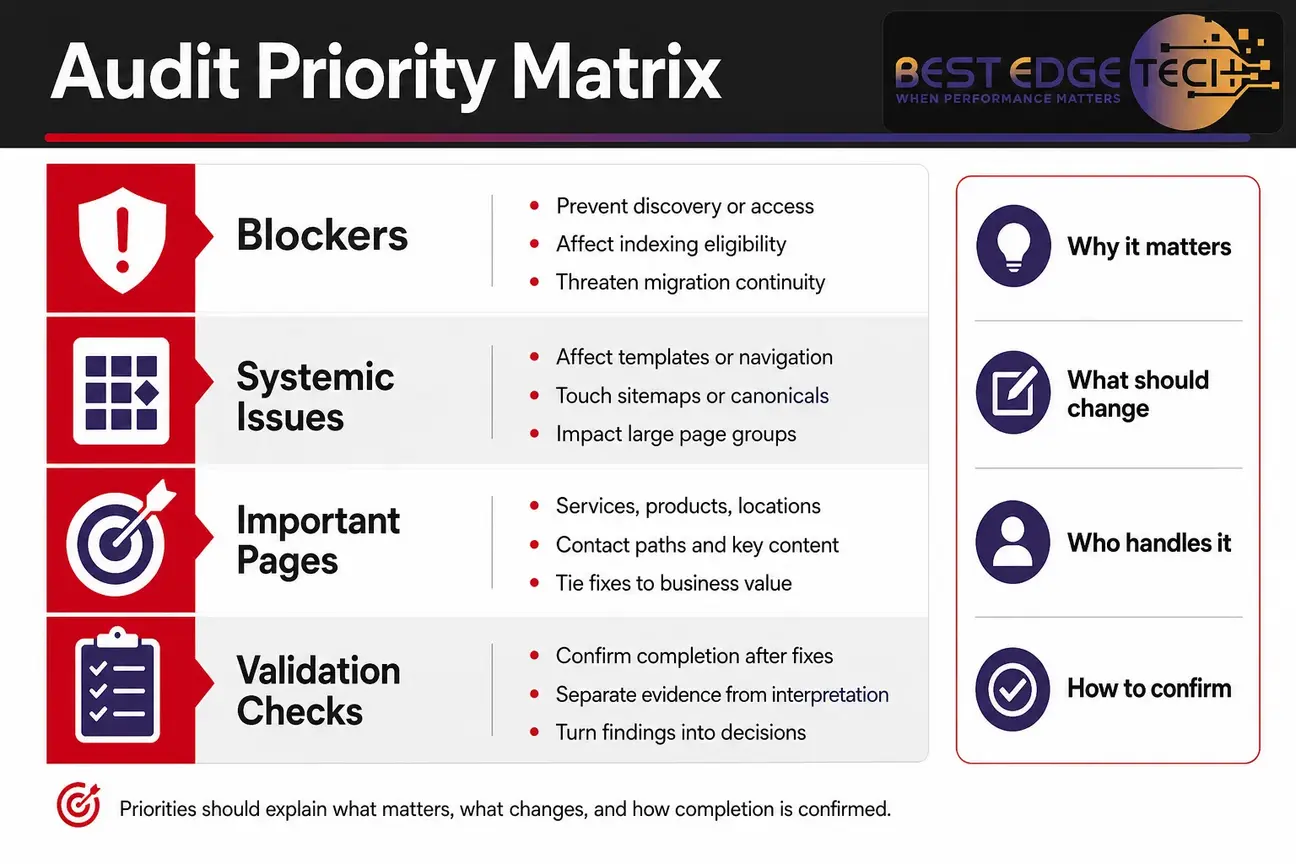
SEO audit priorities should convert observations into decisions. A finding says what was detected. A priority explains why it matters, what should change, who should handle it, how risky the change is, and how the team will confirm completion. This is where many audits become useful or fail.
A practical prioritization framework has five layers. First are blockers: issues that prevent discovery, access, indexing, or migration continuity. Second are systemic issues that affect templates, navigation, sitemaps, canonicals, or large page groups. Third are important page issues affecting services, products, locations, contact paths, or high-value content. Fourth are quality and clarity improvements that make the site easier to interpret and maintain. Fifth are monitoring items that need observation rather than immediate action.
That framework is not an official search-engine scoring system. It is a business-focused way to prevent teams from chasing every warning at the same level. A broken canonical on a priority service page deserves more attention than a harmless duplicate of a tag archive. A redirect chain across a sitewide navigation template may matter more than a single old blog redirect. A noindex directive on a contact page may deserve faster action than a structured-data warning on a low-value page.
Strong SEO audit priorities also help teams avoid accidental harm. A developer needs to know which redirect changes are safe to deploy. A content lead needs to know whether a page should be consolidated, updated, or left alone. A business owner needs to understand why some crawlability issues are urgent while others can wait.
Every recommendation should include affected URLs or patterns, evidence, likely cause, recommended action, owner, implementation risk, validation method, and priority rationale. Without those details, the audit becomes a list of complaints instead of a plan. If your team needs help deciding which fixes belong in the first implementation cycle, SEO consulting can help connect the audit to execution.
What a useful audit deliverable should include
A useful deliverable should be understandable to a business owner and actionable for a developer, content lead, or agency partner. It should include an executive summary, the intended URL set, crawl findings, indexing findings, sitemap review, canonical review, redirect review, internal-link findings, structured-data findings, page-experience observations, and a prioritized action plan.
A completed SEO audit checklist should separate evidence from interpretation. Evidence might be a Search Console status, a crawl result, a response code, a canonical target, a sitemap URL, or a template pattern. Interpretation explains whether the condition is intentional, harmful, uncertain, or low priority. This distinction matters because not every warning should be fixed.
A strong deliverable should include validation steps. If the recommendation is to remove an accidental noindex tag, the validation step might be to inspect the URL, recrawl it, and monitor the Page indexing report. If the recommendation is to fix redirects, the validation step might be to test old URLs, recrawl internal links, and confirm that the sitemap lists final canonical URLs.
The deliverable should also connect crawlability issues and indexing problems to ownership. Some fixes belong with developers, some with content managers, some with SEO specialists, and some with platform vendors. Clear ownership keeps SEO audit priorities from becoming a stalled backlog.
The best audit conversations are practical. What can be fixed by the CMS? What requires development? What belongs in content strategy? What should wait until a redesign? What is risky to change without staging? What should be monitored after launch? These answers help leadership approve work and help implementation teams avoid creating new issues while fixing old ones.
How this applies to AI visibility and modern search
Technical foundations also affect how content is discovered and interpreted in AI-influenced search experiences, but they do not create assured AI citations. As search products change, technical audits should continue to focus on fundamentals: accessible pages, clear canonical signals, accurate structured data, helpful content, crawlable links, and clean architecture. Those elements support search visibility broadly, including environments that rely on indexed or interpreted web content.
For businesses exploring answer engine optimization or generative engine optimization, technical fixes are only one layer. Content clarity, entity consistency, trust signals, and measurement also matter. Best Edge Tech offers AI SEO and GEO services, but any AI-search work should be framed honestly: no agency can promise citations or placement in AI answers.
AI-focused work should not skip the SEO audit checklist. Crawlability issues can still prevent discovery, indexing problems can still limit eligibility, and unclear entity signals can still make a site harder to interpret. The same SEO audit priorities that protect traditional search visibility often create a cleaner foundation for modern search experiences.
When to request help with an audit
You may need outside help when the site has recently migrated, organic visibility has changed unexpectedly, Search Console shows unfamiliar exclusions, developers are preparing a redesign, multiple tools disagree, or your team cannot tell which fixes matter first. You may also need help if your site has many locations, complex templates, gated content, legacy URLs, or multiple stakeholders making changes.
Audit scope is driven by factors such as site size, number of templates, amount of technical debt, migration history, CMS complexity, location structure, content volume, integrations, and how much implementation guidance the team needs. Best Edge Tech does not need to promise fixed outcomes to make an audit valuable. The value is in clarifying the current state, identifying risks, and creating a practical order of operations.
If you are considering an audit, you can contact Best Edge Tech or call 252-303-0074. Share your website URL, goals, markets served, recent site changes, whether Search Console access is available, and the service you are considering. A request starts a conversation about scope; it should not be treated as a promise of pricing, timing, or results.
Final takeaway
A technical SEO audit should answer a practical question: can search engines and users reach, understand, and use the pages that matter to the business? The strongest audits do not stop at crawl errors. They connect crawling, indexing, sitemaps, canonicals, redirects, internal links, structured data, page experience, and business priorities into one decision-ready plan.
Use the SEO audit checklist to gather evidence, then use SEO audit priorities to decide what comes first. Crawlability issues and indexing problems deserve close attention, but they matter most when they are tied to important URLs, clear intent, and validated fixes.
Search engines and AI products change often. Check current platform documentation before acting, and treat any result as dependent on your site, market and competition.
Frequently Asked Questions
Can a small business run a technical audit without enterprise tools?
Yes, a small business can start with a crawl, Google Search Console, sitemap checks, page inspections, and manual review of important pages. The hard part is not collecting data; it is interpreting which findings affect priority pages and which are intentional or low impact.
How often should a site be audited?
Audit timing depends on site size, publishing frequency, technical complexity, and recent changes. A deeper review is especially useful before or after a redesign, migration, CMS change, navigation update, or noticeable change in search visibility.
Do technical fixes always improve rankings?
No. Technical fixes can remove barriers and improve clarity, but rankings depend on many factors, including competition, content quality, relevance, authority signals, user demand, and execution. Avoid any provider that promises a specific ranking outcome from an audit.
What is the difference between crawlability and indexability?
Crawlability is about whether search engines can discover and fetch a URL. Indexability is about whether that URL is eligible to be stored and shown in search results. A page can be crawlable but still not indexable because of noindex tags, canonical signals, duplication, redirects, or other conditions.
Should every page in a sitemap be indexed?
No. A sitemap should list important, preferred URLs, but indexing is not assured. Some submitted URLs may be excluded because they are duplicates, canonicalized elsewhere, redirected, blocked, low value, or otherwise not selected for indexing.
What should an audit report include besides errors?
It should include business-critical URL scope, evidence, diagnosis, affected patterns, recommendations, priority rationale, implementation owner, risk notes, and validation steps. A useful report helps the team decide what to do first, not just what a tool flagged.
Who should implement audit fixes?
Implementation may involve developers, SEO specialists, content managers, designers, or agency partners. Redirects, templates, rendering, and performance often require development support, while internal links, content updates, and sitemap governance may involve SEO or content teams.