AI Search Visibility Tracking: How to Measure Mentions, Citations, Accuracy and Revenue in 2026
Last reviewed: July 29, 2026
AI search visibility tracking is the process of measuring whether a brand or website appears in AI-generated answers, which pages are cited, how accurately the brand is represented, and whether that visibility contributes to qualified traffic, leads, or revenue.
A useful measurement system does not reduce AI visibility to one proprietary score. It separates technical eligibility, source retrieval, citations, brand mentions, factual accuracy, and business outcomes because each represents a different stage of the customer-discovery process.
This guide provides a repeatable framework for measuring visibility across Google AI features, ChatGPT, Microsoft Copilot, Bing, Perplexity, Gemini, and other AI-assisted discovery platforms.
Key takeaways
- An AI mention, website citation, recommendation, and referral visit are separate events.
- Crawler activity shows possible access, not proof that a page was cited or influenced an answer.
- First-party platform reports generally provide stronger measurement evidence than third-party visibility estimates.
- Manual prompt testing is useful only when the prompt, platform, date, location, and testing conditions are preserved.
- One chatbot response is an observation, not a permanent ranking.
- Visibility should be measured alongside factual accuracy and business outcomes.
- No agency, consultant, or software platform can guarantee a ranking, citation, mention, or recommendation.
What does AI search visibility tracking measure?
AI search visibility tracking measures how a business, brand, product, expert, or website appears inside generated answers and AI-assisted search experiences.
It should answer six practical questions:
- Can the relevant platform access and understand the content?
- Is the website being retrieved for relevant questions?
- Are its pages displayed as supporting sources?
- Is the brand named, described, or recommended?
- Are material statements about the brand accurate?
- Does the exposure contribute to useful customer behavior?
Traditional rank tracking usually records the position of a web page within an ordered search result. AI-generated answers may synthesize multiple sources, omit a conventional ranking position, vary between sessions, and satisfy a user without producing a click.
That makes AI visibility a multi-stage measurement problem rather than a replacement keyword-ranking report.
AI mentions, citations, recommendations, and traffic are different
Clear definitions are essential because many dashboards use similar language for different events.
| Event | What happened | What it does not prove |
|---|---|---|
| Brand mention | The generated answer names or describes the brand. | It does not prove that the brand’s website was used as a source. |
| Website citation | A page from the website is displayed as a supporting source. | It does not prove that the brand was recommended or that every claim came from that page. |
| Recommendation | The brand is presented as a possible solution, provider, or option. | It does not represent a formal platform endorsement or guarantee a customer inquiry. |
| AI referral visit | A detectable visit arrives from an AI assistant or AI-powered search experience. | It does not reveal every zero-click answer, mention, or citation. |
A website can be cited without the brand being named. A brand can be mentioned using information from a third-party source. A recommendation can occur without a detectable referral visit. Each event therefore needs its own metric.
The AI Visibility Evidence Hierarchy
Not every data source provides the same level of evidence. Use the strongest available source for the question being investigated.
| Evidence level | Examples | Best use | Important limitation |
|---|---|---|---|
| 1. First-party platform reporting | Google Search Console, Bing Webmaster Tools, and Microsoft Clarity | Measuring platform-reported impressions, citations, cited pages, and queries | Coverage and metric definitions vary by platform. |
| 2. Preserved answer evidence | Complete response, screenshot, citations, prompt, and test conditions | Reviewing answer-level mentions, recommendations, and accuracy | The observation may not reproduce for every user or session. |
| 3. Web analytics and CRM evidence | GA4 sessions, landing pages, key events, leads, and sales | Measuring detectable traffic and business outcomes | Zero-click influence and missing referral information remain invisible. |
| 4. Server and CDN logs | Requests from documented crawlers and user agents | Diagnosing crawl access and technical behavior | Crawling does not establish citation or recommendation. |
| 5. Third-party monitoring estimates | Visibility scores, sampled prompts, and competitor benchmarks | Scaling monitoring and spotting directional changes | Results depend heavily on the vendor’s prompts, modes, locations, and scoring method. |
Third-party tools can be valuable, but their outputs should not override contradictory first-party data or complete answer evidence. Always document what a vendor score actually measures before using it in an executive report.
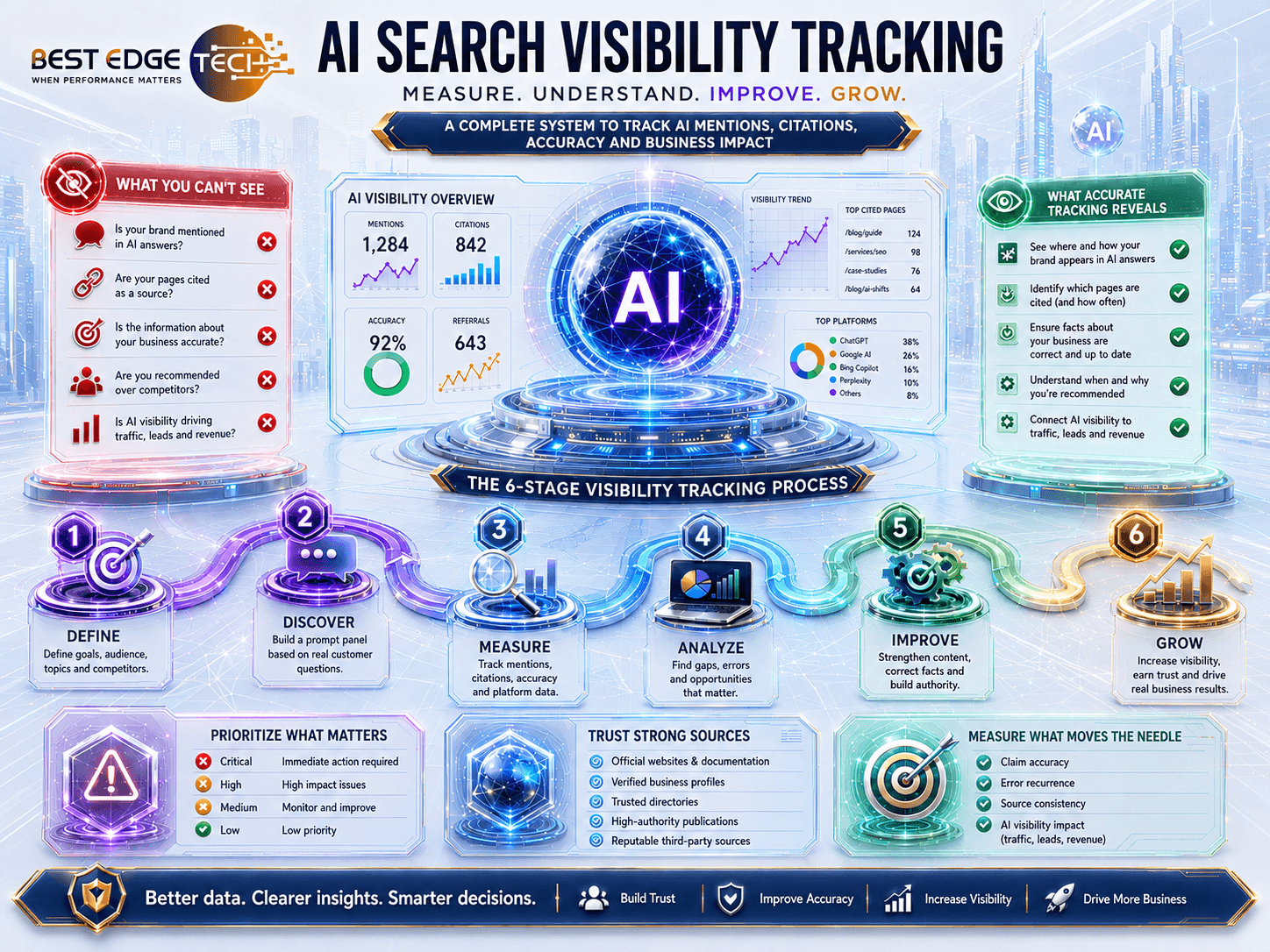
The six-stage AI search visibility measurement pipeline
AI visibility can break down at several different stages. Measuring the stages separately makes the resulting action plan far more useful.
Stage 1: Technical eligibility
Technical eligibility asks whether relevant content is publicly accessible, indexable, and technically available to search or retrieval systems.
Review:
- Robots.txt rules
- Robots meta directives
- HTTP status codes
- Canonical URLs
- Rendered text
- Internal links
- XML sitemaps
- JavaScript dependencies
- Page speed and mobile usability
- Structured data consistency
Google states that pages must meet its technical search requirements and be eligible to appear with a search snippet before they can be considered for its generative AI features. Meeting those requirements does not guarantee crawling, indexing, or display. Review Google’s guidance for generative AI features.
OpenAI documents OAI-SearchBot as a crawler associated with surfacing websites in search experiences. Its robots.txt controls are separate from GPTBot training preferences.
A crawler request is evidence of access activity. It is not evidence that a page appeared in an answer.
Stage 2: Retrieval presence
Retrieval presence asks whether a platform appears to consider content from the website for relevant questions.
Possible signals include:
- Grounding or retrieval queries reported by the platform
- Pages appearing in first-party citation reports
- Visible citations in generated answers
- Repeated appearances of the same domain or URL across related prompts
Retrieval should not be inferred solely from a brand mention. The answer may rely on another website, previously learned information, or an undisclosed source.
Stage 3: Citation exposure
Citation exposure measures how frequently pages from the monitored domain are displayed as supporting sources.
Track:
- Total citations
- Answers containing at least one citation to the domain
- Unique cited URLs
- Citations by topic
- Citations by platform
- Citation share compared with selected competitors
- Citation trends over time
- Dependence on a small number of pages
Citation count alone does not show how prominently a source appeared or how much of the answer it supported.
Stage 4: Brand presence
Brand presence measures whether a company is named or associated with relevant services, products, expertise, industries, or locations.
Measure:
- Unbranded discovery prompts that mention the company
- Commercial prompts that recommend the company
- Branded prompts that return the correct identity
- Competitors named in the same answers
- Services and locations associated with the brand
- Positive, neutral, negative, or uncertain framing
A website may earn citations through educational content while the business remains absent from provider recommendations. That pattern suggests a brand-association or conversion-path issue rather than a simple content-quality problem.
Stage 5: Answer integrity
Answer integrity measures whether material claims about the business are accurate, current, and properly attributed.
Review claims involving:
- Business identity
- Ownership and leadership
- Locations and service areas
- Contact information and hours
- Services and products
- Prices and policies
- Licenses, qualifications, and affiliations
- Availability and operational status
Use verdicts such as accurate, outdated, incorrect, partially accurate, misattributed, unsupported, and not independently verifiable.
When inaccurate claims appear, use the separate SOURCE Audit System for correcting AI misinformation. Do not duplicate that full correction process inside the visibility report.
Stage 6: Business outcomes
The final stage evaluates whether detectable AI-assisted discovery contributes to useful customer activity.
Possible outcome metrics include:
- AI-referred sessions
- Engaged sessions
- Landing-page engagement
- Contact-form submissions
- Telephone calls
- Quote or consultation requests
- Qualified leads
- Booked appointments
- Sales or estimated pipeline value
AI referral volume may be small while lead quality is high. Report both volume and commercial value rather than treating every visit as equally useful.
Build a representative AI visibility prompt panel
A prompt panel is a maintained collection of questions that represents how customers discover a problem, explore possible solutions, compare providers, and verify a business.
Build the panel using customer evidence such as:
- Sales calls
- Search Console queries
- Internal site-search data
- Customer emails
- Support questions
- Consultation notes
- Reviews and objections
- Competitor comparisons
Best Edge Tech operating recommendation: A small or midsized business can begin with approximately 30 to 60 priority prompts. This is a practical starting range, not an official platform requirement.
| Category | Example pattern | What it measures |
|---|---|---|
| Problem discovery | How can a company measure its visibility in AI search? | Educational authority |
| Solution discovery | What services help businesses improve AI-search visibility? | Category association |
| Provider discovery | Which agencies offer AI SEO and GEO services? | Unbranded commercial visibility |
| Comparison | How should I compare AI SEO agencies? | Decision-stage inclusion |
| Local discovery | Which companies provide AI SEO services in North Carolina? | Geographic relevance |
| Brand validation | What does Best Edge Tech specialize in? | Entity accuracy and brand understanding |
| Risk or objection | Can an SEO agency guarantee ChatGPT citations? | Trust and expectation management |
Use prompt families rather than isolated wording
People can express the same intent in several ways. Create a prompt family containing a canonical question and several natural paraphrases.
For example:
- How do I measure AI search visibility?
- How can a company track whether it appears in ChatGPT?
- What metrics show if a brand is visible in AI-generated answers?
This reduces the risk of treating one unusually favorable or unfavorable wording as representative of the entire topic.
Use a repeatable AI visibility testing protocol
Manual tests become useful evidence only when their conditions are preserved.
Record these fields for every observation
- Unique test ID
- Exact prompt
- Prompt category and intent
- Platform and product
- Visible model or mode, when available
- Date, time, and time zone
- Relevant user location
- Signed-in or signed-out state
- Fresh or existing conversation
- Whether search, browsing, or deep research was enabled
- Complete answer
- Visible citations and cited URLs
- Brand and competitor mentions
- Material factual claims
- Referral visit or conversion evidence, when available
Repeat high-value tests
For commercially important questions, run comparable tests more than once and use natural paraphrases. Do not declare a permanent improvement or decline from one answer.
Keep conditions as consistent as practical. When a condition changes, document it instead of silently merging the result with the previous sample.
Preserve negative observations
Do not record only the answers in which the brand appears. The denominator must include valid tests where the brand was absent, otherwise mention and citation rates will be artificially inflated.
Respect platform rules and user privacy
Do not submit confidential customer, employee, legal, medical, financial, or account information as part of routine monitoring. Automated collection should comply with applicable platform terms, privacy requirements, and organizational policies.
How to measure Google AI search visibility
Google announced dedicated generative AI performance reports in Search Console on June 3, 2026. The initial rollout included dedicated reporting for Search and Discover generative AI features.
Depending on property eligibility and report availability, reports may include:
- Generative AI impressions
- Pages receiving visibility
- Countries
- Dates
- Devices for applicable Search reporting
Review the current Google generative AI performance report announcement before documenting the dimensions available in a specific property.
Recommended Google reporting workflow
- Record an initial baseline before major changes.
- Identify pages receiving the most generative AI exposure.
- Group those pages by topic, format, and funnel stage.
- Compare generative visibility with traditional organic performance.
- Review the landing pages in GA4.
- Record content changes and their publication dates.
- Evaluate trends across a meaningful period rather than attributing every fluctuation to one edit.
A Google generative AI impression should not be reported as a click, recommendation, or lead.
How to measure Bing and Microsoft Copilot visibility
Microsoft introduced AI Performance in Bing Webmaster Tools as a public preview in February 2026. The report shows when pages are cited across supported Microsoft AI experiences.
Available reporting may include:
- Total citations
- Citation trends
- Cited pages
- Grounding query phrases
- Page-level citation activity
Microsoft notes that total citations do not indicate a page’s placement or presentation within a specific generated answer. Read the Bing AI Performance announcement.
Microsoft Clarity also documents an AI Visibility Citation dashboard for examining how website content is referenced in AI-generated answers. Review the current Microsoft Clarity citation documentation before configuring reports.
Do not combine a Bing citation, Google impression, and third-party prompt mention into one total. The events have different definitions and denominators.
How to track visibility in ChatGPT and other AI assistants
When a platform does not provide a comparable first-party site-owner performance report for every visibility event, combine several evidence types.
- Technical access review: Confirm that important public pages are accessible to relevant documented crawlers.
- Controlled prompt monitoring: Test maintained prompt families under recorded conditions.
- Answer preservation: Save the complete answer, citations, and material claims.
- Referral analytics: Identify detectable visits from AI platforms.
- CRM review: Ask qualified leads how they discovered the business when appropriate.
OpenAI’s crawler documentation allows site owners to manage OAI-SearchBot and GPTBot independently. Allowing a crawler does not guarantee that a page will appear in ChatGPT search or be cited in a response.
Evaluate third-party AI visibility tools carefully
Before buying or trusting a monitoring platform, ask:
- Which AI products and modes are tested?
- Are prompts custom, sampled, or generated by the vendor?
- How frequently are prompts retested?
- Are location and language supported?
- Does the platform separate mentions from citations?
- Can users inspect the underlying answer and cited URL?
- How are competitors selected?
- How is share of voice calculated?
- Are failed and absent results included in the denominator?
- Can raw observations be exported?
For a separate software comparison, review Best Edge Tech’s guide to the best AI SEO tools.
Track AI referral traffic and conversions in GA4
Google Analytics 4 can identify many visits that arrive with detectable source information. Begin with the Traffic acquisition report and review session-scoped source and medium dimensions.
Basic GA4 workflow
- Open the Traffic acquisition report.
- Use Session source or Session source/medium as the primary dimension.
- Look for known AI-assistant referral sources.
- Add Landing page plus query string as a secondary dimension when useful.
- Create a custom AI-assistant channel group when the property’s reporting needs justify one.
- Compare sessions with engagement and key-event data.
Google documents the Traffic acquisition report as a session-scoped report for analyzing where visits originate. It also supports custom channel groups built from rule-based traffic-source categories.
Measure customer actions, not only visits
Report:
- Sessions
- Engaged sessions
- Engagement rate
- Average engagement time
- Landing pages
- Contact-page visits
- Key events
- Form submissions
- Calls
- Qualified leads
- Revenue or estimated pipeline value when valid data is available
Some AI-assisted visits may appear as direct traffic or lose identifiable referral information. GA4 referral reporting is therefore an outcome signal, not a complete measure of AI exposure.
AI search visibility metrics and formulas
Every metric should state its platform coverage, prompt panel, geography, date range, and testing method.
| Metric | Calculation | What it reveals |
|---|---|---|
| Prompt mention rate | Valid tests containing a brand mention ÷ valid tests performed × 100 | How often the brand appears across the monitored panel |
| Domain citation rate | Valid tests citing the monitored domain ÷ valid tests performed × 100 | How often the website is displayed as a source |
| Recommendation rate | Commercial tests recommending the brand ÷ valid commercial tests × 100 | Decision-stage inclusion |
| Commercial prompt coverage | Commercial prompt families with at least one brand appearance ÷ commercial prompt families monitored × 100 | Breadth of commercial visibility |
| Citation share of voice | Your tracked citations ÷ citations received by all monitored brands × 100 | Relative citation exposure within the defined sample |
| Material claim accuracy rate | Accurate material claims ÷ material claims reviewed × 100 | Factual integrity of the monitored answers |
| Critical-error count | Number of unresolved critical factual errors | Immediate brand, customer, or compliance risk |
| Outcome stability rate | Comparable tests producing the defined outcome ÷ comparable tests performed × 100 | How consistently the result reproduces |
| Cited-page concentration | Citations to the three most-cited pages ÷ all tracked citations × 100 | Whether visibility depends excessively on a few URLs |
| AI referral conversion rate | Qualified conversions from detectable AI-referred sessions ÷ detectable AI-referred sessions × 100 | Commercial performance of identifiable AI traffic |
Do not hide everything inside one composite score
A single index can conceal important differences. A brand with many mentions but severe factual errors should not receive the same interpretation as a brand with fewer, highly accurate recommendations that produce qualified leads.
Executive reporting should retain three separate groups:
- Visibility: Mentions, citations, recommendation rate, and share of voice
- Integrity: Accuracy, error recurrence, and source consistency
- Outcomes: Referral traffic, conversions, leads, and revenue
A practical executive AI visibility scorecard
| Reporting area | Current result | Previous period | Interpretation | Next action |
|---|---|---|---|---|
| Google generative AI exposure | Enter verified first-party result | Enter comparable result | Rising, stable, falling, or unavailable | Inspect affected topics and pages |
| Microsoft citations | Enter verified first-party result | Enter comparable result | Identify cited-page and query changes | Strengthen relevant pages |
| Prompt mention rate | Enter calculated percentage | Enter comparable percentage | Review by intent and platform | Address weak commercial categories |
| Accuracy rate | Enter calculated percentage | Enter comparable percentage | Identify critical or recurring errors | Run the SOURCE Audit process |
| AI referral conversions | Enter verified count and rate | Enter comparable count and rate | Assess volume and lead quality | Improve landing pages and conversion paths |
Replace every instructional cell with verified client or website data before presenting the scorecard as a completed report.
How to diagnose common AI visibility problems
| Observed pattern | Likely interpretation | Best next investigation |
|---|---|---|
| Low crawl access | Important content may be blocked, inaccessible, or technically difficult to retrieve. | Review robots controls, status codes, rendering, canonicalization, and internal links. |
| Good organic performance but low AI citations | The page may rank traditionally without supplying the evidence or format used in generated answers. | Compare cited competing pages for intent alignment, evidence, definitions, and structure. |
| High citations but low brand mentions | Educational content is useful, but the company is not strongly associated with the topic. | Review authorship, About information, service context, entity clarity, and internal links. |
| High mentions but low website citations | Third-party sources or general brand recognition may be driving the mention. | Inspect visible sources and strengthen authoritative owned pages. |
| High visibility but low accuracy | The information environment contains conflicting, stale, or ambiguous facts. | Run a claim-level misinformation and source-consistency audit. |
| High visibility but low traffic | Users may be satisfied without clicking, or citations may have low prominence. | Measure brand searches, assisted influence, and cited-page usefulness. |
| Traffic rising but conversions weak | The cited content may not lead users toward the correct next decision. | Improve landing-page intent, proof, CTA, and contact path. |
| Results vary heavily between tests | The observed visibility may be unstable or highly sensitive to phrasing and conditions. | Increase repetitions, add paraphrases, and separate results by platform and mode. |
| Most citations point to one page | The site has concentrated visibility and may be vulnerable to one page losing relevance. | Build genuinely useful supporting coverage without creating near-duplicate articles. |
Match the action to the broken stage
- Eligibility problem: Address technical SEO.
- Retrieval problem: Improve topic and intent coverage.
- Citation problem: Add stronger evidence, definitions, examples, and extractable supporting information.
- Brand-presence problem: Improve entity clarity, authorship, service association, and corroboration.
- Accuracy problem: Correct the underlying source environment.
- Conversion problem: Improve the landing page and customer journey.
Worked example: interpreting an AI visibility report
Consider a fictional commercial cleaning company that monitors 40 customer-intent prompts across several AI platforms.
Its monthly observations show:
- 12 tests containing a brand mention
- 7 tests citing the company website
- 4 commercial recommendations
- 2 answers containing an outdated service-area claim
- 18 detectable AI-referred sessions
- 3 qualified contact submissions
The resulting metrics would be:
- Prompt mention rate: 12 ÷ 40 × 100 = 30%
- Domain citation rate: 7 ÷ 40 × 100 = 17.5%
- AI referral conversion rate: 3 ÷ 18 × 100 = approximately 16.7%
The company should not conclude that it has “30% of AI search.” The 30% applies only to its defined prompt panel, platforms, locations, and testing period.
The most urgent issue is also not necessarily citation volume. The outdated service-area claims may cause suitable customers to assume that the company cannot serve them. Accuracy repair should therefore be prioritized alongside visibility growth.
This example is hypothetical and is provided only to demonstrate the calculation and interpretation process.
A practical 30-day AI visibility measurement plan
Days 1–5: Define the measurement scope
- Select priority services, products, locations, and customer decisions.
- Choose the platforms relevant to the audience.
- Identify direct business and search competitors.
- Define mentions, citations, recommendations, and qualified conversions.
- Assign responsibility for maintaining the measurement system.
Days 6–10: Establish technical and analytics baselines
- Review crawl access, indexability, and canonical URLs.
- Verify Google Search Console and Bing Webmaster Tools.
- Check whether generative AI reports are available.
- Configure GA4 acquisition reporting.
- Verify key events and contact-form tracking.
Days 11–15: Build the prompt panel
- Create prompt families across the customer journey.
- Separate branded and unbranded questions.
- Add commercial, local, comparison, and validation prompts.
- Record the required testing fields.
- Preserve both positive and negative observations.
Days 16–21: Run the baseline measurement
- Test priority prompts under documented conditions.
- Record mentions, citations, recommendations, and competitors.
- Review material business claims for accuracy.
- Export first-party reports where available.
- Connect cited pages with GA4 landing-page data.
Days 22–26: Diagnose the gaps
- Identify weak topics and commercial prompt categories.
- Compare cited competitor pages.
- Find conflicting or outdated business information.
- Locate pages receiving visibility but failing to convert.
- Prioritize problems by customer and business impact.
Days 27–30: Create the action plan
- Strengthen the best existing page before creating a new one.
- Add original evidence, examples, comparisons, or expert explanation.
- Correct inconsistent business facts.
- Improve internal links between educational and service pages.
- Set the next comparable testing date.
- Document what changed and what remains uncertain.
AI visibility measurement mistakes to avoid
- Treating one response as a permanent ranking. Generated answers can vary between users, sessions, modes, and dates.
- Counting only successful tests. Missing results must remain in the denominator.
- Combining incompatible metrics. An impression, citation, mention, click, and conversion are not interchangeable.
- Tracking only branded questions. Branded prompts test recognition rather than unbranded discovery.
- Changing the prompt panel constantly. Trend reporting requires a reasonably stable benchmark.
- Assuming crawler access equals visibility. Crawling shows possible access, not citation or influence.
- Ignoring factual accuracy. Increased exposure can be harmful when the information is wrong.
- Comparing vendor scores without reviewing their methodology. Similar labels may use different prompts, platforms, and formulas.
- Reporting correlation as causation. A visibility change after a page edit does not prove that the edit caused it.
- Publishing near-duplicate pages for every prompt variation. Improve the strongest relevant resource instead.
- Using unsupported benchmarks. There is no universal “good” AI visibility percentage across every market.
- Promising guaranteed citations. Final inclusion and presentation remain controlled by the platform.
Limitations of AI search visibility tracking
AI visibility measurement remains incomplete and platform-specific.
Important limitations include:
- Generated answers can change between otherwise similar tests.
- Not every platform provides first-party site-owner reporting.
- Referral data may be missing, stripped, or classified as direct traffic.
- A visible citation may support only part of an answer.
- Third-party platforms observe samples rather than every customer interaction.
- Localization, personalization, and conversation history can affect output.
- Prompts selected by the measurement team may not perfectly represent real-world demand.
- Visibility improvements cannot always be attributed to one action or page change.
Emerging research has proposed distinguishing citation selection from citation absorption—the extent to which a cited source appears to contribute evidence or language to a final answer. This is a useful research direction, but it should not yet be treated as a universally standardized commercial metric.
A trustworthy report states these limitations instead of presenting sampled observations as complete market coverage.
Turn measurement into an AI-search improvement loop
The purpose of AI search visibility tracking is not to produce another decorative dashboard. It is to identify why customers cannot find the brand, where AI systems misrepresent it, and where existing exposure fails to produce a useful next step.
- Measure a stable panel of genuine customer questions.
- Identify the most important visibility, integrity, or conversion gap.
- Determine which stage of the measurement pipeline is failing.
- Improve the strongest relevant page or source.
- Document the action and publication date.
- Retest under comparable conditions.
- Evaluate trends across multiple observations.
Businesses needing help with this process can explore Best Edge Tech’s AI SEO and Generative Engine Optimization services or request a broader SEO analysis.
Frequently asked questions
What is AI search visibility tracking?
AI search visibility tracking measures whether a brand or website appears in AI-generated answers, which pages are cited, how the brand is described, and whether the exposure contributes to customer activity.
What is the difference between an AI mention and an AI citation?
A mention occurs when an answer names or describes a brand. A citation occurs when the answer displays a page or website as a supporting source. A brand can be mentioned without its website being cited.
Can Google Search Console track AI Overviews?
Google introduced dedicated generative AI performance reports for eligible Search Console properties in June 2026. Report availability and dimensions should be confirmed within the individual property.
Can Bing Webmaster Tools track AI citations?
Bing’s AI Performance report can show citations, cited pages, grounding queries, and visibility trends across supported Microsoft AI experiences. The feature was introduced as a public preview.
How can a business track traffic from ChatGPT?
Review GA4 session-source and referral data for detectable ChatGPT traffic, then compare landing pages, engagement, key events, and qualified conversions. Analytics will not reveal every zero-click ChatGPT mention or citation.
How often should AI visibility be measured?
High-value commercial prompts and high-risk business facts may justify weekly monitoring. Broader strategic reporting may be reviewed monthly. Use comparable test conditions and avoid reacting to one isolated result.
What is a good AI visibility score?
There is no universal percentage that represents good AI visibility across every industry. The result depends on the prompt panel, competitors, platforms, locations, language, and measurement method. Establish a documented baseline and evaluate improvement against relevant business outcomes.
Does structured data guarantee AI citations?
No. Google states that no special structured data is required for its generative AI search features. Valid structured data can help search engines understand eligible page content, but it does not guarantee crawling, indexing, rankings, or citations.
Does an llms.txt file guarantee AI visibility?
No. An llms.txt file does not guarantee Google rankings, ChatGPT citations, or inclusion in generated answers. Technical accessibility, useful content, clear entities, authoritative evidence, and consistent public information remain more important than relying on one optional file.
Can an agency guarantee ChatGPT or Google AI citations?
No ethical agency can guarantee that an external platform will rank, cite, mention, or recommend a business. An agency can improve accessibility, content quality, authority, entity clarity, and measurement, but the final output remains controlled by the platform.
Build a reliable AI visibility baseline
AI-assisted discovery is becoming more measurable, but no single dashboard provides the complete picture. The strongest approach combines first-party platform reports, repeatable prompt testing, claim-level accuracy review, referral analytics, and business outcomes.
Contact Best Edge Tech to discuss an AI search visibility audit focused on the platforms, questions, and customer decisions that matter to your business.
Primary sources and further reading
- Google Search Central: Generative AI performance reports
- Google Search Central: Optimizing for generative AI features
- Google Search Central: AI features and your website
- Bing Webmaster Tools: AI Performance report
- Microsoft Clarity: AI Visibility Citation dashboard
- OpenAI: Overview of OpenAI crawlers
- Google Analytics: Traffic acquisition report
- Google Analytics: Custom channel groups
- Emerging research: Citation selection and citation absorption