
What Is AI Citation Optimization?
AI citation optimization is a focused part of generative engine optimization. Its goal is not simply to make a brand appear in an AI answer. Its goal is to increase the likelihood that a specific page is retrieved and displayed as a supporting source for a relevant answer. That distinction matters. A brand mention, a recommendation, a linked citation, and a referral visit are different outcomes. A business can be mentioned without receiving a link. A page can be retrieved without being displayed. A citation can appear without producing a click. A useful strategy treats each stage separately. Google Search Central states that the same foundational SEO practices used for Search remain relevant to AI Overviews and AI Mode, with no special technical requirements beyond being indexed and eligible to appear with a snippet. OpenAI documents OAI-SearchBot as the crawler used to surface websites in ChatGPT search and recommends allowing the bot and its published IP ranges for search eligibility. In other words, AI citation work begins with solid search fundamentals rather than a secret markup trick. For a broader foundation, see Best Edge Tech’s guide to AI SEO. Businesses that need implementation support can explore AI SEO and GEO services.How Does a Page Become an AI Search Citation?
A citation can appear only after several conditions are met. The exact systems are proprietary and vary by platform, query, location, freshness needs, and user context, but publishers can evaluate five practical stages.- Discovery: An eligible crawler or search index must be able to find the URL.
- Understanding: The page must communicate its subject, publisher, author or reviewer, entities, and relationships clearly.
- Retrieval: The page or passage must be relevant enough to a query or subquery to enter the candidate set.
- Selection: The system must judge the source useful enough to support the generated response.
- Presentation: The interface may show a link, source card, citation, brand mention, or another attribution format.
| Outcome | What it means | Useful measurement |
|---|---|---|
| Organic ranking | A URL appears in a conventional search result | Impressions, average position, clicks |
| AI mention | The brand or product appears in a generated answer | Mention rate and factual accuracy |
| AI citation | A page is displayed as a supporting source | Citation count, citation share, cited URLs |
| AI referral | A user clicks from an AI experience to the website | Sessions, engaged visits, assisted conversions |
| Business outcome | AI-assisted discovery contributes to a lead or sale | Qualified leads, revenue, conversion quality |
The CITABLE Page Test for AI Citation Optimization
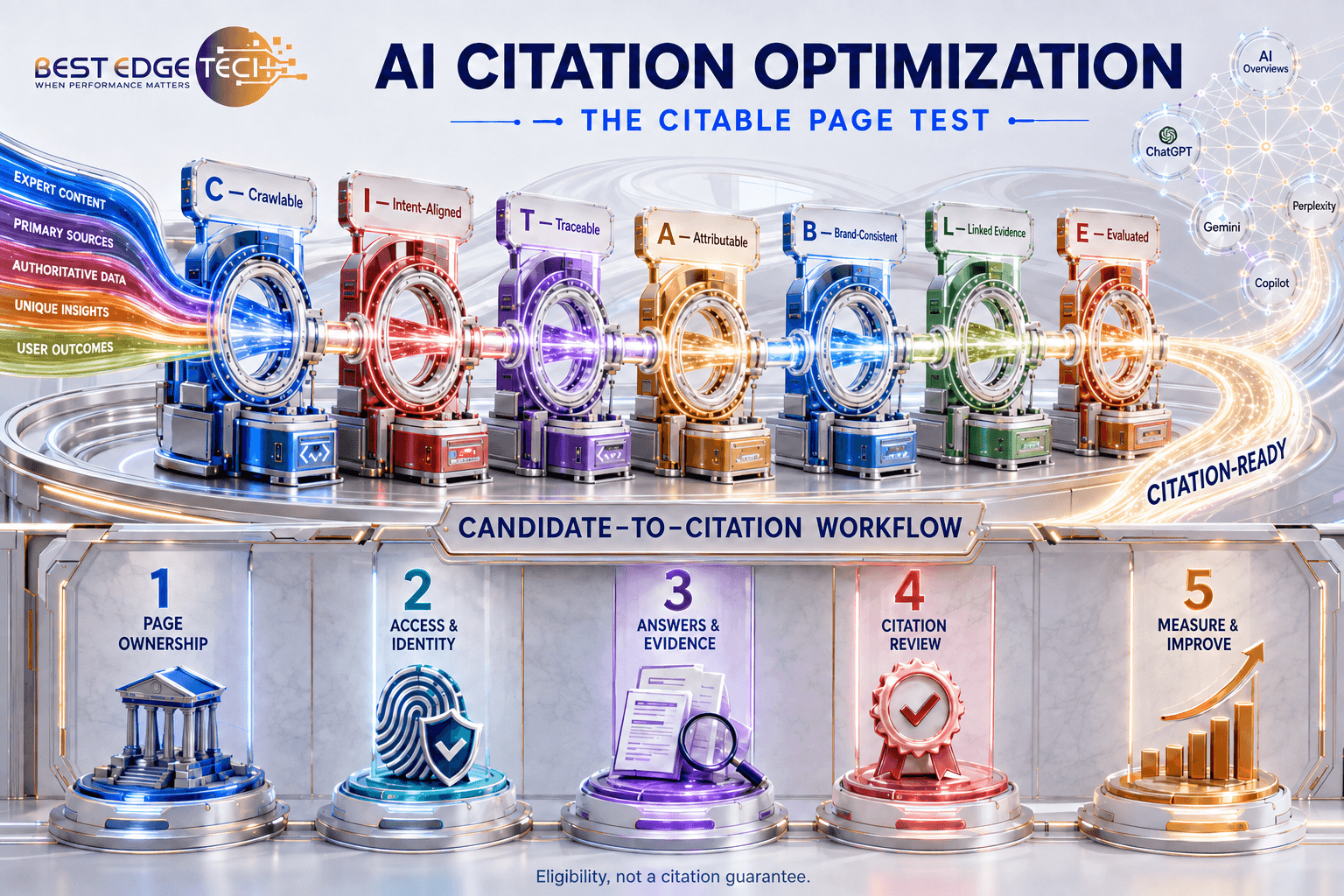
The CITABLE Page Test is an editorial framework developed for this guide. It is not an official score, ranking factor, or platform requirement. Use it to identify preventable weaknesses before publishing or updating an important page.C — Crawlable and Indexable
A strong answer cannot become a citation if the systems that power an experience cannot access it. Confirm that the preferred URL returns a successful status, is not blocked unintentionally, has a self-referencing canonical when appropriate, appears in the XML sitemap, and is internally linked from relevant pages. Check platform controls separately. OpenAI documents OAI-SearchBot and GPTBot as independent controls: OAI-SearchBot manages eligibility for ChatGPT search, while GPTBot manages potential model-training use. A site can allow search discovery while choosing a different policy for training. Also inspect CDN, firewall, and bot-protection rules because a permissive robots.txt file does not help if the server blocks an eligible crawler.I — Intent-Aligned
Choose one primary job for the page. A page about “how to compare managed service providers” should help a buyer evaluate providers; it should not become a broad history of cloud computing, cybersecurity, and AI. Clear intent makes passages easier to retrieve and gives readers a more useful experience. Map the main question and its necessary subquestions before drafting. Then place a concise, qualified answer near the beginning of each relevant section. The answer should make sense when extracted, but the surrounding discussion should add criteria, limitations, examples, and next steps.T — Traceable
Every consequential claim should have a visible evidence path. Link changing platform rules to current official documentation. Identify the date range and method behind original data. Distinguish a verified fact from Best Edge Tech’s professional judgment. Remove statistics that cannot be traced to a credible source. The original GEO research introduced a benchmark for testing how presentation changes can affect visibility in generative answers. Its results support the value of evidence, citations, and clear writing, but they are not a universal promise for every platform, query, or business. Treat research as directional evidence within its stated scope.A — Attributable
Readers and machines should be able to tell who created or reviewed the information and why that person or organization is qualified to address it. Include a real author profile, relevant experience, a meaningful review date, and editorial corrections when necessary. Do not add an expert-review credit unless that review actually occurred. Attribution also applies to the material itself. Label first-party findings as first-party findings. Name the source of third-party definitions and policies. If a framework is original, say who developed it instead of presenting it as an industry standard.B — Brand-Consistent
Use the same organization name, service descriptions, key people, locations, and contact details across the website and credible business profiles. Inconsistency creates ambiguity. A page should not claim a service area, credential, award, or result that the organization cannot verify. Structured data can reinforce visible facts and help search engines understand organizations and people. Google explains that structured data helps it understand page content, but valid markup does not guarantee a rich result or an AI citation. Keep one consistent sitewide organization entity, and make page-level schema match what visitors can see.L — Linked to Supporting Evidence
Build two kinds of connections. Internally, link the page to relevant services, definitions, case studies, author profiles, and deeper guides. Externally, cite authoritative sources where they materially support a claim. Links should help a reader verify or continue the topic; they should not be added merely to make the page look researched. Independent corroboration matters too. A company’s own website is the primary source for its current services and policies, but self-published claims about market leadership or performance require stronger evidence. Earn accurate mentions through legitimate partnerships, professional associations, expert contributions, original research, and digital PR. Never manufacture consensus with fake profiles or copied articles.E — Evaluated and Maintained
After publication, verify indexing, inspect how the page renders, test its structured data, and monitor whether the page is cited for representative topics. Microsoft provides an AI Performance report in Bing Webmaster Tools that includes cited URLs and grounding-query data for supported Microsoft and partner experiences. OpenAI explains that ChatGPT referral URLs include autm_source=chatgpt.com parameter, which can help publishers identify visits in analytics.
Do not reduce success to a single visibility score. Track citations, mentions, factual accuracy, referral quality, and conversions separately. Use Best Edge Tech’s AI search visibility tracking guide to build a repeatable measurement system.
Build a Claim-to-Evidence Worksheet Before You Publish
A citation-worthy page is easier to maintain when each important statement has an owner and a source. Create this worksheet during research, not after the draft is finished.| Claim | Claim type | Best evidence | Owner | Review trigger |
|---|---|---|---|---|
| Current platform requirement | Changing fact | Official platform documentation | SEO or technical lead | Documentation or product change |
| Company service or process | First-party fact | Approved service documentation | Service owner | Offer or process change |
| Performance result | First-party evidence | Dated analytics plus defined method | Analyst and client approver | Case-study update or correction |
| Industry statistic | Third-party evidence | Original study or dataset | Editor | New edition or material change |
| Professional recommendation | Expert judgment | Named reviewer and reasoning | Qualified subject expert | Evidence or standard changes |
Anatomy of a Citation-Ready Page
There is no universal template, but high-value pages usually need more than a short answer and a collection of keywords. Use the following components when they genuinely help the reader.- A precise title and opening definition: State the page’s subject and give a direct, qualified answer.
- A visible update or review date: Use it only when the content was meaningfully checked.
- Logical H2 and H3 sections: Organize the decisions and subquestions a reader must resolve.
- Evidence near the claim: Place source links beside the statement they support.
- Useful tables and checklists: Summarize exact comparisons, criteria, steps, or responsibilities.
- Defined limitations: Explain where an answer changes by platform, market, location, or circumstance.
- Real authorship: Connect the content to a complete author or reviewer profile.
- Contextual internal links: Help readers move between the guide, proof, service, and next action.
- Accurate structured data: Mark up the page type, publisher, author, dates, and image without inventing properties.
- A relevant CTA: Offer a next step aligned with the reader’s problem.
FAQ sections can improve usability when they answer genuine follow-up questions. Google discontinued FAQ rich results in Search in May 2026, so FAQ markup should not be added solely to pursue a Google rich result.
Seven AI Citation Optimization Mistakes to Avoid
- Publishing commodity summaries: Rewriting the same points already found across the results gives a system little reason to select your page.
- Writing one page for every keyword variation: Near-duplicate pages divide internal signals and create unclear ownership.
- Adding unsupported statistics: A precise number without a traceable method is not stronger evidence.
- Treating schema as a citation guarantee: Structured data can improve understanding, but it does not replace valuable visible content.
- Blocking eligible crawlers unintentionally: Robots rules, firewalls, CDNs, and bot protection can conflict.
- Hiding the useful answer beneath filler: Readers and retrieval systems should not need to cross a long introduction to find the core response.
- Measuring citations without accuracy or outcomes: A cited page can still be misrepresented or produce no business value.
The Candidate-to-Citation Workflow
Instead of forcing AI citation work into an arbitrary calendar, move each page through five evidence-based gates. A page advances only when it meets the exit criteria for the current stage. This keeps technical fixes, editorial improvements, and measurement connected to the same business question.Gate 1: Establish Page Ownership
- Choose three to five commercially relevant pages with established expertise or evidence.
- Assign one distinct intent to each page.
- Create a representative set of customer questions and subquestions.
- Check the site for overlapping URLs before creating anything new.
Gate 2: Verify Access and Identity
- Confirm crawl access, indexability, canonicals, sitemaps, and internal links.
- Review OAI-SearchBot and other relevant crawler controls.
- Align visible organization, person, service, and location facts.
- Validate only the structured data supported by the page.
Gate 3: Build the Answer-and-Evidence Layer
- Add a direct answer to the primary question.
- Complete the claim-to-evidence worksheet.
- Add original criteria, a process, a comparison, or first-party information that competitors lack.
- Remove duplicated explanations and unsupported claims.
Gate 4: Run the Citation-Readiness Review
- Score the page with the CITABLE Page Test and resolve weak dimensions.
- Inspect the rendered mobile and desktop page for hidden, broken, or hard-to-scan content.
- Test structured data against the visible copy and remove unsupported properties.
- Confirm that titles, headings, internal anchors, and calls to action match the page’s assigned intent.
Gate 5: Observe, Diagnose, and Improve
- Request indexing through the appropriate webmaster tools when needed.
- Record citations, mentions, accuracy, cited URLs, and referrals for the established question set.
- Separate discovery problems from content-selection problems before changing the page.
- Revise when evidence, user needs, or platform behavior changes—not merely to display a newer date.
How Should You Measure AI Citation Optimization?
Measure the entire evidence chain. Start with technical eligibility, then track retrieval indicators, citations, mentions, accuracy, traffic, and qualified outcomes. Establish a baseline before editing so you can distinguish a real change from normal answer variation.- Eligibility: crawl status, indexing, canonical selection, snippet controls;
- Citation visibility: cited pages, citation count, citation share, and topic coverage where platform data is available;
- Brand representation: mention rate, sentiment, and factual accuracy;
- Engagement: AI referrals, engaged sessions, returning users, and assisted journeys;
- Business value: qualified leads, sales, bookings, and conversion quality.
Frequently Asked Questions About AI Citation Optimization
How do you get cited in AI search?
Start by making the page accessible and indexable, answer a distinct question clearly, support material claims with traceable evidence, identify the author or reviewer, keep entity facts consistent, and measure citations over time. These steps improve eligibility and usefulness but cannot guarantee selection.Is AI citation optimization different from GEO?
Yes. GEO is the broader practice of improving visibility in generative search and answer systems. AI citation optimization focuses specifically on increasing the eligibility and usefulness of a page as a displayed supporting source.Does structured data make AI systems cite a page?
No. Structured data can help search engines understand a page and its entities, but valid schema does not guarantee a rich result, ranking, recommendation, or AI citation. It must accurately represent visible content.Does a page need to rank first on Google to earn an AI citation?
Not necessarily. Conventional rankings remain relevant, but AI search systems may retrieve sources for related subquestions and use different presentation logic. Strong SEO is a foundation, not proof that a citation will appear.Should a website allow GPTBot to appear in ChatGPT search?
OpenAI documents OAI-SearchBot for search inclusion and GPTBot for potential model training. The controls are independent, so publishers should review both and choose policies that fit their goals.What content is most citation-worthy?
Useful candidates include original research with a transparent method, primary documentation, expert explanations, well-supported comparisons, definitions with necessary context, and current answers to specific questions. Accuracy and relevance matter more than adding words.How long does AI citation optimization take?
There is no universal timeline. Crawl frequency, indexing, platform refresh cycles, competition, query demand, content quality, and authority all vary. Measure from a documented baseline and avoid vendors promising a fixed citation date.How can a business track AI citations?
Use first-party platform reports where available, analytics referral data, a controlled prompt panel, and manual evidence capture. Microsoft provides AI citation data in Bing Webmaster Tools, while OpenAI identifies ChatGPT referrals with a source parameter. Combine these with accuracy and conversion measurements.Make Your Best Pages Easier to Find, Trust, and Cite
AI citation optimization is not about manipulating an answer engine. It is about making genuine expertise clearer, better supported, technically accessible, and easier to verify. That work strengthens conventional search, AI search eligibility, and the experience people have when they reach your site. Best Edge Tech combines technical SEO, evidence-led content, entity clarity, structured data, authority development, and measurement. Request an AI visibility audit to identify the pages and evidence gaps with the greatest opportunity.Sources and Further Reading
- Google Search Central: AI Features and Your Website
- Google Search Central: Optimizing for Generative AI Features
- Google Search Central: How Structured Data Works
- Google Search Central: General Structured Data Guidelines
- OpenAI: Overview of OpenAI Crawlers
- OpenAI Help Center: ChatGPT Search
- Bing Webmaster Tools: AI Performance
- Bing Webmaster Guidelines
- GEO: Generative Engine Optimization

Strategic Content Review
Strategically Reviewed by Christopher A. Whitfield
Founder & CEO, Best Edge Tech | SEO, AI Search & GEO Strategy
Christopher strategically reviewed this article to ensure it reflects current search best practices, aligns with the intent behind AI citation optimization, and gives businesses technically sound, practical guidance for traditional and AI-powered search.
This review evaluated:
- Search intent and content completeness
- SEO, AI search, and GEO alignment
- Technical and entity clarity
- Source quality and claim support
- Readability and user experience
- Actionability for business owners
Strategic review covers digital marketing quality, SEO, AI search optimization, and content strategy. It does not replace legal, financial, medical, or other specialized professional review when separate subject-matter expertise is required.