
Last reviewed: .
An AI search readiness audit determines whether a website has the technical accessibility, entity clarity, content ownership, factual evidence, and customer pathways needed before AI search optimization or visibility tracking begins. It is a preflight assessment—not a prediction of whether Google, ChatGPT, Perplexity, Gemini, Copilot, or another platform will cite or recommend a business. A website can look polished and still fail this assessment. A priority service page may be non-indexable. Several articles may compete for the same search intent. Business facts may conflict across the website and external profiles. Important claims may lack evidence. Useful educational content may lead nowhere commercially. The Best Edge Tech Five-Gate Preflight Model identifies those weaknesses before a company invests in additional content, structured data, authority development, or AI visibility monitoring.Key Takeaways
- AI search readiness and AI search visibility are different assessments.
- A page must be accessible, understandable, useful, supportable, and connected to an appropriate next step.
- One strong page should own each important search intent whenever possible.
- Structured data should confirm visible information rather than compensate for missing or unclear content.
- A readiness audit should use individual gate verdicts instead of hiding foundational problems inside one attractive score.
- Visibility monitoring should begin after critical readiness failures have been resolved.
- No audit can guarantee crawling, indexing, rankings, citations, recommendations, traffic, or leads.
What Is an AI Search Readiness Audit?
An AI search readiness audit is a structured evaluation of whether important website information can be discovered, interpreted, verified, and used within modern search experiences. The audit examines five connected dependencies:- Technical eligibility: Can priority pages be accessed, rendered, indexed, and reached through the website?
- Entity clarity: Does the website clearly explain who the organization is and how its people, services, products, and locations relate?
- Intent ownership: Does each important customer question or decision have one appropriate primary page?
- Evidence integrity: Are material claims accurate, current, attributable, and appropriately supported?
- Action readiness: Can visitors move from useful information to the correct next step?
What This Audit Does Not Measure
This audit deliberately excludes ongoing AI visibility measurement so that it serves a clear and distinct search intent. An AI search readiness audit does not calculate:- Brand mention rate.
- Domain citation rate.
- Recommendation frequency.
- AI citation share of voice.
- Prompt-level competitive visibility.
- Answer consistency across repeated tests.
- AI-referred sessions or conversions.
- Revenue attributed to AI-assisted discovery.
The Best Edge Tech Five-Gate Preflight Model
The model uses dependencies rather than one composite score. A website should not pass by accumulating points for easy improvements while leaving one critical foundation broken.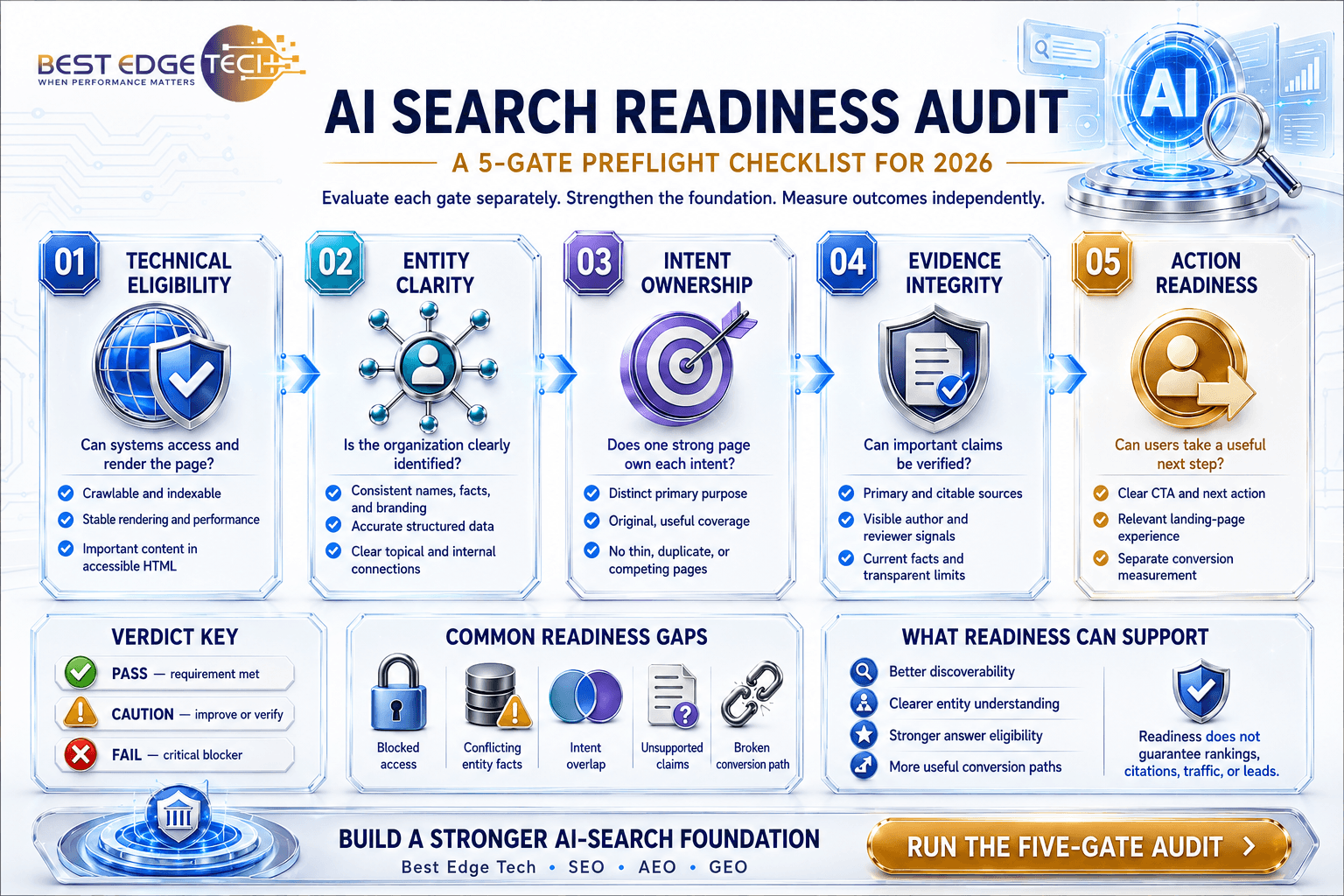
Gate 1: Technical Eligibility
The first gate asks whether priority content is technically available for discovery and use. Confirm that:- Priority URLs return the intended successful HTTP response.
- Important pages are not accidentally blocked by
robots.txt. - Priority pages do not contain unintended
noindexdirectives. - Canonical tags identify the correct preferred URLs.
- Redirects lead to the intended destination without loops or unnecessary chains.
- The main page information appears in the rendered content.
- Important pages are reachable through normal internal links.
- The XML sitemap contains current, canonical, indexable URLs.
- Mobile visitors can access and use the primary content.
- The website is verified in the appropriate webmaster tools.
Gate 1 fails when:
- A priority page is blocked or non-indexable.
- A canonical tag points to an unrelated or incorrect URL.
- Essential page information is unavailable in the rendered experience.
- The page is orphaned from the navigable website structure.
- The page or its primary action is inaccessible on common devices.
Gate 2: Entity and Business Clarity
The second gate asks whether the organization and its important relationships are unambiguous. Confirm that the website clearly identifies:- The official organization or business name.
- Any legitimate alternate or former name.
- The primary services, products, or areas of expertise.
- The intended customers or audiences.
- Current locations and genuine service areas.
- Accurate contact details and operating information.
- Current owners, leaders, authors, and reviewers.
- The relationship between people, services, locations, and the organization.
- The authoritative page for each important business fact.
- Consistent information across profiles and listings controlled by the business.
Gate 2 fails when:
- The website presents materially conflicting names, locations, services, or leadership information.
- No authoritative page establishes the organization’s identity.
- Structured data contradicts the visible page.
- Profiles controlled by the business repeatedly present outdated or conflicting information.
Gate 3: Intent Ownership and Information Value
The third gate asks whether every important customer decision has a clear primary destination. Each priority page should have one dominant job, such as:- Explaining a service.
- Answering a specific informational question.
- Helping a user compare options.
- Establishing genuine local relevance.
- Documenting expertise or evidence.
- Enabling contact, booking, quotation, or purchase.
- Each important service has one designated primary service page.
- Each article satisfies a distinct informational or decision intent.
- Closely related questions are consolidated when one strong page can satisfy them.
- Multiple pages are not optimized around the same primary query and purpose.
- Location pages contain genuine local information rather than swapped city names.
- Articles add experience, analysis, examples, frameworks, or evidence beyond common summaries.
- Titles, headings, introductions, internal links, and calls to action reinforce the page’s assigned purpose.
- Older pages are updated, consolidated, redirected, or deoptimized when they compete unnecessarily.
Gate 3 fails when:
- Two or more pages compete for the same primary intent without a strategic reason.
- No existing page adequately satisfies an important customer decision.
- The proposed content repeats information already owned by another page.
- The content exists primarily to capture keyword variations rather than help readers.
Gate 4: Evidence and Claim Integrity
The fourth gate asks whether important statements are supportable and appropriately attributed. Confirm that:- Material factual claims are accurate and current.
- Statistics link to the original or most authoritative available source.
- Professional judgment is distinguished from verified fact.
- Articles identify a real author.
- Strategic or subject-matter reviewer credits reflect an actual review.
- Case studies state the scope, dates, metrics, evidence source, and relevant limitations.
- Testimonials and reviews are genuine and attributable.
- Regulated or high-risk claims receive appropriate professional review.
- Publication and review dates appear when freshness materially affects accuracy.
- External references support the exact claims located near them.
Gate 4 fails when:
- A material business, safety, legal, medical, financial, or credential claim is false or unsupported.
- A case study presents results that cannot be traced to a defined source and period.
- A fabricated quote, review, award, statistic, author, or reviewer appears on the page.
- Visible content and structured data make conflicting claims.
Gate 5: Action and Maintenance Readiness
The fifth gate asks whether the website can turn useful discovery into an appropriate next step and maintain the accuracy of its information. Confirm that:- Every priority page has a next step appropriate to its intent.
- Educational articles lead naturally to the relevant service or decision page.
- Contact, booking, quotation, or purchasing paths work correctly.
- Forms, telephone links, maps, and scheduling tools work on mobile devices.
- Page owners are assigned for important business information.
- Time-sensitive pages have review dates or maintenance procedures.
- Material website changes are documented.
- Old pages and files are not left online with conflicting information.
- The organization has defined what happens after readiness problems are fixed.
- AI visibility measurement remains a separate operational process.
Gate 5 fails when:
- The primary conversion or contact path is broken.
- An informational page creates a dead end for a qualified reader.
- No one is responsible for maintaining important information.
- Obsolete pages or documents repeatedly conflict with current information.
How to Assign Pass, Caution, and Fail Verdicts
Do not reduce the audit to one proprietary score. Assign a separate verdict to each gate.| Verdict | Meaning | Required action |
|---|---|---|
| Pass | No critical failure is present, and the gate’s priority requirements are substantially satisfied. | Maintain the foundation and document material changes. |
| Caution | No immediate critical failure is present, but important weaknesses could reduce clarity, usefulness, trust, or maintainability. | Add the weaknesses to a prioritized remediation backlog. |
| Fail | A critical failure could prevent discovery, create material confusion, mislead users, or break the customer journey. | Resolve and verify the failure before expanding optimization work. |
How to Audit Intent Ownership and Prevent Cannibalization
Content cannibalization occurs when multiple pages send overlapping signals about which URL should satisfy the same search intent. The problem is not simply that two pages mention the same topic. Closely related pages can support one another. The risk arises when several pages share the same primary purpose, audience, focus keyword, title direction, and expected conversion action.Create an Intent-Ownership Map
| Intent | Primary page | Supporting pages | Required action |
|---|---|---|---|
| Commercial service evaluation | One primary service page | Case studies, FAQs, and supporting guides | Keep the primary service page commercially focused. |
| Broad topic education | One pillar or definitive guide | Narrow supporting articles | Link supporting articles back to the primary guide. |
| Specific problem diagnosis | One problem-focused article | Relevant service and process pages | Avoid repeating the entire solution on several pages. |
| Performance measurement | One measurement guide | Tool reviews and platform documentation | Keep metrics and formulas centralized. |
| Local service discovery | One genuinely useful location page for each real market | Service pages and local supporting content | Avoid city-swapped doorway pages. |
Use Five Cannibalization Decisions
- Strengthen: Improve the best existing page when it already owns the intent.
- Consolidate: Merge overlapping pages when neither provides a distinct purpose.
- Differentiate: Assign separate purposes when both pages are genuinely useful.
- Redirect: Redirect obsolete or redundant URLs when consolidation is appropriate.
- Deoptimize: Remove competing title, heading, keyword, or internal-link signals when a page must remain accessible for another purpose.
Create a Business-Fact Source of Truth
AI search readiness depends partly on whether important business information is clear, consistent, and maintainable. A company should maintain an internal source-of-truth register for facts that commonly become outdated or contradictory.| Business fact | Recommended authoritative location | Responsible owner | Typical review trigger |
|---|---|---|---|
| Official business name | Homepage, About page, and organization records | Business leadership | Rebrand, acquisition, or ownership change |
| Current services | Service hub and primary service pages | Service or department owner | Service launch, material change, or retirement |
| Locations and service areas | Contact and location pages | Operations team | Opening, closure, relocation, or coverage change |
| Leadership and professional roles | About, team, and profile pages | Leadership or human resources | Personnel, responsibility, or title change |
| Hours and contact information | Contact page and appropriate local profiles | Operations team | Schedule, telephone, email, or channel change |
| Credentials and affiliations | Relevant person or organization profile | Credential holder or compliance owner | Renewal, expiration, suspension, or status change |
What a Completed AI Search Readiness Audit Should Deliver
A useful audit should produce decisions—not merely a list of observations or automated warnings. The final audit package should include:- A clearly defined business and website scope.
- A list of priority services, audiences, locations, and customer decisions.
- A representative inventory of important URLs.
- A Five-Gate verdict for each priority page or page group.
- A separate list of critical failures.
- An intent-ownership and cannibalization map.
- A business-fact source-of-truth register.
- A list of unsupported, outdated, or conflicting material claims.
- A prioritized remediation backlog.
- An owner and verification method for every critical action.
- A list of pages ready for visibility monitoring.
- A documented handoff into the AI visibility tracking process.
Minimum Remediation-Backlog Fields
| Field | Purpose |
|---|---|
| Affected URL | Identifies where the issue occurs. |
| Failed gate | Connects the issue to the readiness model. |
| Evidence | Records how the issue was verified. |
| Customer or search impact | Explains why the issue matters. |
| Recommended action | Defines the correction or decision required. |
| Priority | Separates critical, high, medium, and low work. |
| Owner | Assigns responsibility. |
| Verification method | Defines how the team will confirm completion. |
How to Prioritize AI Search Readiness Improvements
Fix issues according to dependency, customer risk, and business importance.1. Correct Harmful or Misleading Information
Address false business identities, incorrect locations, unsupported credentials, dangerous claims, and materially inaccurate customer information.2. Restore Technical Eligibility
Resolve indexing blocks, incorrect canonicals, broken destinations, inaccessible content, and orphaned priority pages.3. Establish Page Ownership
Choose the strongest primary page for each important intent. Consolidate, redirect, differentiate, or deoptimize competing URLs.4. Strengthen Information Value
Add missing definitions, processes, criteria, limitations, examples, evidence, and decision support to the primary page.5. Align Entities and Business Facts
Correct organization names, services, people, locations, profiles, structured data, and authoritative source pages.6. Repair Action Paths
Connect informational pages to the appropriate service, contact, booking, quotation, or purchasing step.7. Begin Visibility Measurement
After critical readiness problems are resolved, establish an AI visibility baseline and recurring measurement process. Use Google Search Console’s generative AI performance reporting and Bing Webmaster Tools’ AI Performance reporting where available. Track search visibility, AI mentions and citations, referral traffic, factual accuracy, and conversions as separate measures rather than combining them into one score.AI Search Readiness Myths
“A Special AI Schema Is Required.”
Google states that no special structured-data type is required for its generative search features. Continue using appropriate structured data when it accurately represents visible content and supports a legitimate search feature.“An llms.txt File Makes a Website Rank in Google AI Search.”
Google states that it does not use llms.txt as a special ranking or visibility mechanism. Other platforms may establish their own uses, so evaluate the file according to current platform-specific documentation.
“Every Answer Must Be Placed in a Tiny Content Block.”
There is no universal requirement to divide pages into artificial fragments for generative search. Organize information according to what helps readers understand and use it.“More Pages Automatically Create More AI Visibility.”
Publishing several near-duplicate pages can create maintenance problems, conflicting facts, diluted internal signals, and cannibalization. One complete page is often stronger than several weak variations.“A Readiness Score Predicts Citations.”
No internal or third-party readiness score can guarantee a mention, citation, ranking, recommendation, or lead. Readiness frameworks should guide remediation rather than imitate a proprietary platform-ranking metric.“Structured Data Can Replace Visible Business Information.”
Structured data should support the page. Important facts should also be visible, accurate, and understandable to visitors.“Crawler Access Proves That a Page Influenced an Answer.”
A crawler request may indicate technical access activity. It does not prove that the page influenced, supported, or appeared in a generated answer.Frequently Asked Questions About AI Search Readiness Audits
What Is an AI Search Readiness Audit?
An AI search readiness audit evaluates whether a website’s important pages are technically accessible, clearly associated with the correct organization, assigned to distinct customer intents, supported by reliable evidence, and connected to useful next steps.How Is AI Search Readiness Different From AI Visibility?
Readiness describes the condition of the website foundation. Visibility describes what happens in search and AI-generated experiences, including mentions, citations, recommendations, referral traffic, and conversions.Does an AI Readiness Audit Replace a Technical SEO Audit?
No. A technical SEO audit generally investigates a broader range of crawling, indexing, architecture, performance, ranking, and organic-search issues. AI search readiness uses that foundation while adding entity clarity, intent ownership, factual evidence, and operational handoff requirements.How Does the Audit Prevent Content Cannibalization?
The audit maps each important intent to one primary page and evaluates whether other URLs support, duplicate, or compete with that page. Overlapping URLs can then be strengthened, consolidated, differentiated, redirected, or deoptimized.Does Structured Data Guarantee AI Citations?
No. Accurate structured data may help search engines understand page information and support eligible search features, but it cannot guarantee crawling, indexing, citations, recommendations, rankings, traffic, or leads.Is an llms.txt File Required?
It is not required for Google Search or Google’s generative AI features. Other systems may publish different guidance, so implementations should follow current platform-specific documentation.
Should Readiness and Visibility Be Combined Into One Score?
No. A combined score can conceal important differences. A website may have excellent technical readiness but weak visibility, or it may receive visibility while presenting inaccurate information. Readiness, visibility, accuracy, and business outcomes should be evaluated separately.When Should AI Visibility Tracking Begin?
Establish the measurement baseline after critical readiness failures have been corrected or clearly documented. Otherwise, the organization may spend time measuring problems that already have known foundational causes.Can an Agency Guarantee That a Website Will Appear in AI Answers?
No. A responsible agency can improve accessibility, clarity, usefulness, evidence, authority, and measurement systems, but it cannot guarantee inclusion in proprietary search or AI-generated results.Move From Readiness to Measurable AI Search Performance
An AI search readiness audit should make the next decision clearer. It should identify which pages are technically unavailable, which business facts are ambiguous, which URLs are competing, which claims require evidence, and which customer pathways are incomplete. Best Edge Tech integrates these foundations into its AI SEO and Generative Engine Optimization services, combining traditional SEO, entity and intent mapping, content strategy, structured-data validation, authority development, and performance measurement. Organizations needing a broader website review can begin with Best Edge Tech’s SEO audit and analysis services. Ready to identify the barriers affecting your website? Contact Best Edge Tech to discuss your search strategy.Primary References
- Google Search Central: Optimizing Your Website for Generative AI Features
- Google Search Essentials
- Google Search Central: Organization Structured Data
- Google Search Central: General Structured Data Guidelines
- Microsoft Bing: AI Performance in Bing Webmaster Tools
- OpenAI: Overview of OpenAI Crawlers
- Perplexity: Crawler Documentation

Strategic Review Verified
Strategically Reviewed by Christopher A. Whitfield
Founder & CEO Best Edge Tech
This article was strategically reviewed by Christopher A. Whitfield for alignment with current SEO, Answer Engine Optimization, Generative Engine Optimization, technical search, entity clarity, content differentiation, source quality, internal linking, search intent, user value, and marketing accuracy.
- SEO Strategy
- AEO & GEO
- Search Intent
- Entity Clarity
- Source Quality
- Content Completeness
View Christopher’s Profile →
Reviewed for Best Edge Tech editorial standards