AI Visibility Audit: How to Audit AI Search Visibility Without Third-Party Scores
An AI visibility audit should not begin with a mystery score. It should begin with first-party data where it exists, a clearly documented query sample where complete reporting is unavailable, and an evidence log that separates what is documented from what was only observed. Quick Answer: Use Google Search Console data first, especially the dedicated generative AI reporting when it is available for the property. Then document manual AI-search observations separately by platform, prompt, date, location, device, session state, and cited URLs. Vendor scores can be recorded, but they should not be treated as equal to Search Console data or presented as proof of total AI visibility.
For business owners, healthcare practices, law firms, and agencies, the practical goal is not to prove that a site is “visible everywhere.” That claim is not defensible. The goal is to answer a narrower question: what evidence do we have, what does it actually support, and what should be checked next? That is where a structured audit beats a dashboard score. It gives your team a trail of reports, pages, dates, prompts, screenshots, and limitations that can be reviewed before technical, content, or entity work begins.
What an AI search audit should and should not measure
An AI search audit measures defined evidence of visibility in AI-influenced search surfaces and AI answer products. It does not measure every possible user session, prompt variation, location, device, personalization state, or product interface. That distinction matters because “visibility” is now used to describe several different things: an impression in a platform report, a linked source in an AI answer, a brand mention, a recommendation, a citation, or a page used as supporting context.
In this guide, AI search audit means a documented review of evidence, not a promise that one tool can see every AI answer. The phrase should point to a repeatable process: collect first-party data, record manual observations, classify uncertainty, and decide what to verify next. A useful AI search audit also names the evidence that was not available, because missing access can shape the conclusion as much as the records you do collect.
Before you collect data, define the unit of measurement. For example, a documented Google Search Console record is not the same thing as a manual observation in an AI answer. A cited URL is not the same thing as a business mention. A recommendation is not the same thing as a link. If a vendor dashboard combines those signals into one score, the audit should ask how those pieces were collected and weighted.
For Google surfaces, as of 2026, Google’s guidance says to “use the Generative AI performance report in Search Console” for available generative-AI reporting and to “continue prioritizing” core SEO practices such as crawlability, indexability, helpful content, and a strong page experience. Google’s guide to optimizing websites for generative AI features is the primary reference point for that boundary. It does not support the idea that an unexplained third-party score can reverse-engineer AI answers.
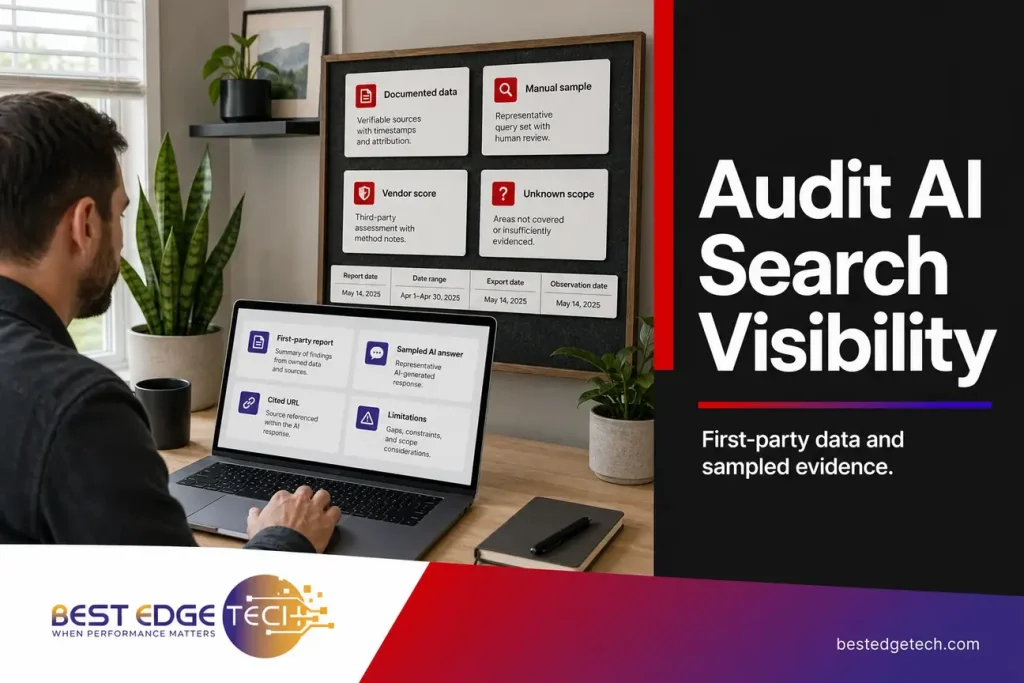
A defensible audit should classify every finding as one of four things:
- Documented: supported by first-party platform reporting or official platform documentation.
- Observed: seen in a controlled manual sample with the prompt, date, device, market, and capture recorded.
- Reported by vendor: supplied by a third-party dashboard, with its methodology and limits recorded.
- Unknown: not measured, not exposed by the platform, or not supported by the available evidence.
This classification prevents a common reporting mistake: treating a sampled AI answer as if it represents the whole market. It also prevents the opposite mistake: treating one missing citation as proof that a page is never cited.
AI visibility audit evidence hierarchy
The most useful audit framework is an evidence hierarchy. It tells the analyst, the client, and the decision-maker how much weight each record deserves. The higher the evidence sits in the hierarchy, the more directly it supports a visibility claim. The lower it sits, the more it should be treated as a lead for investigation rather than a conclusion.
| Rank | Evidence type | What it supports | Main limitation |
|---|---|---|---|
| 1 | Google Search Console Generative AI performance report | First-party Google-reported visibility within the report’s available scope | Availability and scope must be verified for the property |
| 2 | Google Search Console Performance report | Broader Google Search visibility and traffic patterns | May not isolate every AI-feature appearance |
| 3 | Indexing and URL inspection evidence | Whether Google reports that a URL is indexed or has indexing issues | Indexing is not proof of ranking or AI citation |
| 4 | Reproducible manual observations | What a defined prompt produced at a defined time | Samples are not population-wide measurement |
| 5 | Displayed citation or source links | Which URLs appeared as supporting sources in that observation | Behavior can vary by time, query, user, and interface |
| 6 | Vendor-reported scores | A comparative signal if methodology is disclosed | Not equivalent to first-party platform data |
| 7 | Anecdotal screenshots or isolated reports | A lead for follow-up | Weak reproducibility and high selection bias |
This hierarchy does not mean vendor tools are useless. It means the audit should not place a vendor-reported score beside a Search Console impression as though both measure the same thing. If the denominator, query set, market assumptions, collection dates, and platform coverage are unclear, label the record as vendor-reported with incomplete methodology.
Good AI search evidence also needs a confidence label. A first-party report, a manual observation, and a vendor score may all be useful, but they should not carry the same weight in planning. When AI search evidence is labeled clearly, a team can see which findings are ready for action and which ones need more verification.
For teams comparing SEO, answer engine optimization, and generative engine optimization work, this evidence hierarchy also keeps the scope realistic. Best Edge Tech’s AI SEO and GEO services are built around improving the conditions that help a business become easier to crawl, understand, and evaluate. That work can support search visibility, but no agency can promise that an AI product will cite a specific page.
The hierarchy also helps with AI visibility tracking because it prevents weak observations from driving strong claims. If a report contains first-party data, vendor notes, and manual screenshots, AI visibility tracking should keep those records separate instead of averaging them into a single unsupported score.
Where AI visibility tracking starts in Search Console
AI visibility tracking should begin with the platform data you can actually verify. For Google, the key source is Search Console. Google documents a Generative AI performance report in Search Console that provides reporting for supported generative AI features on Google Search and Discover, including dimensions such as pages, countries, devices, and dates where available. If that report is available for the verified property, it belongs at the top of the audit file.
Because availability and rollout can differ by property, verify whether the Generative AI performance report is available for each Search Console property before treating its absence as a visibility finding. Google’s 2026 guidance says to “use the Generative AI performance report in Search Console” where it is available and to “continue prioritizing” core SEO practices rather than replacing documented SEO work with an opaque AI score.
The general Search Console Performance report is still useful because it shows broader search performance patterns. Google’s documentation on AI features and websites explains how AI features interact with Google Search reporting and site visibility. However, the broader report should not be treated as a complete, isolated AI-search ledger unless the report itself exposes that level of detail.
That is why AI visibility tracking should record report availability as its own finding. If the dedicated generative AI report is not visible for a property, write: “The dedicated report was not available for this property at the time of access.” Do not write: “The site has no AI visibility.” The first sentence is a documented limitation. The second is an unsupported conclusion.
For a practical workflow, start with these Search Console checks:
- Confirm the property type and whether it covers all URL variants that matter.
- Confirm that the person exporting data has the right access level.
- Record the exact report name, date range, filters, and export date.
- Inspect pages, countries, devices, and search or Discover scope where the report exposes those dimensions.
- Preserve the export file name and screenshot or capture identifier.
- Record whether the report was available, unavailable, or available but filtered to no results.
For audit buyers, this is a basic quality check. Credible AI visibility tracking should show the report name, property, date range, filters, and URL evidence. If a vendor says a page gained or lost AI visibility but cannot show which platform, which report, which query set, or which dates support the claim, the conclusion should remain provisional.
Strong AI search evidence in Search Console also includes the conditions around the export. If the filters, property type, and dates are missing, the AI search audit should treat the export as incomplete until the analyst can reproduce the view.
How AI search evidence should separate pages and dates
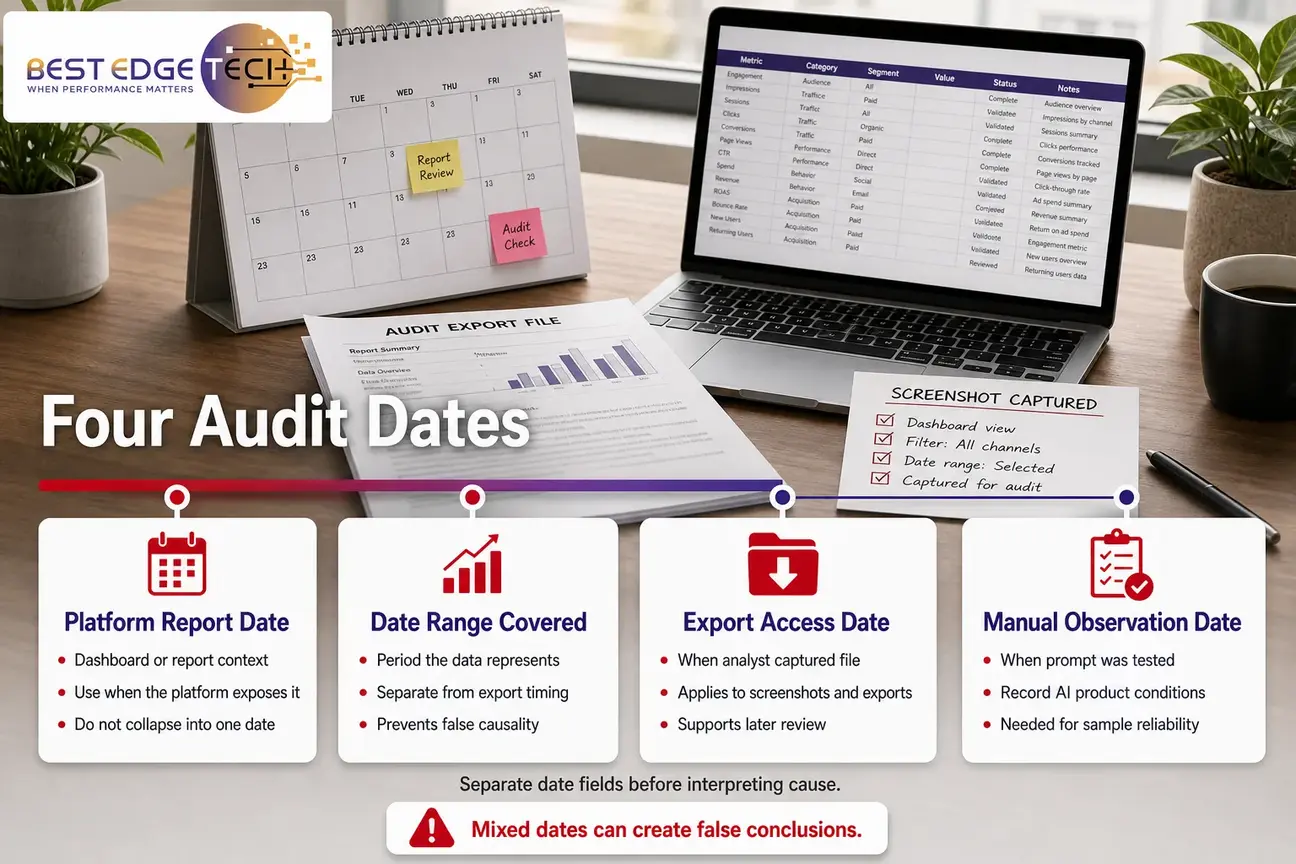
AI search evidence becomes unreliable when all dates are collapsed into one “checked on” field. Search data, manual observations, screenshots, and exports each have their own time context. Mixing them can make a change look causal when it may simply reflect a reporting window, a different prompt, or a later export.
Keep at least four date fields in the audit:
- Date of the platform report: the report or dashboard context, if the platform exposes one.
- Date range represented by the report: the period the data covers.
- Date the analyst accessed or exported the data: when the file or screenshot was captured.
- Date of any manual AI observation: when a prompt was tested in an AI product.
This is especially important during migrations, redesigns, major content updates, or technical fixes. If a site changed templates during the measurement period, AI search evidence should not be interpreted until URL ownership, indexing, canonicalization, redirects, and date ranges have been confirmed. Google’s Search Console Help documentation for the Page indexing report is useful when the audit needs to understand whether pages are indexed, excluded, or affected by indexing issues.
Search Console page data also needs URL discipline. Record the exact URL shown in the report. Do not merge http, https, www, non-www, trailing slash, parameterized, localized, or redirected versions unless the audit documents why they are being grouped. A page that appears in a report under one canonical URL may not support a claim about a different URL.
If the Search Console record points to a page, the next question is not “did this page win AI search?” The next question is: “What does the report show, within which scope, and what can we verify about that URL?” That framing keeps technical SEO, content strategy, and reporting governance from talking past one another.
Date discipline also improves AI visibility tracking because it shows whether a change happened before, during, or after the evidence window. Without those dates, the team may attribute a movement to content work when the record actually reflects a different export period.
Manual query samples for AI visibility tracking
Manual sampling is useful, but it is not complete measurement. It helps answer, “What did this product show for this prompt under these conditions?” It does not answer, “What does every user see?” For that reason, manual AI visibility tracking should be handled as a reproducible observation process, not a substitute for first-party reporting.
Start with a question set tied to real business intent. A healthcare practice might test service, condition, and local-intent questions. A law firm might test practice-area and eligibility questions, while making sure marketing teams do not turn the audit into legal advice. An agency may test a client’s brand, service category, comparison, and informational questions. In every case, the prompt set should be documented before results are judged.
Manual AI visibility tracking works best when the question list stays stable long enough to compare observations. If the prompt set changes every week, the audit may be measuring prompt drift rather than a meaningful visibility trend.
A defensible manual record should include:
- Platform and product surface.
- Exact prompt, including punctuation.
- Date and local time.
- Location or market setting.
- Device and browser.
- Signed-in or signed-out state, when known.
- Personalization or session context, when visible.
- Short response summary, not a wholesale copied answer.
- Whether citations, links, or source cards appeared.
- Exact cited URLs.
- Whether the target business, page, or entity appeared.
- Whether the result repeated under the same conditions.
- Screenshot or capture identifier.
- Uncertainty note.
The wording of the finding matters. Use “the sample did not show the target page” instead of “the page was not cited.” Use “the platform did not expose a source link in this observation” instead of “there was no source.” Use “the audit observed a citation for this prompt” instead of “the page is favored by AI.” These small wording choices keep the report honest.
Manual AI visibility tracking should also identify prompts that are too broad to support a useful decision. If a query could apply to many industries, markets, or user needs, the AI search audit should narrow the prompt set before making recommendations.
If your team already tracks AI-search appearances, compare that workflow with a dedicated AI search visibility tracking process. The stronger your documentation, the easier it is to decide whether the next step is technical cleanup, content improvement, entity clarification, or a larger sample.
AI citation tracking without overclaiming causation
AI citation tracking records when an AI product displays a page, source card, citation, or link in response to a defined prompt. It is a useful audit layer because citations are more concrete than a vague “visibility” label. But a citation observation still has limits. A source shown at one time may not appear later. A source shown to one user may not appear to another. A cited page may support one answer without proving broad topical authority.
The audit should separate citation evidence from mention evidence. If the AI answer names the business but does not link to the website, record that as a mention. If it links to a specific page, record the exact URL. If it links to a third-party profile, record that too, but do not treat the third-party page as proof that the owned website earned the citation.
Reliable AI citation tracking should also record what did not happen. If a response included a brand mention but no link, that is a different finding from a linked source. If the answer displayed no source area at all, that should be logged as a platform observation rather than a site failure.
For teams working on AI citation optimization, the practical question is usually: “Can search and AI systems understand which page, entity, service, and market are relevant to this question?” That leads to concrete checks: crawlable pages, indexable URLs, clear headings, useful page content, consistent business facts, structured data where appropriate, and source material that supports the answer. It does not lead to a promise that a citation will appear.
When a citation disappears, do not jump straight to content rewrites. First confirm whether the prompt changed, the product surface changed, the location changed, or the observation was taken under a different session state. Then check whether the target URL is indexed, canonicalized correctly, internally linked, and still answering the question. Only after those checks should the content team decide whether the page needs expansion, clarification, consolidation, or freshness work.
AI citation tracking is most useful when it supports a decision, not when it becomes a vanity metric. The decision might be to clarify a page, consolidate overlapping content, document entity facts, or expand the sample before acting.
Use AI citation tracking as one part of the larger evidence file, not as a stand-alone ranking report. A citation record is stronger when it is paired with AI search evidence about the prompt, date, exact URL, and technical status of the page.
Vendor scores belong in a separate worksheet
Third-party scores can help with prioritization when their methodology is clear. They become risky when they are presented as a percentage of real-world AI visibility. A score built from a selected prompt set, selected platforms, selected dates, and a proprietary weighting system is not the same thing as total user exposure.
The audit should ask every vendor-score record to answer these questions:
- What is the score’s definition?
- What are the numerator and denominator?
- How was the query set selected?
- Which platforms and product surfaces are included?
- Which geographic and device assumptions are used?
- What collection dates are represented?
- How often are prompts repeated?
- Are results personalized or session-influenced?
- How are citations, mentions, links, and recommendations treated?
- How are missing results handled?
- Does the vendor disclose confidence intervals or uncertainty?
- Is the score normalized, benchmarked, or versioned?
- Has the methodology changed since the previous report?
If these fields are not available, write: “The vendor reports this score, but the methodology is incomplete.” That phrasing preserves the record without exaggerating it. It also protects your team from making decisions based on a number that may change because of sampling or methodology rather than actual visibility.
A strong AI search audit does not reject tools. It puts tools in the right evidence class. Vendor dashboards can help generate leads for investigation, spot prompt categories worth sampling, or compare directional patterns over time. They should not replace Search Console records, indexing evidence, or documented manual observations.
When a vendor score is included, the AI search audit should label it separately from first-party and observed records. That separation makes the final recommendation easier to defend if the score changes after a vendor updates its model or prompt set.
Vendor data can support AI visibility tracking when it is treated as a sampled signal with limits. It should not override stronger AI search evidence from Search Console, indexing checks, or repeatable manual observations.
Practical worksheet for an AI search audit
A worksheet turns a loose review into an accountable process. If your team is evaluating SEO analysis support or building an internal workflow, use the worksheet structure below to keep evidence, claims, and uncertainty in separate fields.
This worksheet is also a quality-control tool for AI search evidence. If a finding cannot be traced back to a report, prompt, URL, date, or source file, it should not drive a major recommendation.
A complete AI search audit worksheet should be boring in the best way: consistent fields, repeatable labels, and enough detail for another analyst to understand the same record later. The worksheet is where AI visibility tracking, AI citation tracking, and broader Search Console review meet in one evidence file.
Scope fields
- Client or site.
- Search Console property.
- Audit owner.
- Audit date.
- Markets included.
- Platforms included.
- Products or surfaces included.
- Questions being tested.
- Excluded platforms or products.
- Access limitations.
First-party evidence fields
- Report name.
- Search Console property.
- Date range.
- Export or access date.
- Page URL.
- Impressions, if exposed by the report.
- Countries and devices, where available.
- Search appearance or feature, where available.
- Filters applied.
- Source file.
- Confidence classification.
- Notes and limitations.
Manual observation fields
- Platform.
- Product surface.
- Exact prompt.
- Date and time.
- Location.
- Device and browser.
- Session state.
- Response summary.
- Citation or source link present.
- Cited URL.
- Target entity or page present.
- Repeated successfully.
- Screenshot or capture ID.
- Classification.
- Uncertainty.
Vendor-score fields
- Vendor.
- Score name.
- Score value.
- Collection date.
- Query set disclosed.
- Platform coverage.
- Geographic assumptions.
- Methodology disclosed.
- Comparable to first-party data: yes, no, or not established.
- Reliability note.
Finding fields
- Finding ID.
- Evidence type.
- Claim.
- Supporting record.
- Confidence.
- Alternative explanations.
- Recommended owner.
- Next verification date.
The most important field is often “alternative explanations.” If a page was not observed in a sample, alternatives may include prompt wording, product variation, personalization, market setting, lack of source links, indexing issues, duplicate pages, unclear entity facts, or content that does not answer the query. Without that field, teams tend to overdiagnose based on too little evidence.
Evidence log for AI search evidence
A clean evidence log lets executives, marketing leads, and agency teams understand what the audit can defend. It also makes the next review easier because new evidence can be compared against a stable format.
Use the log to group AI search evidence by class before discussing recommendations. That way, a team can see whether a finding rests on documented data, a reproducible sample, a vendor report, or an unknown area that still needs verification.
| ID | Date observed | Source | Claim | Evidence class | Reproducibility | Uncertainty | Owner |
|---|---|---|---|---|---|---|---|
| E-001 | YYYY-MM-DD | Search Console report | URL appeared in the available generative-AI report | Documented | High within report scope | Report availability and scope | Technical SEO |
| E-002 | YYYY-MM-DD | Manual prompt | Page appeared as a cited source for the recorded prompt | Observed | Medium or low | Results may vary by session, location, and time | Content or entity |
| E-003 | YYYY-MM-DD | Vendor dashboard | Vendor reports a visibility score | Vendor-reported | Depends on disclosed method | Denominator and sampling may be unknown | Analyst |
| E-004 | YYYY-MM-DD | No available report | Dedicated report unavailable for property | Documented limitation | High | Does not prove absence of AI visibility | Technical SEO |
The evidence log should make AI search evidence easier to challenge, not harder. If a stakeholder asks how a conclusion was reached, the log should point back to the exact report, sample, citation record, or limitation behind it.
For healthcare practices, clinics, law firms, and medical-tourism providers, keep this evidence log focused on marketing and search visibility. Do not use the audit to make clinical, legal, HIPAA, or regulatory determinations. Those questions should be confirmed with the organization’s own counsel or compliance team.
Escalation rules for technical, content, and entity issues
The audit should end with a decision: what needs to be investigated, who owns it, and what evidence must be collected next. Escalation rules prevent the team from treating every visibility issue as a content problem or every missing citation as a technical failure.
| Issue type | Escalate when | How to confirm the fix in the audit |
|---|---|---|
| Search Console access or property scope | The property is unverified, incomplete, or does not cover the URLs being reviewed | Record the verified property, access level, URL variants covered, report name, filters, and export date |
| Indexing or crawl availability | Important URLs are excluded, blocked, unavailable, or not indexed | Recheck the Page indexing report, URL inspection evidence, robots directives, and HTTP status, then save the updated record |
| Canonicalization or redirects | The reviewed URL points to a different canonical, redirects unexpectedly, or has conflicting URL versions | Document the final destination, selected canonical where available, internal links, and the exact URL used in Search Console |
| Content relevance | The page is available but does not clearly answer the sampled question or competes with overlapping pages | Re-run the same prompt sample after documenting the page reviewed, the query intent, the updated content area, and the new observation date |
| Entity and trust facts | Business facts conflict across owned sources or the wrong entity appears in observations | Log the corrected owned-source statements, affected URLs, and any follow-up observations without adding unsupported claims |
| Measurement governance | Prompts, markets, devices, dates, or platforms differ while results are presented as a trend | Freeze the conclusion as provisional, standardize the worksheet fields, and repeat the sample under documented conditions |
Escalate to technical SEO when access or URL evidence is unclear
Escalate to technical SEO when the Search Console property is unverified, incomplete, or not aligned with the URLs being reviewed. Also escalate when URLs are excluded, blocked, redirected unexpectedly, canonicalized to another page, missing from important internal links, or not indexed. Google’s guidance on creating helpful, reliable, people-first content still assumes that useful content can be accessed and understood; technical availability comes first.
The decision rule is simple: do not interpret a visibility decline until URL ownership, indexing, canonicalization, date range, and property scope are confirmed. Confirm the fix by saving the updated Search Console view, URL inspection evidence where available, final URL status, selected canonical evidence, and the exact date the issue was rechecked. If a site migration, redesign, or major template change occurred during the measurement period, document that event before drawing conclusions.
Escalate to content when the page is available but weak for the question
Escalate to content when the relevant page is indexed but does not clearly answer the sampled question, lacks unique and useful information, has unclear definitions or evidence, or competes with multiple pages targeting the same intent. Content is also the likely owner when a sampled answer cites an outdated, thin, or mismatched page.
The decision rule: treat content as the likely workstream only after technical availability and URL identity have been checked. Confirm the fix by documenting the page reviewed, the question it should answer, the content area changed, the same prompt sample used for follow-up, and the date of the new observation. A page cannot earn meaningful visibility if it is not accessible, indexable, or identifiable as the right URL.
Escalate to entity and trust review when business facts conflict
Escalate to entity and trust review when the business name, organization description, location, services, credentials, or ownership facts conflict across owned sources. Also escalate when AI products merge the business with another entity, associate it with services it does not provide, or cite outdated third-party pages.
The decision rule: record the conflicting statements and sources. Confirm the fix by documenting the owned pages or profiles updated, the exact facts made consistent, and any later observation that still shows a conflict. Do not try to “correct” an AI answer by manufacturing unsupported mentions, adding false credentials, or publishing claims the business cannot substantiate. Entity clarity depends on consistent, supportable facts.
Escalate to measurement governance when the process is inconsistent
Escalate to measurement governance when analysts use different prompts, markets, devices, dates, or products while presenting the results as a trend. Also escalate when screenshots cannot be tied to a timestamp and exact query, or when a report mixes documented, observed, inferred, and vendor-reported claims without labels.
The decision rule: freeze the conclusion as provisional. Confirm the fix by standardizing the worksheet fields, repeating the sample under documented conditions, and labeling every finding as documented, observed, vendor-reported, or unknown. For agencies, this protects both the client relationship and the analyst’s credibility.
How to write a defensible AI visibility audit conclusion
A useful conclusion does not overstate. It tells the reader what is known, what was observed, what remains unknown, and what should happen next. This format works well for internal marketing teams, business owners, and agencies presenting client work.
Documented: “The available Search Console report shows records for the listed pages during the selected date range, with the filters and export file noted in the evidence log.”
Observed: “The manual sample observed the target page as a cited URL for the recorded prompt on the listed date, device, market, and session state.”
Unknown: “The audit does not establish total visibility across all prompts, products, sessions, locations, or users. The platform did not expose complete coverage for those conditions.”
Next check: “Confirm indexing and canonical status for the target URLs, expand the prompt sample, and review the page for answer clarity, supporting evidence, and entity consistency.”
This is also where an audit should be plain about guarantees: no agency can guarantee AI citations, rankings, traffic, leads, revenue, or a timeline to results. Search visibility depends on the site, market, competition, platform behavior, content quality, technical execution, and how each product exposes data.
A defensible conclusion should mention which AI visibility tracking records were first-party, which AI citation tracking records were observed samples, and which AI search evidence still needs confirmation. That structure keeps the final recommendation grounded in evidence rather than a blended score.
If your team wants help building a defensible audit file, contact Best Edge Tech or call 252-303-0074. Share your website URL, goals, markets served, recent site changes, Search Console access status, and whether you are looking for SEO analysis, AI search visibility work, or consulting support. A quote request starts a conversation; it should not be treated as a promise of a specific result.
Use an AI visibility audit as a decision framework
An AI visibility audit is strongest when it becomes a decision framework rather than a scorecard. It should show what Google documents, what the sample observed, what the vendor reports, and what the platform did not expose. That gives business owners and agencies a reliable way to prioritize technical SEO, content improvements, entity cleanup, and measurement governance without pretending to know more than the evidence supports.
For teams beginning this work, a good sequence is: run an AI search readiness audit, document current appearances through a visibility workflow, evaluate citation opportunities, and then decide whether the next step belongs to technical SEO, content, entity trust signals, or broader SEO consulting. The order matters because it keeps execution tied to evidence.
A practical AI search audit can then become an operating rhythm: repeat the same query sample, preserve the same fields, update AI visibility tracking records, review AI citation tracking findings, and keep unresolved AI search evidence separate from documented conclusions.
Search engines and AI products change often. Check current platform documentation before acting, and treat any result as dependent on your site, market and competition.
Frequently Asked Questions
What is an AI visibility audit?
An AI visibility audit is a structured review of whether and how a business, page, or entity appears in documented AI-search reporting and defined manual observations. It should identify the evidence source, date, scope, and uncertainty behind every conclusion.
Can Search Console prove that a business was cited by every AI search product?
No. Search Console provides Google reporting within its documented scope. It does not establish complete visibility across every AI product, interface, prompt, user, location, or session.
Is a third-party AI visibility score reliable?
It can be useful as a supplementary signal when the provider discloses its query set, platforms, locations, dates, denominator, and collection method. Without those details, the score should be labeled vendor-reported with incomplete methodology.
Does not seeing a page in an AI answer prove that it was not cited?
No. It proves only that the page was not observed under the recorded conditions. The result may vary by prompt, time, location, device, personalization, or product state.
What should an AI search audit record?
At minimum, record the platform, product surface, exact prompt, date and time, location, device, session context, response summary, cited URLs, screenshots or capture IDs, and uncertainty.
When should an AI visibility issue be escalated to technical SEO?
Escalate when indexing, canonicalization, redirects, sitemaps, property verification, URL variants, or reporting scope have not been confirmed. Technical uncertainty should be resolved before interpreting a visibility result.
Can an agency guarantee AI citations?
No. AI products change, expose incomplete data, and may vary results by context. An agency can document evidence, improve relevant technical and content conditions, and measure defined observations, but it cannot guarantee citations.
Sources
- Google Search Central: Optimizing your website for generative AI features on Google Search
- Google Search Console Help: Generative AI performance report
- Google Search Central: AI features and your website
- Google Search Console Help: Page indexing report
- Google Search Central: Creating helpful, reliable, people-first content