
Structured data AI search: 5 practical safe rules
Quick Answer: structured data AI search works best when you treat schema as machine-readable context, not as a ranking switch. Structured data can help search systems interpret a page and may support eligibility for certain Google Search features, but it is not required for Google AI Overviews or AI Mode. As of 2026, Google says there is no special schema.org markup to add for its generative AI features, and valid markup does not ensure rankings, AI visibility, rich results, or citations.
For business owners, healthcare practices, law firms, and agencies, the practical answer is this: keep using structured data where it accurately describes visible content, but do not build an AI search strategy around schema alone. Crawlability, indexability, helpful content, entity clarity, trust signals, and policy compliance still matter. Schema can support that foundation; it cannot replace it.
What structured data actually does
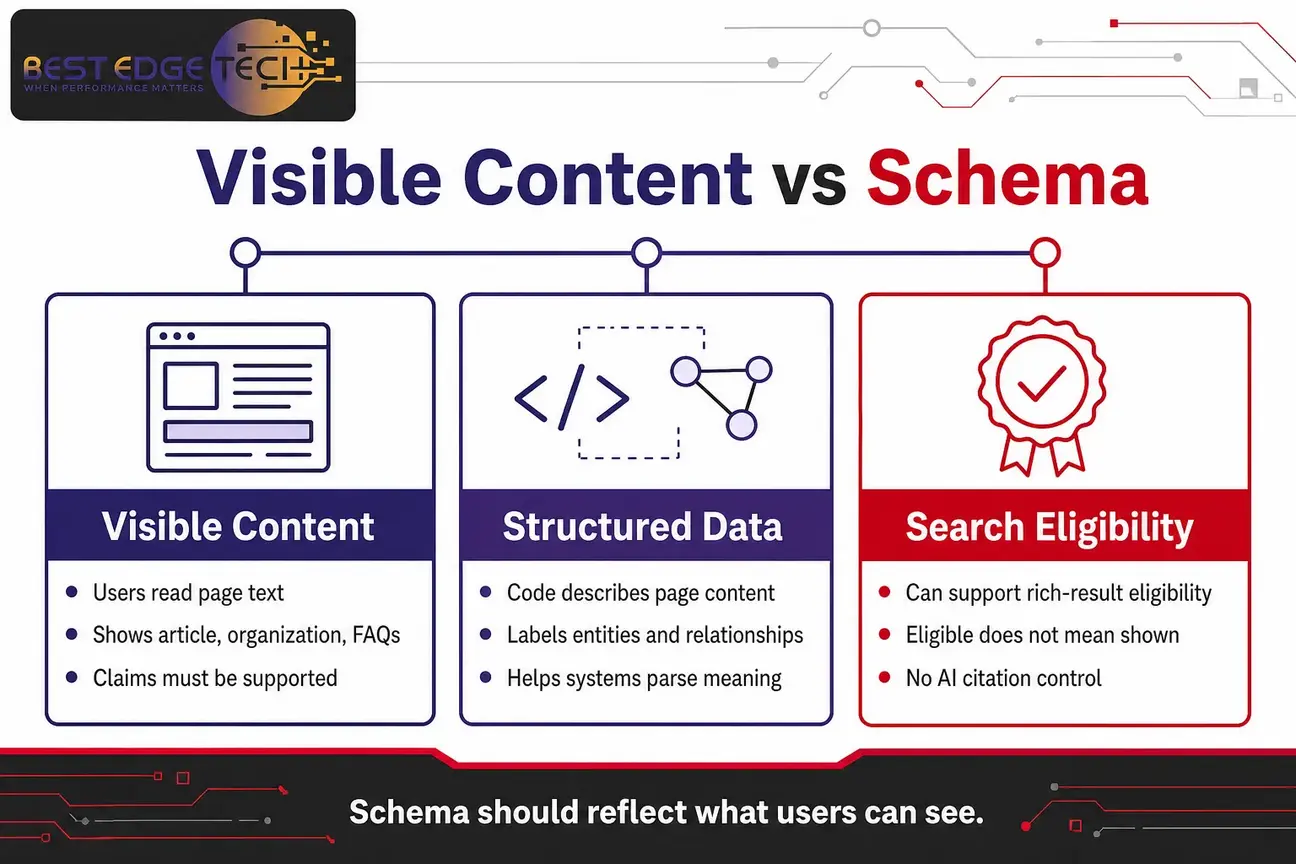
Structured data is code that describes page content in a format search systems can process. Instead of leaving every relationship to be inferred from visible text, it can label a page as an article, identify an organization, describe a breadcrumb trail, or mark up visible questions and answers. Google’s intro to structured data markup explains that structured data helps Google understand information on a page and can make a page eligible for certain search result features.
That word eligible matters. Structured data can help search systems understand what is on the page. It can help connect entities, attributes, and page types. It can also support eligibility for supported rich-result features when the page and markup meet the relevant requirements. It does not, by itself, create rankings, force a rich result, or make an AI system cite the page.
A clean way to think about schema is: context, not control. The markup gives machines a structured description of what users can already see. If the content is thin, blocked from crawling, not indexed, or inconsistent with the markup, schema will not rescue it. If the markup makes claims the page does not visibly support, it can create policy problems instead of search value.
Schema markup AI expectations: context, not control
The phrase schema markup AI often gets used as if adding code is a shortcut to AI answers. That is not a safe assumption. The practical use of schema markup AI work is to make important entities and relationships easier to parse, not to control what a generative system says.
For example, an article page can use article-like markup to identify the headline, page type, and organization author when those details are accurate. A service-area business can use organization-level information to clarify its public identity. A page with visible questions and answers can use FAQPage schema to describe those same questions and answers. None of those implementations proves that the page will be selected as an AI source.
Schema markup AI projects should therefore start with visible content. If the page does not clearly answer the user’s question, explain the business entity, or support the stated claim, the markup has little useful work to do. The code should confirm and organize what the page already communicates.
How structured data AI search fits Google’s documented AI features
As of 2026, Google’s documentation for AI features focuses on the same search fundamentals that apply beyond AI: the page must be eligible for Google Search, accessible to Google, and suitable to show with a snippet. Google’s AI Features and Your Website documentation states that a page must be indexed and eligible to appear with a snippet to be eligible as a supporting link in AI Overviews or AI Mode, and that meeting requirements does not ensure crawling, indexing, serving, or display.
That means schema is not the entry ticket for AI Overviews or AI Mode. Indexing and snippet eligibility come first. A blocked page, a noindexed page, a page hidden behind login, or a page with weak visible content will not become a reliable AI-search candidate because a plugin added JSON-LD.
Structured data can still be useful in the broader search system. It can clarify the page type, entity, and relationships. But for AI search, Google’s documented position is not “add special schema.” It is closer to “make your site accessible, useful, eligible for Search, and consistent with policies.”
AI Overviews schema myths to avoid
The most common AI Overviews schema myth is that there is a hidden schema type that makes a page more likely to be cited. Google does not document a special AI Overviews schema type. If a vendor claims that a specific AI Overviews schema implementation will cause inclusion, citations, or supporting links, treat that as an unsupported claim unless the platform itself documents it.
Another myth is that every paragraph needs its own markup so an AI system can “extract” it. Google’s current guidance does not require chunking a page into AI-specific schema blocks. If the content is clear, crawlable, indexable, and well organized, normal SEO and structured-data best practices are the safer baseline.
A third myth is that validation equals visibility. A page can pass schema validation and still never appear in an AI Overview, AI Mode response, or rich result. Validation means the markup can be parsed and may meet relevant requirements. It does not prove that Google will display a feature or that any AI system will cite the page.
What Google documents about generative AI and schema
Google’s guide to optimizing for generative AI features on Google Search says structured data is not required for generative AI search and that there is no special schema.org markup to add. The same guidance says site owners can continue using structured data as part of a broader SEO strategy, where it accurately represents page content.
That is the key distinction for business websites. Schema can support interpretation, but it is not a separate AI feed. It is not a command file for AI Overviews, AI Mode, ChatGPT, Perplexity, Gemini, Copilot, or any other answer system. Where platform behavior is not documented, it should be described as observation or technical inference, not fact.
For Google AI features, the documented baseline is straightforward: make content helpful, reliable, people-first, technically accessible, and eligible for Search. For other AI products, public documentation varies by platform. Because those systems do not all publish the same retrieval, citation, or ranking details, it is not accurate to claim that structured data directly causes citations across AI platforms.
This is why Best Edge Tech treats schema as one part of AI SEO and GEO services, not as a standalone shortcut. Generative Engine Optimization and Answer Engine Optimization depend on content quality, entity clarity, crawlable technical foundations, and measurement discipline. Schema supports that work when it is accurate.
Where common schema types fit on a business website
Not every schema type belongs on every page. The right type depends on what the page is, what users can see, and what the business can accurately claim. A service page, blog article, FAQ section, local landing page, and homepage do not all need the same markup.
The following use cases are practical starting points. They are not promises of rankings, rich results, or AI citations.
Organization schema for identity clarity
Organization markup is generally used to describe the business entity behind a website. It can identify the organization name, official website, logo, and contact information where appropriate. For some sites, it can also connect accurate public profiles or relationships, but those references should be used only when they are current and approved.
For AI search and traditional search, organization-level clarity matters because inconsistent identity signals can confuse users and systems. If the site footer, contact page, schema, and business listings all describe different names, locations, or services, the structured data is not solving the underlying problem. It may be exposing it.
For Best Edge Tech content, the safe implementation principle is accuracy over expansion. The agency may be described as North Carolina-based, but this article does not publish an unverified street address or create a LocalBusiness or Place node with unsupported address details. Other businesses should apply the same rule: mark up what is accurate, public-facing, and supported by the visible site.
Article schema for educational content
Article-like markup can describe an educational blog post or resource page. Typical fields can include the headline, description, page URL, image when available, and accurate authorship information. On business blogs, the author may be an organization when that is the approved and accurate attribution.
Article markup can help clarify what the page is, but it does not make the article more persuasive to users. The visible page still needs a clear title, concise structure, accurate information, and useful examples. If the article claims expertise, results, dates, or credentials that are not supported, structured data should not be used to amplify those claims.
In schema markup AI planning, Article schema should be treated as descriptive metadata. It can help organize information about the page. It should not be reported as a cause of AI citations or ranking movement.
Breadcrumb schema for hierarchy and internal structure
Breadcrumb markup describes where a page sits in the site hierarchy. It can help search systems understand relationships between a blog post, category, service hub, or parent page. It should match the visible breadcrumb trail and actual URL structure.
Breadcrumbs are especially useful on larger sites, healthcare practice sites with multiple service lines, law firm sites with several practice areas, and agencies managing many client templates. If the visible breadcrumb says one thing and the markup says another, fix the navigation first. The markup should reflect the real structure, not a preferred structure that users cannot see.
Breadcrumb implementation also ties into internal linking. A breadcrumb trail is not a replacement for contextual links in the body. If a topic depends on related resources, link them naturally so users and crawlers can follow the relationship.
FAQPage schema: useful only when users see the answers
FAQPage schema is appropriate only when the page visibly contains the marked-up questions and answers. If the FAQ section is not present on the page, do not mark it up. If the answer in the schema is different from the answer users see, correct the mismatch before deployment.
FAQPage schema can be useful for clarity because it labels a specific question-and-answer section. It can also help with eligibility where Google supports a relevant feature. It does not ensure that a visible FAQ rich result will appear, and it does not ensure AI answer inclusion.
For regulated or sensitive industries, including healthcare and law firm marketing, FAQPage schema deserves extra care. The visible answer and the marked-up answer should be accurate, restrained, and reviewed under the business’s own advertising, privacy, and compliance requirements. This article provides marketing and search guidance only, not legal, medical, HIPAA, or regulatory advice.
LocalBusiness schema for public-facing local details
LocalBusiness markup can describe a business location when the details are accurate, appropriate, and public-facing. It should not be used to invent a public office, stuff location keywords, or publish an address that does not accurately represent how the business serves customers.
For service-area businesses, local schema decisions need care. The website, business profile, contact page, and structured data should not conflict. If a business serves clients remotely or by appointment, the markup should not imply a walk-in storefront unless that is true and supported by the business’s public information.
LocalBusiness markup also should not be described as a local ranking lever. The supplied official sources do not establish that LocalBusiness schema directly improves local rankings. It is better to describe it as identity and context markup that must align with visible and public-facing business details.
Schema validation before and after deployment
Schema validation is quality control. It helps confirm that the code parses, the selected type is supported where applicable, and required or recommended fields are not missing for a specific search feature. It does not prove that a page will rank, receive a rich result, or appear in AI answers.
If you are auditing an existing implementation, start with a structured process rather than checking random pages. Best Edge Tech’s schema markup audit guide is a useful companion for identifying overlapping plugins, template conflicts, stale values, and mismatches between markup and visible content.
A practical schema validation checklist
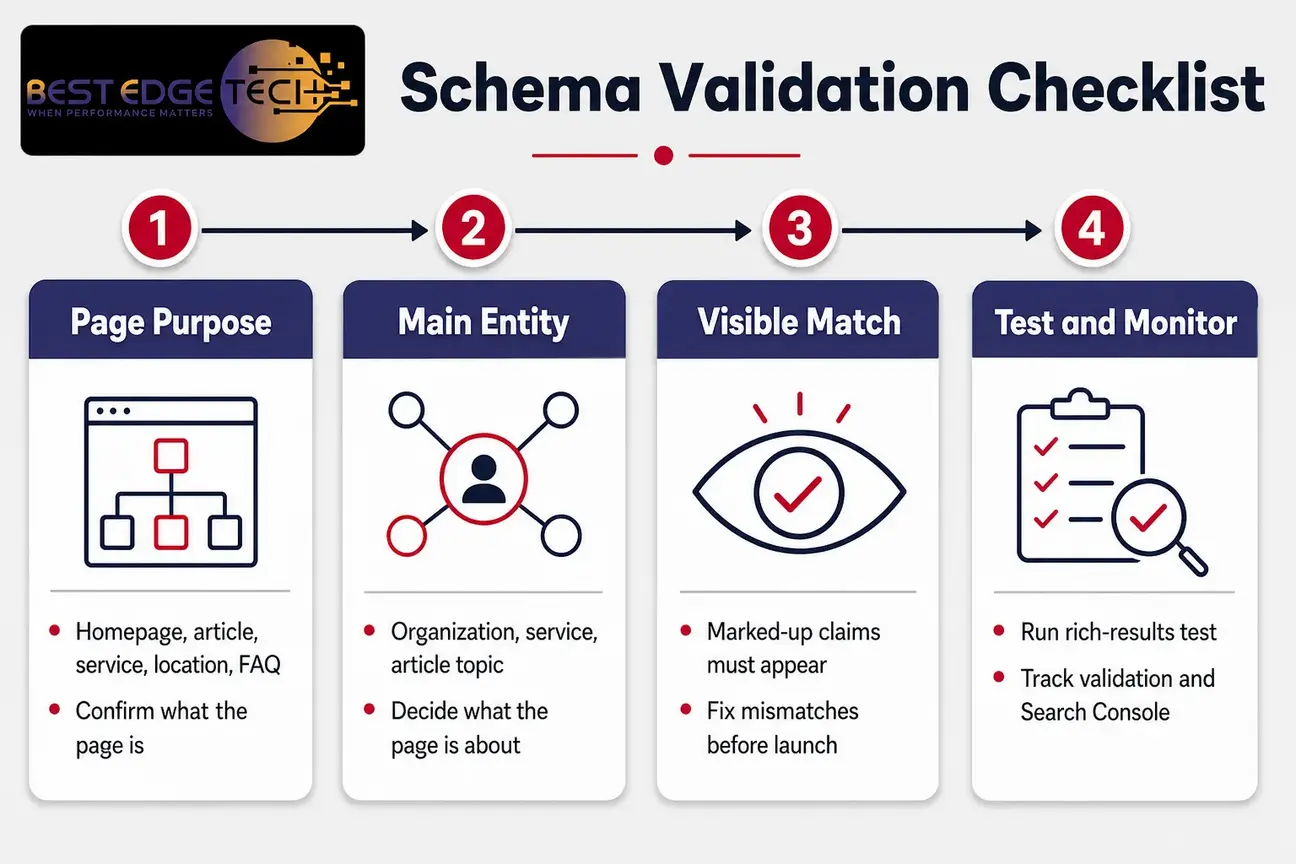
- Identify the page purpose. Confirm whether the page is a homepage, article, service page, location page, FAQ resource, or another type.
- Identify the main entity. Decide what the page is primarily about: the organization, a service, an article topic, a local practice, or a specific resource.
- Match markup to visible text. Every marked-up claim should be visible or clearly supported on the page.
- Check the selected type. Use a type that actually fits the page instead of adding every possible schema type.
- Review required and recommended properties. Where a search feature has specific requirements, confirm that the implementation follows them.
- Run a rich-results test before launch. Treat the result as a technical and eligibility check, not as a visibility forecast.
- Inspect the live URL after launch. Confirm that the deployed page is accessible, indexable, and not blocked.
- Monitor Search Console reports. Template updates and plugin changes can create new structured-data issues after a page goes live.
- Remove stale markup. Do not keep outdated offers, people, addresses, reviews, FAQs, or services in the code after the visible page changes.
- Document the change. Record what changed, when it changed, and what outcome you are watching so later reporting does not overstate causation.
Schema validation is not AI visibility tracking
Schema validation and AI visibility tracking are different jobs. A valid schema item tells you something about implementation quality. It does not tell you whether Google displayed the page in AI Overviews, whether AI Mode used it as a supporting link, or whether another AI product cited it.
For that reason, schema validation should be tracked beside, not inside, AI performance reporting. Keep a record of schema errors, rich-result eligibility, index coverage, Search performance, and AI visibility observations as separate lines. If multiple changes happen at once, do not attribute a visibility change to schema alone without stronger evidence.
Businesses that need a broader technical baseline can connect schema checks with SEO audit services. Scope depends on site size, templates, content volume, technical debt, and the number of markets or locations involved. Pricing and outcomes should not be assumed from the presence of schema errors alone.
Structured data policies that matter before deployment
Google’s general structured data guidelines make the policy side clear: structured data should represent the page content and comply with applicable Search policies and feature-specific guidance to be eligible for rich-result appearance. Compliance supports eligibility; it does not ensure appearance.
The most common structured data policies problems are not advanced technical errors. They are ordinary accuracy problems. The code says one thing, the page says another, and the business cannot support the claim. That can happen when plugins auto-generate markup, old templates keep outdated fields, or marketing teams add schema before confirming visible page content.
Common structured data policies failures to fix
- Hidden claims: the schema includes ratings, prices, dates, services, questions, or locations that users cannot see on the page.
- Unsupported identity details: organization or local-business markup uses a name, address, phone number, logo, or profile reference that conflicts with the visible site.
- Wrong entity: the page describes one service or business unit, while the markup describes another.
- FAQ mismatches: FAQPage schema includes answers that are absent, rewritten, exaggerated, or different from the visible FAQ.
- Plugin duplication: multiple SEO, review, event, or ecommerce plugins generate overlapping schema that describes the same page in conflicting ways.
- Stale template data: old dates, authors, services, or locations remain in JSON-LD after a redesign or content update.
- Spam-policy conflicts: structured data is used to promote misleading, irrelevant, or policy-violating content.
Structured data policies should be part of the publishing workflow, not an afterthought. Before publishing, ask whether the marked-up details are accurate, visible, current, and necessary. If the answer is no, remove or revise the markup.
Eligibility is not appearance
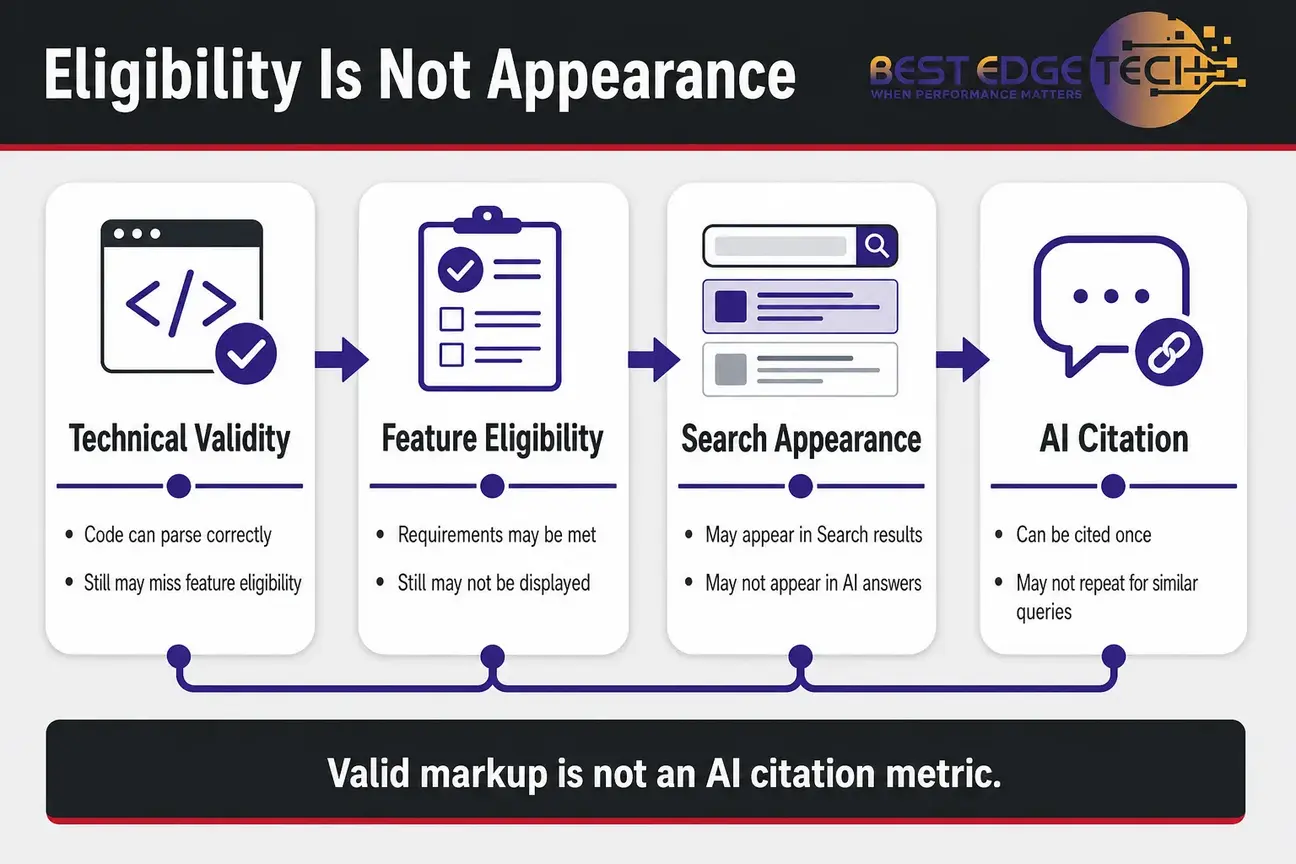
Many reporting mistakes come from treating every step in the search pipeline as the same outcome. They are not the same. A page can be technically valid but not eligible for a specific feature. It can be eligible but not displayed. It can appear in Search without appearing in an AI answer. It can be cited once and then not cited again for similar-looking queries.
| Stage | What structured data may support | What it cannot promise |
|---|---|---|
| Understanding | Clarifies entities, page type, relationships, and attributes | Perfect interpretation by every system |
| Eligibility | May support eligibility for applicable rich-result features | Eligibility for AI Overviews or AI Mode by itself |
| Retrieval | Provides additional machine-readable context | Selection as an AI source |
| Display | May support a qualifying Search enhancement | A rich result, AI Overview, or AI Mode appearance |
| Citation | Can describe the page and its entities | A citation, link, ranking, or recommendation |
This distinction is especially important when executives or clients ask, “Did schema improve AI search?” The honest answer may be: schema quality improved, eligibility improved for certain Search features, and AI visibility changed over time. That is not the same as proving schema caused the AI outcome.
How to measure the effect without overclaiming
Measurement should separate implementation quality from visibility. Start by recording what was changed: schema type, page template, fields added or removed, validation status, and whether visible content changed at the same time. Then track search and AI-related visibility separately.
For Google AI features, the Search Console Generative AI performance report is the appropriate Google-provided reporting reference where it is available. It should not be interpreted as proof that schema caused an AI appearance. It can help measure performance in Google’s generative AI surfaces, while schema validation measures markup implementation.
A practical measurement setup might include:
- Indexing status for the affected URLs.
- Structured-data validity and rich-result eligibility where applicable.
- Search performance for relevant queries and pages.
- Generative AI performance reporting where available.
- Manual observations of AI answers, recorded with query, date, location context, and limitations.
- Notes about content updates, internal links, technical fixes, template changes, and market changes.
If a page starts appearing more often after a schema fix, that is worth investigating. It is not enough evidence to claim that schema caused the visibility change. Crawling, indexing, content quality, internal linking, query demand, competition, and platform updates may also be involved.
For teams that need a repeatable measurement plan, AI search visibility tracking should be handled separately from schema QA. Valid markup is a technical signal to monitor; AI citations and supporting links are visibility outcomes to observe with caution.
The Context Eligibility Appearance framework
Use the Context Eligibility Appearance framework when deciding whether schema work is worth doing and how to report it. It keeps the conversation grounded and prevents the common jump from “valid markup” to “AI visibility improved because of schema.”
Context
Ask whether the markup accurately describes the page and entity. Does the page clearly state the business name, service, article topic, location information, or FAQ content being marked up? If the visible page is unclear, fix the content before relying on schema.
This is where schema markup AI work can provide real value. It forces the team to define what the page is about, which entity it represents, and whether the site’s visible identity is consistent. If the markup cannot be written without stretching the facts, the page probably needs editorial or business-data cleanup first.
Eligibility
Ask whether the implementation meets applicable technical and policy requirements. Does the code parse? Are required fields present for the targeted feature? Do structured data policies allow the implementation? Does the markup match the page users see?
Eligibility is still conditional. A page may meet the requirements for a supported feature and still not receive that feature in search results. That is why reports should use words like “eligible,” “valid,” and “detected” carefully.
Appearance
Ask whether Google or another platform actually displayed the feature, supporting link, or answer. This is where Search Console, Search performance data, generative AI reporting, and documented observations matter. Appearance is an outcome, not a property of the code.
If the appearance changes, document other changes that happened at the same time. A schema update launched alongside a content rewrite, internal linking pass, sitemap cleanup, and technical crawl fix cannot be credited as the sole cause without stronger evidence.
Attribution
Ask whether there is evidence that the markup itself caused the outcome. In ordinary SEO reporting, the answer is usually no. You can say schema errors were fixed, eligibility improved, and visibility changed. You should not say schema caused an AI citation unless the platform documentation and the evidence support that claim.
Five practical safe rules for schema and AI search
Use these five rules to keep structured data work useful without overstating what it can do.
Rule 1: Mark up what users can verify
If a user cannot see or verify the claim on the page, do not put it in the markup. This rule applies to FAQPage schema, organization details, local information, authorship, ratings, service claims, and dates. Visible content comes first.
Rule 2: Do not create AI-only schema
As of 2026, Google does not document a special AI schema requirement for AI Overviews or AI Mode. AI Overviews schema language should therefore be treated as a planning shorthand, not as an actual special schema type. Use established markup only when it fits the page.
Rule 3: Keep business identity consistent
Organization, LocalBusiness, contact, and author information should align with the public website. If a business recently changed branding, locations, phone numbers, or service lines, update the visible site and the markup together.
Rule 4: Validate templates, not just sample pages
Schema validation on one URL does not prove that every template is clean. Category templates, blog posts, service pages, location pages, and FAQ sections may each generate different markup. Recheck after plugin changes, redesigns, CMS updates, and content migrations.
Rule 5: Report eligibility separately from AI visibility
A valid schema item is not an AI citation metric. Keep structured-data status, Search visibility, and AI visibility in separate reporting lines. This protects the team from overstating results and makes future troubleshooting easier.
When a schema audit is worthwhile
A schema audit is worthwhile when the site has changed, the business identity has changed, or Search Console reports structured-data issues. It is also useful before measuring AI search visibility because it gives the team a cleaner technical baseline.
Consider an audit when:
- A redesign, migration, or CMS change affected templates.
- Multiple plugins or custom scripts generate overlapping JSON-LD.
- Search Console reports structured-data errors or warnings.
- Business names, services, locations, phone numbers, or authorship details changed.
- FAQ sections were added, removed, or rewritten.
- The site is preparing a broader AI search readiness project.
- Pages appear in Search inconsistently and the team needs to separate technical issues from content issues.
A schema audit should not be sold or reported as a path to promised rankings or AI citations. It is a technical and content-alignment check. For businesses planning broader AI-search work, an AI search readiness audit can connect schema, indexing, content quality, entity consistency, and measurement into one baseline.
How website owners should prioritize schema work
If your site has crawl blocks, accidental noindex tags, thin service pages, outdated business information, or weak internal linking, fix those issues before spending time on advanced markup. Schema helps most when the underlying content and technical foundation are already coherent.
A practical priority order looks like this:
- Confirm that important pages are crawlable and indexable.
- Make the visible content clear, accurate, and useful for the intended audience.
- Clean up inconsistent business identity, contact, service, and location information.
- Add or refine structured data that accurately describes the page.
- Validate the markup and monitor Search Console.
- Track Search and AI visibility separately over time.
For a healthcare practice, that might mean clarifying services, provider attribution, locations, and patient-facing FAQs before adding FAQPage schema. For a law firm, it might mean making practice-area pages clearer and confirming advertising rules with counsel before marking up sensitive claims. For an agency, it might mean documenting schema templates and quality checks before scaling work across client sites.
If you want help deciding where schema fits in a larger AI search plan, you can contact Best Edge Tech or call 252-303-0074. Share your website URL, goals, markets served, recent site changes, current Search Console access if available, and whether you are considering AI SEO, a schema audit, or a broader technical SEO review.
Conclusion: structured data AI search is useful context, not an AI citation switch
For structured data AI search, the strongest use case is honest context. Structured data gives search systems a clearer, machine-readable description of page content and entities. It can support eligibility for applicable Search features when the page and markup meet the relevant requirements. It also helps teams maintain a cleaner technical baseline as websites grow.
But structured data is not an AI-ranking switch, an automatic rich-result trigger, or a citation-control mechanism. Google states that no special schema.org markup is required for its generative AI features, and no agency can promise AI citations. The safest strategy is to make content helpful, crawlable, indexable, accurate, and policy-compliant, then use schema to describe that content honestly.
Search engines and AI products change often. Check current platform documentation before acting, and treat any result as dependent on your site, market and competition.
Frequently Asked Questions
Does structured data improve AI Overviews?
Structured data is not required for Google AI Overviews. It can help describe page content, but Google does not document special AI schema, and valid markup does not ensure inclusion or a supporting link.
Is there special schema for Google AI Mode?
Google’s current guidance says no special schema.org structured data is needed for its generative AI features. Use structured data where it accurately describes visible page content, not as an AI Mode control.
Can schema markup cause an AI citation?
No authoritative source in the reviewed material establishes that structured data causes AI citations. It is safer to describe schema as machine-readable context, not as a citation-control mechanism.
Does valid schema ensure a rich result?
No. Validation and policy compliance can support eligibility, but eligibility is not the same as appearance. Google may choose not to show a rich result even when markup is valid.
What happens if schema does not match visible text?
The implementation conflicts with Google’s structured-data guidance. The page may lose eligibility for applicable Search features, and the mismatch should be corrected before relying on the markup.
Should every business add LocalBusiness schema?
No. LocalBusiness markup should be used only when it accurately represents the business and its public-facing details. Businesses should not publish inaccurate, unsupported, or inappropriate address information.
Is FAQPage schema still useful?
FAQPage schema can accurately describe visible question-and-answer content, but it does not ensure a displayed FAQ rich result or AI answer inclusion. The marked-up questions and answers must match what users see.
How should structured data be tested?
Test markup before launch, inspect the live URL after deployment, and monitor Search Console status reports for errors or template changes. Treat testing as quality control, not as a promise of visibility.
Sources
- Google Search Central: AI Features and Your Website
- Google Search Central: Optimizing your website for generative AI features on Google Search
- Google Search Central: Intro to How Structured Data Markup Works
- Google Search Central: General Structured Data Guidelines
- Google Search Console Help: Generative AI performance report