
How to Use Organization Structured Data for Trust Signals
Organization structured data helps search engines understand which organization a website represents, what name and logo identify it, how users can contact it, and which external profiles may help disambiguate it. It is not a ranking shortcut, a trust badge, or an instruction that Google, Bing, ChatGPT, or any AI system must display or recommend the business. The practical goal is simple: make the organization’s machine-readable identity match the visible website, then validate it and monitor it when templates, branding, or contact details change.
Quick Answer
Use organization structured data to clarify your business identity with accurate, visible, consistent details such as name, URL, logo, description, contact information, and appropriate sameAs references. Schema.org’s Organization type provides a structured way to describe an organization, but markup by itself does not promise rankings, traffic, rich results, AI citations, or qualified leads.
For business owners, the safest approach is to treat schema as a technical trust layer, not as a marketing claims field. If a claim is not visible on the page, not verified, or not appropriate to publish, it should not be added to the markup.
What organization structured data clarifies for search systems
Structured data is machine-readable information added to a page so search systems can interpret specific facts about the page and the entity it represents. For an organization, that entity is the business, practice, firm, nonprofit, agency, or other institution behind the website.
In plain language, Organization schema says, “This website represents this organization, using this name, this logo, this web address, and these public contact details.” That matters because many businesses have similar names, rebrands, parent brands, service lines, locations, founder pages, and social profiles that can confuse entity recognition.
Schema.org’s Organization type provides vocabulary for describing organizations such as companies, schools, nonprofits, and other institutions. That is a useful, limited purpose. It helps clarify identity; it does not replace helpful content, technical crawlability, strong navigation, accurate public information, or real-world reputation signals.
This is where schema trust signals should be understood carefully. Schema can support trust by reducing ambiguity, but it cannot create trust by itself. If a page claims one name in the header, another in the footer, a different phone number on the contact page, and a different business description in JSON-LD, the markup may create more confusion instead of clarity.
For healthcare practices, law firms, service businesses, and agencies, the distinction is important. Business schema markup should identify the organization, not inflate it. Do not use schema to add credentials, awards, affiliations, ratings, offices, prices, or outcomes that are not verified and visible where users can evaluate them.
Organization schema properties that matter most
Organization schema has flexible properties. That does not mean every possible property belongs on every site. It means the markup should be selective, accurate, and aligned with visible content.
Use this checklist as a practical starting point for business schema markup:
| Property | What it should clarify | Common risk to avoid |
|---|---|---|
| name | The public organization name users see on the website | Using an old, legal, abbreviated, or keyword-stuffed name inconsistently |
| url | The canonical website URL for the organization | Pointing to a staging site, redirect chain, or unrelated property |
| logo | The logo that represents the organization | Referencing an outdated, broken, low-quality, or hidden file |
| description | A concise description that matches the visible site | Adding unsupported superlatives, service claims, or inflated credentials |
| telephone | A current public phone number, if published | Using tracking numbers or old numbers without visible consistency |
| A current public email, if published | Adding private or unmanaged addresses | |
| contactPoint | A specific way users can contact the organization | Claiming support channels, hours, or departments that are not real |
| sameAs | External pages that genuinely identify the organization | Adding weak, unverified, or confusing references |
| address | A publishable, accurate address only when appropriate | Publishing a non-customer-facing or unverified street address |
The strongest Organization schema implementations are usually boring. They use the same name users see in the header and footer. They point to the canonical website. They reference the actual logo. They use public contact details that appear on the site. They describe the business in the same terms the page uses.
For Best Edge Tech, the client-approved public name is Best Edge Tech. The safe schema approach is to use the public brand name and approved contact details only where they are appropriate, without adding unverified legal names, street addresses, offices, ratings, awards, partnerships, or campaign results.
The same discipline applies to any business. A clinic should not use Organization schema to imply clinical credentials that are not visible and verified. A law firm should not use it to imply legal outcomes. An agency should not use it to imply partnerships, certifications, pricing, or performance results that are not confirmed and visible.
How sameAs supports schema trust signals
The sameAs property is often misunderstood. In Organization schema, it is not a place to dump every profile, directory listing, review page, or social account that mentions the brand. It should point to relevant external pages that contain additional information about the organization and genuinely represent it.
Schema.org’s sameAs property describes a URL of a reference web page that indicates the item’s identity. That makes it useful for entity disambiguation when the referenced page is stable, accurate, and clearly about the same organization.
Good sameAs judgment starts with identity. Ask whether the external page helps a search system or user confirm that this organization is the same entity described on the website. A verified official profile may help. A random scraper page, outdated directory, incomplete profile, or review page with uncertain ownership may create ambiguity.
sameAs should not be used to imply awards, affiliations, certifications, partnerships, office locations, or professional credentials unless those claims are verified, current, and visible in an appropriate context. The URL itself can carry meaning. If a business links to a partner page or credential profile in schema, readers and search systems may infer a relationship. Do not invite that inference unless it is accurate.
Be careful with founder, team, and personal profiles. A founder’s profile can be important context on an About page, but it is not automatically the same entity as the organization. If a business adds a person’s page as sameAs for the organization, it may blur the distinction between the company and the person. In most business schema markup, separate organization identity from person identity unless there is a clear, documented reason to connect them.
For agencies serving clients behind the scenes, including white-label SEO for agencies, sameAs discipline is especially important. The goal is to identify the agency’s own entity, not expose client relationships, imply endorsements, or create unsupported affiliations.
Why visible content must match business schema markup
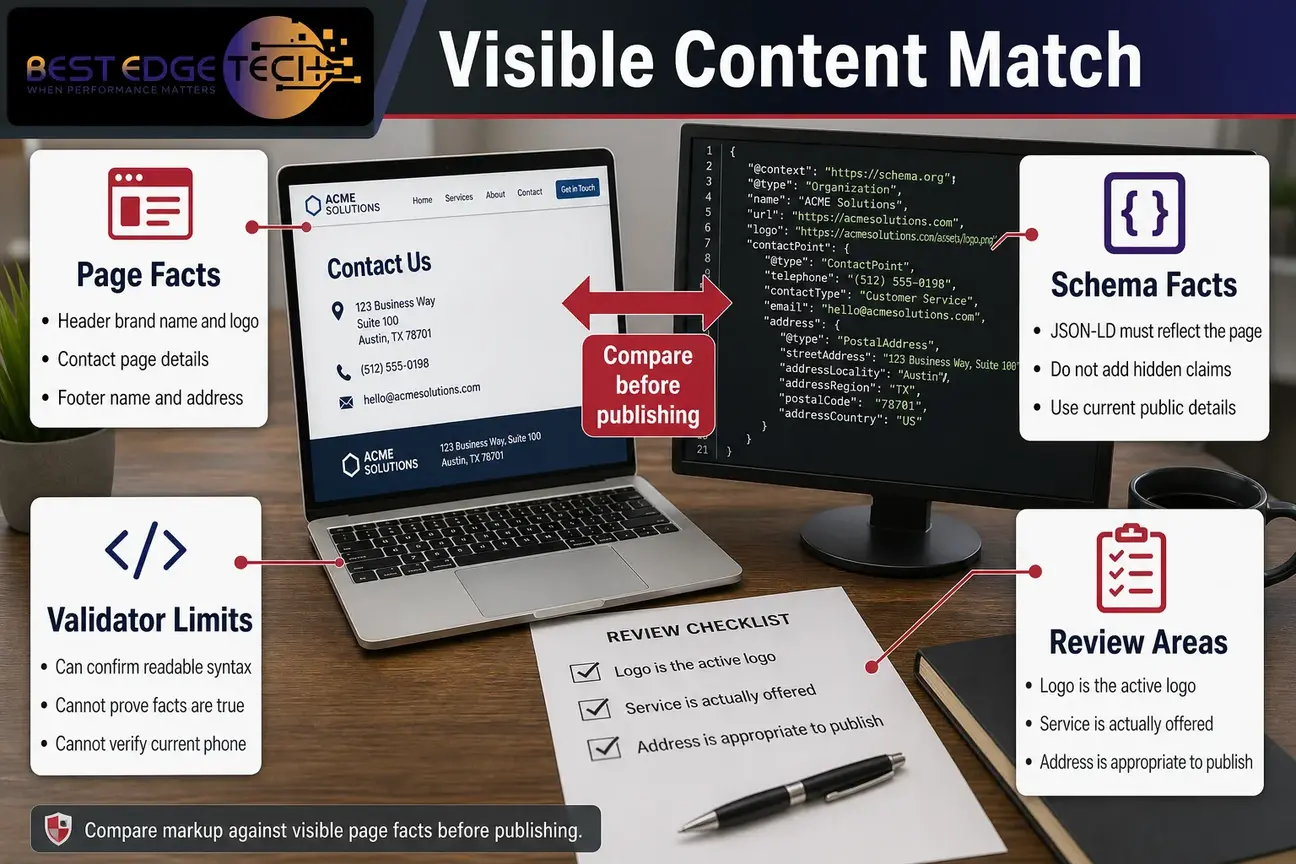
Schema is not a hidden claims layer. Google’s general structured data policies warn against misleading or irrelevant structured data. If users cannot see or verify the information on the page, do not assume it belongs in JSON-LD.
This is one of the most common schema trust signals problems. The JSON-LD may validate technically while still being strategically wrong. A validator can tell you whether the syntax is readable. It cannot confirm that the phone number is current, the logo is the active logo, the claimed service is actually offered, or the address should be published.
A practical visible-content review should compare the markup against these areas:
- The header brand name and logo
- The footer name, phone number, email, and hours
- The About page business description
- The Contact page and any quote-request flow
- Service pages and navigation labels
- Public location language
- External profiles used in sameAs
- Any schema added by SEO plugins, themes, page builders, or custom code
Inconsistent details can happen after a rebrand, redesign, migration, plugin change, or staff turnover. A website may show the current brand visually but still output old schema from a theme setting. A footer may show a new phone number while a plugin emits an old one. A page builder may create duplicate Organization nodes with different URLs.
That is why structured data validation should include both machine checks and human review. For example, a North Carolina-based remote-service agency can mention that it serves Raleigh and the Triangle when appropriate, but the schema should not invent a public storefront, branch, headquarters, or street address if that disclosure is not approved and visible.
For professional-service sites, this visible-content requirement protects more than SEO. Healthcare practices and law firms should keep marketing claims, credentials, reviews, locations, and contact details aligned with their own internal review processes. This article is marketing and technical guidance only, not legal, medical, HIPAA, or regulatory advice.
Does Organization schema improve rankings or AI answers?
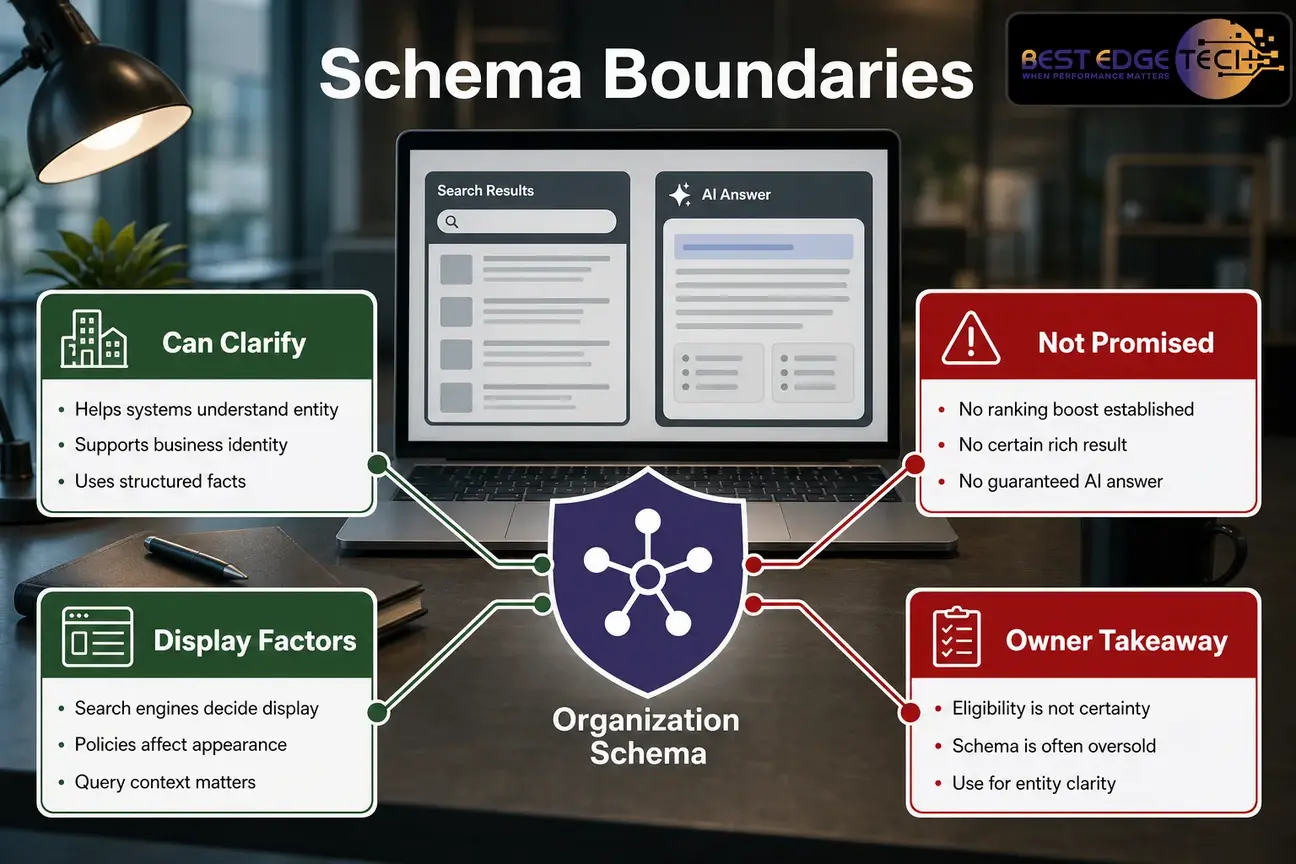
Organization schema can help search systems understand the business entity, but the official documentation cited here does not establish a ranking boost. It also does not promise a knowledge panel, logo display, sitelinks, rich result, AI Overview appearance, ChatGPT recommendation, or inclusion in any AI answer.
Google’s introduction to structured data explains that structured data can make pages eligible for enhanced appearances in search, but eligibility is not the same as a certain display. Search engines decide what to show based on many systems, policies, query contexts, and page-level signals.
That matters for business owners because schema is often oversold. Organization schema is not a substitute for crawlable pages, helpful content, clear internal links, accurate service information, local trust signals, strong site architecture, or an indexable website. It is one technical input in a broader search visibility system.
The same caution applies to AI answers. As of 2026, platform documentation does not support a blanket claim that Organization markup forces AI systems to cite, summarize, or recommend a business. Google provides documentation about AI features and websites, but businesses should avoid treating any single markup field as a control lever for AI inclusion.
For teams working on answer engine optimization, or AEO, and generative engine optimization, or GEO, the better goal is clarity across the whole web presence. Structured data can support that work by making the website’s entity information cleaner. It still needs to be paired with useful content, consistent public facts, crawlable pages, and realistic measurement. Best Edge Tech discusses that broader context in its AI SEO and GEO services.
If a vendor says schema alone will produce rankings, leads, or AI citations, slow down. Results depend on competition, site history, content quality, technical execution, and the way search systems choose to present results. Nobody should promise a fixed outcome from adding Organization schema.
Schema types this content pipeline should avoid
Choosing the correct schema type is as important as filling out the properties. The wrong type can create misleading signals even when the syntax validates. For this article and Best Edge Tech’s content pipeline, the safe implementation boundary is narrow: use Organization where it accurately represents the agency’s site-level identity, and use BlogPosting for the article itself.
The table below separates appropriate use from unsupported or prohibited implementations.
| Type | Pipeline decision | Reason |
|---|---|---|
| Organization | Use where it accurately represents the agency | Appropriate for site-level identity and administrative details |
| Review | Do not use | No approved review content or verified dataset is supplied for this article |
| AggregateRating | Do not use | No approved rating evidence; avoid unsupported ratings |
| Product | Do not use | This article is not a product page |
| Offer | Do not use | No approved prices, packages, discounts, or offer data are published for this topic |
| LocalBusiness | Do not use for this pipeline | Client rules prohibit street-address and public-office implementations here |
| Place with a street address | Do not use | A street address is not approved for publication in this article |
| BlogPosting | Appropriate for the article itself | Approved post-level schema type for blog articles |
| FAQPage | Use only if visible FAQ content is published | FAQ schema must match the visible FAQ content word for word |
A genuine user review is not the same thing as Organization schema. Review markup should not be added just because a business has testimonials somewhere on the web. AggregateRating should not be added unless there is valid, visible, policy-compliant rating evidence and an approved implementation. For this client pipeline, those objects are prohibited.
Product and Offer markup are also wrong for this article. SEO services, audits, and website strategy discussions should not be marked up as a product or offer unless the page genuinely qualifies and the visible page includes the necessary information. Do not add prices, packages, discounts, inventory, availability, or product ratings when those details are not approved and visible.
LocalBusiness and Place deserve special caution. Some businesses do have customer-facing locations where LocalBusiness markup can be appropriate. This article should not imply that Best Edge Tech has a public storefront, branch, headquarters, or street-address location. The approved language is that Best Edge Tech is North Carolina-based and serves clients remotely across North Carolina and the United States.
Structured data validation without false confidence
Structured data validation is necessary, but it is not enough. A clean test can show that markup is parseable, but it cannot prove that the details are true, visible, current, or strategically appropriate.
In practice, teams should test the rendered page so they can see the markup that search systems may encounter after templates, plugins, and scripts run. Use testing tools as a quality-control step, but understand what they are and are not telling you.
Testing can help identify syntax issues, eligibility signals, and many technical errors. It does not promise rankings, search appearance, AI visibility, or business accuracy.
A reliable structured data validation process should include:
- Testing the rendered page, not only the source code.
- Checking whether the Organization node appears once or multiple times.
- Confirming that name, URL, logo, phone, email, and description match visible content.
- Reviewing sameAs URLs for ownership, relevance, and accuracy.
- Checking whether a plugin, theme, or custom script adds duplicate or conflicting schema.
- Using URL inspection after deployment when appropriate.
- Rechecking after redesigns, migrations, template changes, plugin updates, and rebrands.
Structured data validation should be part of a broader SEO analysis. If the markup is correct but important pages are blocked, duplicated, thin, slow, or disconnected from the site architecture, schema will not solve the underlying problem.
For marketing leads, the practical question is not “Does the schema validate?” The better question is, “Does the schema accurately reinforce what users and search systems can already confirm from the website?”
What a schema markup audit should check
A schema markup audit should look beyond pass-or-fail validation. It should inventory every structured data node, identify conflicts, compare schema to visible content, and separate useful identity signals from unsupported claims.
For a deeper technical review, Best Edge Tech’s schema markup audit guide is the right internal next step. For Organization-focused work, the audit should check at least the following items:
- Duplicate Organization nodes created by themes, plugins, custom code, or page builders
- Conflicting organization names, URLs, logos, descriptions, or contact details
- Logo references that are broken, outdated, blocked, or inconsistent with the visible site
- Phone numbers or emails that do not match the header, footer, or contact page
- Unapproved addresses or location language that implies a storefront or office
- sameAs URLs that do not clearly represent the organization
- Review, AggregateRating, Product, Offer, LocalBusiness, or Place markup that is unsupported for the page
- Markup that includes claims users cannot verify on the page
- Validation status before deployment and after deployment
- Template-level schema that changes unexpectedly across service pages or blog posts
Business schema markup is often added in multiple places. A WordPress SEO plugin may output Organization schema sitewide. A theme may output its own company schema. A page builder may add article schema. A developer may add custom JSON-LD for a landing page. None of those layers is automatically wrong, but the combined output can become confusing.
The audit should also review whether schema trust signals are supported by the rest of the site. If the About page is vague, the Contact page is incomplete, service pages contradict each other, or the footer has old details, Organization schema can only expose those inconsistencies more clearly.
For agencies managing multiple client sites, a schema markup audit should be built into launch and migration workflows. White-label and fulfillment teams should document which plugin or code layer owns each schema type so future updates do not create duplicates or conflicts.
How Organization schema fits SEO web design and AI visibility
Organization schema performs best when it is built into the website strategy instead of added at the end as a plugin checkbox. The same visible facts that support structured data also support user confidence: clear branding, consistent navigation, reliable contact details, accurate service pages, and sensible conversion paths.
That is why schema belongs in SEO web design, not only in technical SEO cleanup. During a redesign, teams should decide how the business name appears, where the logo is stored, which contact details are public, how services are described, and how schema is generated across templates.
A redesign is also a common moment for schema drift. The old site may use one brand description while the new site uses another. A staging environment may use placeholder contact details. A plugin setting may continue to output old information after launch. Pairing structured data validation with a website redesign SEO checklist can reduce those risks.
For AI search visibility, Organization schema is one part of an entity clarity program. The broader work includes accurate service pages, helpful content, crawlable internal links, consistent public business information, and realistic tracking. Best Edge Tech also covers related local and entity considerations in its page on trust signals and AI rankings, without treating schema as a promised outcome.
Google’s AI features documentation should be checked directly before making AI-search decisions, because AI product behavior and eligibility guidance can change. If a platform has not documented how it uses a particular schema property in AI answers, treat any observed connection as an observation, not a rule.
For a small or mid-sized business, the practical sequence is straightforward: fix visible business information first, align the schema second, validate third, and monitor after changes. That sequence is more reliable than adding broad schema properties to a site with inconsistent facts.
Implementation checklist for business owners and marketing leads
Use this checklist before asking a developer, SEO consultant, or plugin to publish Organization schema.
- Confirm the public name. Use the name customers see across the site. Avoid keyword-stuffed names and unverified legal names.
- Confirm the canonical URL. Use the preferred website URL, not a staging URL, redirecting variation, or unrelated profile.
- Confirm the logo. Use a current logo file that matches the visible brand.
- Write a factual description. Keep it short and aligned with visible page copy.
- Use only public contact details. Add phone, email, and contactPoint only when accurate and visible.
- Review location language. Add an address only when it is accurate, appropriate to publish, and consistent with the page.
- Review sameAs carefully. Use verified external pages that genuinely identify the organization.
- Remove unsupported schema types. Do not add Review, AggregateRating, Product, Offer, LocalBusiness, or Place markup unless the page and client policy support it.
- Validate the rendered page. Use structured data validation tools and manually compare the output with visible content.
- Monitor after changes. Recheck schema after plugin updates, migrations, redesigns, rebrands, and contact-detail changes.
If you are not sure whether your schema supports clarity or creates risk, keep it conservative. A smaller, accurate Organization node is better than a large markup block filled with unsupported properties.
Best Edge Tech can help businesses review structured data as part of practical SEO work. To start a conversation, contact Best Edge Tech with your website URL, goals, markets served, current traffic or Search Console access if available, recent site changes, and the service you are considering. You can also call 252-303-0074.
Final guidance on schema trust signals
The best use of organization structured data is not to say more than the website proves. It is to make the business identity easier to understand by aligning structured data with visible content, real contact details, appropriate sameAs references, and a clean technical implementation.
Organization schema can support entity clarity, but schema trust signals are only trustworthy when they reflect reality. Business owners should avoid unsupported review markup, rating markup, product or offer markup, and location markup that implies facts the website should not publish.
Search engines and AI products change often. Check current platform documentation before acting, and treat any result as dependent on your site, market and competition.
Frequently Asked Questions
Does Organization structured data promise higher rankings?
No. It can describe and disambiguate an organization, but the cited documentation does not promise higher rankings, traffic, leads, or a specific search appearance.
Can Organization schema force inclusion in an AI answer?
No. Do not treat Organization schema as a way to force inclusion in an AI answer. AI systems may change, and platform documentation does not establish that Organization markup forces citation or recommendation.
What should sameAs point to?
sameAs should point to relevant pages on other websites that contain additional information about the organization. Use only verified pages that genuinely represent the organization and do not create confusion.
Should every business add an address to Organization schema?
No. Add an address only when it is accurate, appropriate to publish, and consistent with visible content and disclosure rules. Do not publish an unverified or non-customer-facing street address.
Is a valid schema test enough?
No. Validation can identify technical issues, but the implementation still needs factual review, visible-content consistency, and ongoing monitoring after template, CMS, plugin, branding, or contact-detail changes.
Should an agency use AggregateRating for its own services?
Not without valid, visible, policy-compliant evidence and an approved implementation. For this content pipeline, AggregateRating is prohibited because no approved rating evidence is supplied.
What should a healthcare practice or law firm do differently?
Use only factual, visible organization information and involve the organization’s own legal, medical, or compliance team when needed. This is marketing and technical guidance, not legal, medical, HIPAA, or regulatory advice.