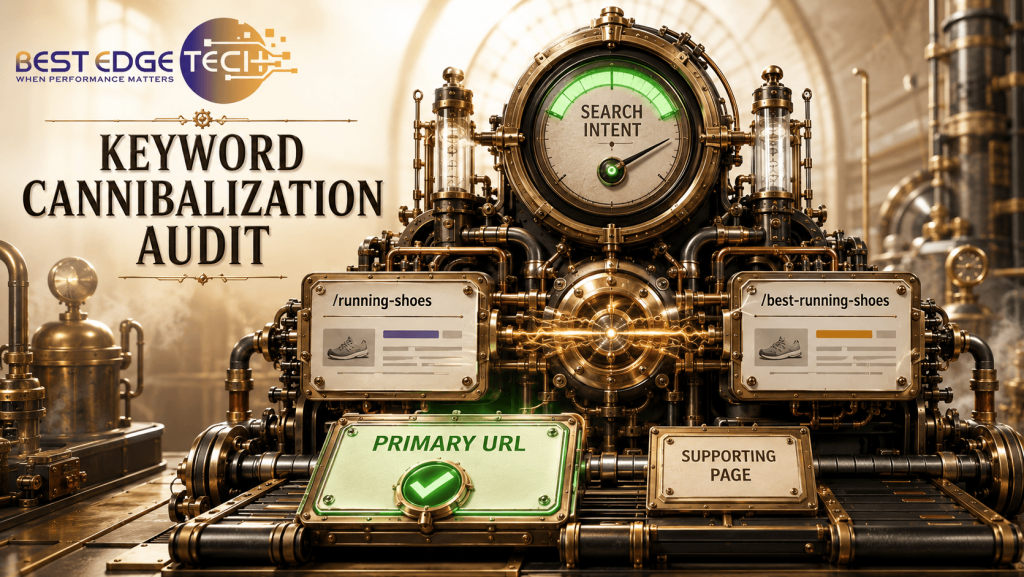
A keyword cannibalization audit determines whether two or more URLs serve the same search intent and whether that overlap is causing the wrong page to rank, unstable URL selection, diluted performance, or a weaker customer journey. Multiple pages receiving impressions for the same query is only a lead. It is not proof that one page is harming another.
The safest audit asks a more useful question than “Do these pages share a keyword?” It asks: Which URL should own this customer need, what evidence supports that choice, and what should happen to every other URL?
How Do You Audit Keyword Cannibalization?
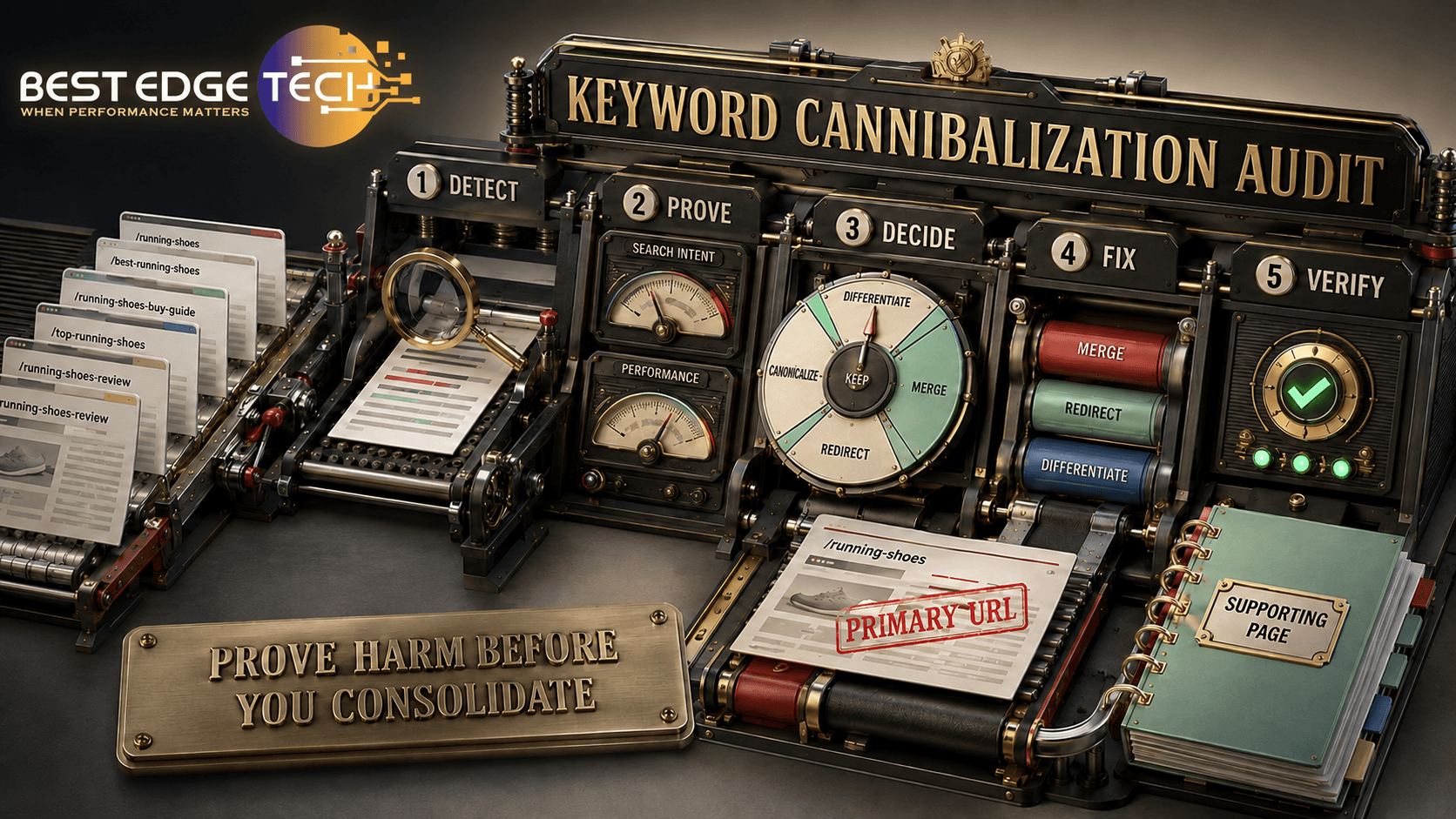
Start with a query or topic cluster, list every URL receiving impressions or intentionally targeting that need, and compare the pages across five dimensions: search intent, audience, page function, historical search performance, and business value. Confirm harm before changing anything. Then assign one verdict to each URL: keep, reinforce, differentiate, merge and redirect, canonicalize, noindex, or retire.
- Define the case: group queries that represent the same underlying customer task.
- Name every claimant: list the URLs receiving impressions or deliberately targeting that task.
- Compare page jobs: document each URL's audience, promise, format, funnel role, and next step.
- Grade the evidence: separate strong signs of harm from normal overlap and short-term volatility.
- Assign ownership: choose the URL best suited to satisfy the intent and business objective.
- Implement and verify: apply one appropriate remedy to each supporting or competing URL, then measure whether the intended owner becomes more stable and useful.
Google Search Console's Performance report shows the queries and pages generating search impressions and clicks. Google notes that page-level data counts each unique URL separately, so analysts should compare URL-level results rather than relying only on property-level totals. See Google's documentation on the Performance report and data aggregation.
Do Not Convict Two Pages Just Because They Share a Query
A page can rank for many queries, and one query can legitimately surface different pages from the same website. Treat the following patterns as possible false positives until the evidence shows harm.
| Pattern | Example | First question |
|---|---|---|
| Different intent | A guide explains SEO audits; a service page sells SEO analysis. | Do the pages serve learning and hiring decisions separately? |
| Different audience | An enterprise migration checklist and a small-business redesign guide. | Are the requirements and next steps materially different? |
| Branded coverage | A homepage, contact page, and profile page appear for a brand query. | Does each result help the searcher complete a different branded task? |
| Legitimate variants | Products, locations, or language versions have distinct content and demand. | Would merging remove information a real user needs? |
| Temporary transition | Old and new URLs coexist during a controlled migration. | Is there a documented URL map and end state? |
Duplicate content and keyword cannibalization are also not identical. Duplicate content concerns the same or substantially similar content being available through multiple URLs. Cannibalization is a performance and intent-ownership problem. Duplicate URLs often need canonicalization or redirects; two genuinely different pages may need clearer positioning instead.
Keyword cannibalization versus content decay
A keyword cannibalization audit begins with a suspected conflict between URLs. A content decay audit begins with a page that may have lost usefulness or performance. The investigations can intersect—a decaying page may overlap another URL—but neither condition proves the other. If the central question is whether an existing page should be kept, refreshed, consolidated, or retired because its value has changed, use Best Edge Tech's content decay audit. Use this guide when the central question is which page should own a search intent.
The URL Ownership Case File
For every suspected conflict, create one case file. This keeps teams from making irreversible changes based on a tool warning, a single-day ranking check, or the loudest opinion in the room.
Case header
- Query cluster: the primary query and close variants being investigated.
- Claimant URLs: every indexable page receiving impressions or intentionally targeting the cluster.
- Preferred outcome: the page and conversion path the business wants searchers to reach.
- Observation window: the dates, search type, country, and device segments used.
- Decision owner: the person accountable for approving content or URL changes.
The five ownership questions
- Do the URLs answer the same underlying need?
- Would the same searcher reasonably need both pages?
- Is Google repeatedly selecting a less suitable URL?
- Would consolidation preserve or improve the information users need?
- Can the team measure the result without confusing it with unrelated changes?
If the first two answers are “no,” the pages probably need clearer differentiation or no action—not consolidation. If the answers are “yes” and the evidence shows a worse outcome, the case is stronger.
Collect Evidence Before Changing a URL
Exhibit A: Query and intent overlap
Export page-level Search Console data for the query cluster. Compare clicks, impressions, click-through rate, and average position by URL, while remembering that average position is an aggregate—not a fixed rank. Review the live results for the query and identify the dominant content type: service page, tutorial, category, product, comparison, tool, or another format.
Then read both pages. Titles and keywords can look different while the pages still perform the same job. Conversely, similar phrases can support separate intents. Record each page's audience, promise, task, depth, and next step.
Exhibit B: URL switching
Look for repeated changes in which URL earns impressions or rankings for the cluster. One isolated switch is weak evidence. A sustained pattern—especially when neither page performs well or the wrong page repeatedly replaces the preferred one—is more meaningful.
Annotate site changes, core updates, title edits, internal-link changes, migrations, and seasonality. Without those notes, normal volatility can be misdiagnosed as cannibalization.
Exhibit C: Page authority and information value
Inventory the assets each URL would bring to a final owner page:
- Unique explanations, examples, tables, images, and expert contributions.
- Relevant backlinks and referring pages.
- Internal links and navigation prominence.
- Conversions, assisted conversions, and qualified engagement.
- Freshness requirements and maintenance history.
- Accessibility, indexability, canonical signals, and HTTP status.
The goal is not to crown the URL with the most traffic automatically. The owner should be the page best equipped to satisfy the target intent, preserve valuable information, support the business goal, and remain maintainable.
Exhibit D: Internal signals
Review which URL receives the strongest descriptive internal links, appears in sitemaps, and is referenced from related content. Conflicting anchors and navigation can make the website's own preference unclear. Google recommends linking internally to the canonical URL and keeping canonicalization signals consistent. Review the official guidance on consolidating duplicate URLs.
Grade the evidence instead of counting URLs
A reliable verdict depends on the quality of the evidence, not the number of warnings in an SEO tool. Use this standard to decide whether a case is ready for action.
| Evidence level | What it may look like | Decision use |
|---|---|---|
| Strong | The same-intent URLs repeatedly switch for a meaningful query cluster; the less suitable URL displaces the preferred page; or neither page provides a distinct user journey. | Supports an ownership verdict when the pattern persists across a consistent observation window. |
| Supporting | Titles, headings, internal anchors, and conversion goals substantially overlap; backlinks and useful sections are divided between the claimants. | Explains why the conflict may exist, but should not trigger an irreversible change by itself. |
| Weak | Two URLs receive impressions for one broad query, a rank tracker reports a single switch, or a site search returns several related pages. | Creates an investigation lead only. Gather intent and historical evidence before acting. |
Search Console does not expose every query, and recent, low-volume, or anonymized data can make small samples misleading. Build clusters from the available query data, retain the same filters when comparing periods, and record data limitations inside the case file.
URL Ownership Verdict Matrix
Issue a separate verdict for every claimant URL. Do not combine “merge,” “redirect,” and “canonicalize” into one vague action; they solve different problems.
| Verdict | Use when | Required handoff | Avoid when |
|---|---|---|---|
| Keep and reinforce | One URL already owns the intent, while the others serve distinct needs. | Strengthen useful content and point relevant internal links to the owner. | The owner is thin, outdated, or mismatched to the current results. |
| Differentiate | Both pages are valuable but their audiences, tasks, or funnel roles are insufficiently clear. | Revise the promise, headings, examples, internal anchors, and CTA so each page has a distinct job. | The pages still answer the same need after the proposed edits. |
| Merge and permanently redirect | Pages serve the same intent and one complete destination can replace the others. | Move unique value, update links and sitemaps, then redirect each retired URL to the closest relevant replacement. | No destination satisfies the retired page's users. |
| Canonicalize | Duplicate or very similar pages must remain accessible through separate URLs. | Choose one canonical, use consistent absolute canonical signals, and link internally to the preferred URL. | The pages contain materially different content or serve different intents. |
| Noindex | A page must remain available to users but should not appear in search results. | Confirm crawlers can access the directive and remove the URL from the XML sitemap. | The real need is duplicate consolidation; Google recommends canonicalization instead of `noindex` for choosing a canonical within a site. |
| Retire without replacement | The page has no useful content, demand, links, traffic, or relevant successor. | Remove internal links and return an appropriate not-found or gone response. | A relevant destination exists or the URL has assets worth preserving. |
Google describes redirects and `rel="canonical"` as strong canonicalization signals, while sitemap inclusion is weaker. Permanent redirects are appropriate when a duplicate page is being deprecated. A canonical is a preference signal rather than a command, and Google may choose a different representative URL. The implementation must match the actual content relationship.
Technical URL Patterns Need a Separate Review
Some apparent conflicts are caused by URL systems rather than editorial overlap. Do not apply a general content-consolidation rule until the technical relationship is understood.
| Pattern | Primary risk | Audit direction |
|---|---|---|
| Filtered or faceted URLs | Large numbers of crawlable combinations can duplicate or fragment category signals. | Review crawl access, indexability, canonicals, internal links, and whether each filtered page serves real search demand. |
| Language or regional versions | Equivalent pages can be mistaken for redundant duplicates. | Keep legitimate localized experiences and review canonical and hreflang relationships rather than merging them automatically. |
| HTML and downloadable files | A PDF or print version may compete with the maintained HTML owner. | Decide which format should appear in search; non-HTML files may require an HTTP canonical signal. |
| Migration or redesign URLs | Old and new addresses can coexist without a completed mapping. | Validate redirects, canonicals, internal links, sitemaps, and the final destination before rewriting content. |
These cases often require server, CMS, or template changes. The content team should document the desired owner and user experience, while the technical owner verifies how crawlers actually receive the signals.
Three Worked Cannibalization Cases
Case 1: Service page versus educational guide
Claimants: “SEO Audit Services” and “How to Run an SEO Audit.” Both receive impressions for “SEO audit.”
Evidence: The service page explains deliverables and invites a consultation. The guide teaches a do-it-yourself process. Each earns distinct long-tail queries and supports a different next step.
Verdict: Keep both. Differentiate titles, introductions, and internal anchors. Link the guide to the service page when professional help becomes the logical next step. Shared head-term impressions alone do not prove harm.
Case 2: Two guides with the same promise
Claimants: “Keyword Cannibalization Guide” and “How to Fix Competing SEO Pages.” Both explain the same diagnosis, tools, and remedies.
Evidence: Rankings alternate, neither page has a distinct audience, and each contains useful sections missing from the other.
Verdict: Build one stronger owner page, merge unique information, update its title and internal links, and permanently redirect the retired URL. Preserve a change log and benchmark data before launch.
Case 3: Printable and HTML versions
Claimants: An HTML checklist and a near-identical printer-friendly version.
Evidence: Users need both formats, but the HTML page should be the preferred search result.
Verdict: Keep both accessible and canonicalize the substantially similar alternate to the preferred page. If the alternate is a non-HTML file, the implementation may require an HTTP `Link` header rather than an HTML element.
A Fix Is Not Finished Until It Is Verified
Record the implementation date and avoid stacking unrelated title, design, navigation, and content changes into the same test when possible. After search systems recrawl and process the changes, compare the same query cluster, country, device, and search type used in the baseline.
Verification ledger
- Does the intended owner return a successful response and remain indexable?
- Do retired URLs reach the closest relevant destination without chains or loops?
- Do canonical tags, internal links, and the XML sitemap agree on the preferred URL?
- Has Google processed the intended canonical in URL Inspection?
- Is the preferred page gaining stable impressions for the target query cluster?
- Did the change preserve valuable long-tail visibility and conversions?
- Did users retain access to information that was unique to the retired page?
Google advises monitoring traffic and indexing after URL changes and explains that crawling and processing take time. Do not declare success or failure from a single ranking check. Use Google's redirect guidance and Search Console's URL Inspection and Performance reports to verify implementation and outcomes.
Prevent Cannibalization With an Intent-Ownership Register
A keyword map lists phrases. An intent-ownership register records decisions. Maintain one row for every strategically important customer need.
| Field | Purpose |
|---|---|
| Intent cluster | Groups queries that represent the same underlying task. |
| Owner URL | Names the primary page responsible for satisfying that intent. |
| Page role | Defines whether the page educates, compares, sells, supports, or navigates. |
| Audience and stage | Prevents two pages from drifting toward the same reader and decision. |
| Supporting URLs | Shows which pages deepen the topic without replacing the owner. |
| Internal-link rule | Defines the descriptive anchors and pathways that reinforce ownership. |
| Review trigger | Starts reassessment after a new page, redesign, migration, decline, or intent shift. |
Before approving a new article, ask what intent it will own, which existing page it supports, and why the need cannot be satisfied by updating a current URL. This one editorial checkpoint prevents many conflicts before they require redirects or content removal.
For sites with broader technical, indexing, or architecture problems, a cannibalization review should sit inside a wider SEO audit and analysis. If the website is being rebuilt, use Best Edge Tech's website redesign SEO checklist to map old and new URLs before launch.
How Page Ownership Supports AEO and GEO
Clear page ownership is not a secret AI-ranking factor, and fixing cannibalization cannot guarantee an AI citation, mention, recommendation, ranking, click, or lead. Its practical value is simpler: one maintained owner page is easier for a team to keep accurate, complete, internally supported, and aligned with a specific user need than several drifting near-duplicates.
For answer-oriented and generative experiences, treat the owner URL as the maintained source of answer for that intent. Give it a direct answer near the relevant heading, preserve the supporting explanation and limitations, use descriptive tables or comparisons when they help the reader decide, and keep factual claims tied to reliable sources. Supporting pages should add a genuinely different use case, audience, example, or decision—not paraphrase the same answer.
| Search layer | Ownership question | Useful evidence |
|---|---|---|
| SEO | Which URL best satisfies the dominant organic intent? | Query-to-page performance, SERP format, internal signals, indexability, links, and conversions. |
| AEO | Which page gives the clearest complete answer without stripping away necessary context? | Answer-first passages, logical headings, accessible tables, definitions, criteria, limitations, and visible FAQs. |
| GEO | Which maintained page contains the strongest supportable version of the information? | Accurate entities, original analysis, primary references, attributable expertise, update discipline, and consistent supporting pages. |
Google's current guidance for generative AI search emphasizes foundational SEO, crawlable and indexable content, clear site structure, and useful, non-commodity information. It also warns against creating separate pages for every possible query variation merely to influence rankings or generative responses. Review Google's generative AI search guidance.
A dedicated cannibalization audit therefore complements—but does not replace—Best Edge Tech's broader AI search readiness audit. The readiness audit asks whether the website foundation is prepared; this process decides which URL should own a specific intent.
Frequently Asked Questions About Keyword Cannibalization Audits
What is a keyword cannibalization audit?
A keyword cannibalization audit evaluates whether multiple URLs target the same or substantially similar search intent and whether the overlap is producing a worse outcome. It identifies the preferred owner page and assigns a documented action to every competing or supporting URL.
Is ranking two pages for the same keyword always bad?
No. Two pages may legitimately appear for the same broad or branded query when they serve different intents, audiences, formats, or tasks. Cannibalization requires evidence that the overlap is harmful—not merely evidence that both URLs receive impressions.
How can I find keyword cannibalization in Google Search Console?
Filter the Performance report by a query or query cluster, switch to the Pages dimension, and compare the URLs receiving impressions and clicks. Review a meaningful date range and consistent country, device, and search-type segments. Then inspect page intent and historical behavior before deciding that the URLs conflict.
Should I merge pages that rank for the same keyword?
Merge pages when they serve the same intent, their useful information can be preserved in one stronger destination, and the evidence indicates that separate URLs are producing a worse result. Keep or differentiate them when they satisfy distinct customer needs.
Should I use a 301 redirect or a canonical tag?
Use a permanent redirect when an old or duplicate page is being replaced and no longer needs its own accessible URL. Use a canonical signal when duplicate or very similar versions must remain available through separate URLs. Do not canonicalize a genuinely different page merely because it shares keywords with another URL.
Does noindex fix keyword cannibalization?
It can remove a page from search results when the page must remain available to users, but it is not the preferred way to consolidate duplicate pages. Google recommends canonicalization rather than `noindex` when the goal is to select a canonical page within one website.
How long should I wait before evaluating a cannibalization fix?
There is no universal waiting period. Search systems must recrawl and process the affected URLs, and timing varies by site and page. Confirm implementation first, monitor indexing and canonical selection, and compare performance across a meaningful observation window rather than one day.
Can fixing keyword cannibalization guarantee better rankings or AI citations?
No. The work can improve page clarity, maintenance, internal signals, and the alignment between a page and a search intent, but no agency or tactic can guarantee rankings, citations, recommendations, traffic, leads, or revenue.
Give Every Important Search Intent a Clear Owner
If your reports show rotating URLs, declining pages, duplicated service content, or uncertainty about what to merge, Best Edge Tech can examine the evidence and build a page-ownership plan. Our team connects content decisions with technical checks, internal linking, redirects, canonicalization, and measurement.
Contact Best Edge Tech to discuss an SEO audit focused on the pages most important to your customers and business.
Primary References

Strategic Content Review
Strategically Reviewed by Christopher A. Whitfield
Founder & CEO, Best Edge Tech
Christopher strategically reviewed this article for search-intent alignment, technical SEO accuracy, source quality, content completeness, and its practical application across traditional and AI-powered search experiences.
Meet the strategic reviewer