
Learning how to get your business recommended by ChatGPT starts with understanding what makes a company relevant, credible, and suitable for a specific buyer’s request.
ChatGPT does not need another page insisting that your business is “the best.” It needs enough current, verifiable context to understand which buyer your company fits, why it may be suitable, and where the recommendation stops being appropriate. The practical work is to build that evidence trail across your website and trustworthy public sources. This can strengthen recommendation eligibility, but no business, agency, or technical tactic can guarantee placement in a ChatGPT response.
Think of every recommendation as a small decision case. The user supplies a need and constraints; the system looks for plausible options; and the available evidence either supports your inclusion, introduces doubt, or points toward a competitor. This guide shows how to find and repair those evidence gaps without producing a pile of near-duplicate “AI SEO” pages.
How to Get Your Business Recommended by ChatGPT: The Short Answer
- A ChatGPT recommendation, brand mention, website citation, and referral visit are different outcomes.
- OpenAI does not publish a universal list of business recommendation factors or offer guaranteed placement.
- Clear business facts, decision-relevant content, first-party proof, independent corroboration, and accurate conversion details form a practical recommendation foundation.
- ChatGPT Search may use current web information and location context, so outdated hours, services, locations, or availability can weaken the usefulness of a business as a recommendation.
- One favorable answer is an observation, not proof of a stable ranking.
- Foundational SEO remains important because crawlability, indexability, useful content, and internal structure help search and retrieval systems find and interpret information.
What Does It Mean to Be Recommended by ChatGPT?
A business is recommended when ChatGPT presents it as a possible provider, product, destination, or solution for a user’s stated need. That is different from merely mentioning the brand or citing one of its pages.
| Outcome | What happened | What it does not prove |
|---|---|---|
| Brand mention | The answer names or describes the business. | That the business is being recommended or that its website was used. |
| Website citation | A page from the website appears as a supporting source. | That the business itself is endorsed or presented as the best choice. |
| Business recommendation | The company is presented as a possible fit for the user’s needs. | A permanent ranking, formal OpenAI endorsement, or guaranteed lead. |
| Referral visit | A detectable visitor arrives from ChatGPT. | Every zero-click mention, citation, or recommendation that occurred. |
This distinction matters strategically. A page designed to become a useful source should prioritize claim clarity and evidence. A business seeking recommendations must also prove suitability: who it serves, what it offers, where it operates, why it may fit a specific decision, and what limitations a buyer should understand. For page-level source optimization, read Best Edge Tech’s AI citation optimization guide.
How ChatGPT Search Can Affect Business Recommendations
ChatGPT can answer from the context available to it and may search the web when a question benefits from current information. According to OpenAI’s ChatGPT Search documentation, search may rewrite a user’s request into one or more targeted queries and use general or optional precise location information to improve local relevance.
That creates three practical consequences for businesses:
- The wording of the buyer’s request matters. “Best accounting firm” is broader than “accounting firm for a multi-location dental group in Raleigh.” A company may be relevant to one and not the other.
- Current public information matters. Services, locations, opening hours, availability, product specifications, and policies should be accurate wherever customers and search systems encounter them.
- Results can vary. Location, conversation context, timing, search availability, source freshness, and the precise prompt can produce different answers.
OpenAI states that ChatGPT Search placement depends on factors intended to surface reliable and relevant information, that no top position can be guaranteed, and that sites seeking inclusion should allow OAI-SearchBot and the associated published IP addresses. Crawler access is a prerequisite for possible discovery—not proof that a page will be used or a business recommended.
The Best Edge Tech Recommendation Evidence Matrix
The Recommendation Evidence Matrix is a practical diagnostic framework for evaluating whether a business has enough clear, current, and decision-relevant information to be considered confidently. It is not a model of ChatGPT’s private systems, and its verdicts are not ranking scores.
| Evidence area | Pass | Caution | Fail |
|---|---|---|---|
| Entity accuracy | Business identity, services, people, locations, and relationships are consistent and current. | Minor gaps or old profile details create uncertainty. | Material facts conflict across the website and external sources. |
| Decision relevance | Pages explain fit, use cases, process, costs or cost factors, comparisons, and limitations. | Services are described, but buyer decisions remain unanswered. | Content is generic, promotional, or unrelated to the prompt being targeted. |
| First-party proof | Material claims are supported by verifiable experience, methods, examples, credentials, or documented results. | Some evidence exists, but major claims remain vague or unsubstantiated. | Claims rely on superlatives, fabricated proof, or unsupported guarantees. |
| Independent corroboration | Relevant third-party profiles, reviews, associations, citations, and media references accurately support the business identity. | Coverage is thin, inconsistent, or concentrated on low-value directories. | Third-party information contradicts the website or appears manipulated. |
| Action readiness | Service areas, hours, availability, policies, contact paths, and next steps are accurate and easy to use. | Customers can act, but important details are difficult to find or outdated. | The business appears unavailable, unreachable, closed, or unsuitable for the requested need. |
How to Use the Matrix
- Select one genuine buyer scenario, such as “commercial HVAC provider for a hospital expansion” or “family-friendly restaurant open late near downtown.”
- Evaluate each evidence area against that specific scenario.
- Record the source behind each verdict rather than relying on opinion.
- Fix failures before polishing caution items.
- Repeat the assessment for other high-value customer scenarios.
A company can pass for one scenario and fail for another. A specialist may be a strong recommendation for a narrow need but a poor fit for a broad one. The purpose is not to make the business look relevant to everyone; it is to document where the business is genuinely a suitable option.
Build a Recommendation Case File, Not Another Content Pile
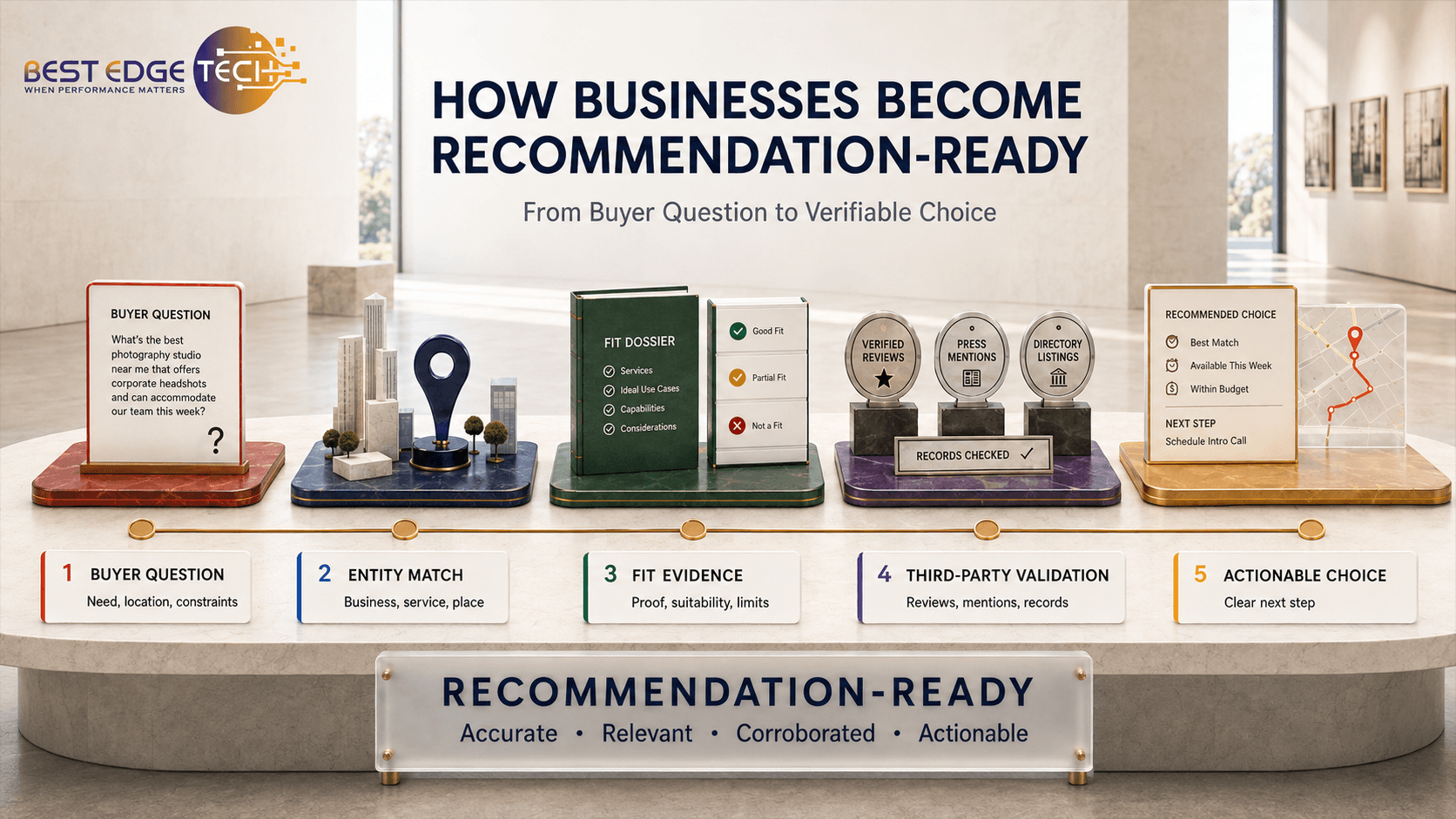
Choose one commercially meaningful buyer prompt and assemble a compact case file for it. The file should identify the exact business entity, the page that best answers the need, the proof behind material claims, independent sources that agree, and the action a qualified customer can take. This structure turns a vague goal—“show up in ChatGPT”—into a specific evidence problem that a team can inspect.
Open the File: Establish One Accurate Source of Truth
Create a verified record of the facts that should remain consistent across your website and public profiles. Include:
- Official business name and commonly used brand name
- Primary website and contact information
- Active locations and legitimate service areas
- Current products and services
- Named professionals and their verified roles
- Opening hours, appointment requirements, and availability
- Licenses, certifications, affiliations, and awards only when verifiable
- Policies or restrictions that materially affect a customer’s decision
Resolve contradictions at the source. Adding more pages or schema will not repair a business name, address, service, or credential that is wrong elsewhere. If conflicting AI-generated claims already exist, use the AI misinformation correction workflow to trace each claim to its likely source and document the correction.
Name the Decision: Map One Page to One Buyer Need
A service page that says “we provide exceptional solutions” gives a recommendation system little basis for deciding who the service suits. Create one strong page for each distinct customer intent and answer the questions that change the decision:
- Who is this service or product for?
- Which problems does it solve—and which does it not solve?
- What does the process involve?
- What factors affect price, timeline, availability, or eligibility?
- How does this option compare with reasonable alternatives?
- What evidence supports the business’s material claims?
- What should a buyer verify before choosing?
Use clear headings, concise answers, accessible tables, and descriptive internal links because those features help people scan the page and understand its relationships. Google’s official guidance for generative AI search emphasizes distinctive, people-first content, ordinary SEO foundations, crawlability, and clear technical structure—not special “AI-only” rewriting.
Enter the Evidence: Publish Proof Competitors Cannot Copy
Generic advice is easy to reproduce. Useful evidence is harder to replace. Depending on the business and privacy constraints, strong first-party material may include:
- A documented service process with decision points and limitations
- Case studies that explain the starting condition, work performed, outcome, and measurement method
- Original photographs, demonstrations, product specifications, or annotated examples
- Named expert guidance with a relevant biography and verifiable experience
- Original research with a transparent methodology and date range
- Eligibility criteria, service-area rules, pricing factors, or implementation checklists
Do not invent results, testimonials, quotes, awards, credentials, customer counts, or years of experience. A narrower supported claim is more useful than a stronger claim that cannot be verified.
Find the Witnesses: Earn Accurate Independent Corroboration
A business should not rely solely on its own claims. Keep legitimate profiles accurate and pursue real coverage where prospective customers already evaluate providers. Depending on the industry, that may include professional associations, local chambers, manufacturer or partner directories, licensing databases, trade publications, credible local media, and established review platforms.
Corroboration should be earned and factual. Do not buy fabricated reviews, create fake local profiles, publish undisclosed sponsored endorsements, or distribute the same promotional paragraph across dozens of low-quality directories. Inauthentic mentions create customer risk and may violate platform policies or applicable law.
Label the Record: Use Structured Data to Confirm Visible Facts
Apply the most specific accurate schema type supported by the visible page. Depending on the page, that may include Organization, LocalBusiness or an eligible subtype, Person, Service, Product, Article, or BreadcrumbList.
Structured data should confirm what readers can see. It should not introduce hidden locations, unsupported ratings, invented prices, false credentials, or a different author. Google states that no special structured data is required for its generative AI features. Schema remains useful for conventional search understanding and eligible rich-result features, but it does not guarantee a ChatGPT recommendation.
Keep the File Discoverable: Protect Technical Access
Before expanding content, confirm that priority pages:
- Return the intended successful status code
- Are not accidentally blocked by robots.txt or a noindex directive
- Use the correct canonical URL
- Appear in the XML sitemap when appropriate
- Can be reached through normal internal links
- Render their essential information as accessible text
- Work on mobile devices and provide usable contact paths
For ChatGPT Search discovery, review OpenAI’s crawler instructions and distinguish OAI-SearchBot search controls from separate training-related controls. Run a broader AI search readiness audit when crawlability, entity clarity, page ownership, evidence, or conversion paths are uncertain.
Close the Case: Make the Next Step Accurate and Friction-Free
A recommendation is less useful when a customer reaches an outdated page or cannot complete the intended action. Display current contact details, supported locations, operating hours, appointment rules, delivery areas, stock or availability when applicable, and an honest description of what happens next.
For high-consideration services, explain how the initial consultation works and what information the customer should prepare. For ecommerce, keep price, shipping, returns, availability, and product identifiers current. For local businesses, make it easy to confirm the correct location rather than sending every visitor to a generic homepage.
How Local Businesses Can Improve Recommendation Relevance
Local recommendation prompts often include explicit or implied geography: “near me,” a city, a neighborhood, a travel route, or the user’s shared location. OpenAI documents that ChatGPT Search may use approximate IP-based location and, when enabled, precise device location to provide more relevant local results.
For each legitimate location:
- Maintain an accurate Google Business Profile and other major customer-facing profiles.
- Use a unique location page only when the business has genuine local relevance and useful location-specific information.
- Show the actual address or service area, local phone number when appropriate, hours, accessibility information, and appointment rules.
- Describe the services available at that location instead of assuming every office offers everything.
- Keep holiday hours, temporary closures, moves, and practitioner changes current.
- Earn legitimate local coverage and reviews without incentives that distort customer feedback.
Avoid city-swapped doorway pages. Publishing dozens of nearly identical pages for places the business does not meaningfully serve can confuse customers and dilute the site’s strongest location signals.
How to Test Whether ChatGPT Recommends Your Business
Testing should reveal patterns, not manufacture a favorable screenshot. Use a documented prompt panel that reflects real customer language.
Build a Representative Prompt Panel
Include several types of unbranded questions:
- Problem discovery: “What type of company helps with [problem]?”
- Provider discovery: “Which businesses offer [service] in [location]?”
- Suitability: “Who is a good fit for [specific customer and constraint]?”
- Comparison: “What should I compare when choosing [provider type]?”
- Branded verification: “What services does [business] offer in [location]?”
Preserve the Test Conditions
For each observation, record:
- Exact prompt and any follow-up question
- Date and time
- ChatGPT mode or search setting when visible
- Location conditions
- Whether the session was new or contained prior context
- Businesses mentioned or recommended
- Displayed citations and destination pages
- Accuracy of the business description
Repeat important prompt families over time instead of running the same prompt until the preferred answer appears. Separate recommendation frequency from citation frequency, accuracy, referral traffic, leads, and sales. Best Edge Tech’s AI search visibility tracking guide provides a measurement framework for these distinct events.
How to Interpret the Results
- Not mentioned: Check eligibility, relevance, entity clarity, and external corroboration.
- Mentioned but not recommended: Strengthen suitability information and decision-stage evidence.
- Recommended with inaccurate facts: Correct the first-party source of truth and conflicting external profiles.
- Recommended without a citation: Preserve the observation, but do not assume which source influenced it.
- Cited without a recommendation: The page may be useful evidence even though the company is not a fit for that prompt.
- Recommended but no leads: Review the landing page, offer, contact path, tracking, and customer fit.
Four Recommendation Rooms: The Evidence Changes with the Buyer
A generic optimization checklist cannot account for the evidence different buyers need. A neighborhood restaurant, a regulated professional, a software platform, and a multi-location service company may all be recommended for different reasons. Start with the buyer’s decision, then build the shortest credible path from the prompt to verifiable proof.
| Business scenario | Likely decision behind the prompt | Evidence that reduces uncertainty | Best destination |
|---|---|---|---|
| Local service business | Can this company solve my problem in my area, at the time I need help? | Real service area, current hours, response expectations, licenses when relevant, service limitations, local reviews, and accurate contact details. | A service-and-location page that explains eligibility, coverage, process, and the next step. |
| Professional or regulated service | Is this provider qualified for my particular situation, and what should I verify before engaging them? | Named professionals, verified roles and credentials, scope of service, jurisdiction, methodology, conflicts or limitations, and relevant experience without unsupported outcome claims. | A specialist service page connected to factual professional profiles and supporting guidance. |
| Software or B2B platform | Will this product fit my use case, technical environment, budget, and risk requirements? | Supported integrations, security documentation, pricing or pricing factors, implementation requirements, product limitations, version dates, and independently verifiable customer evidence. | A use-case or comparison page linked to current product documentation and a transparent conversion path. |
| Multi-location or multi-service company | Which branch or service line can actually meet my need? | Clear parent-brand relationships, unique location facts, services available at each branch, practitioner or team assignments, hours, and location-specific proof. | The most specific valid location or service page—not a generic homepage or a doorway page. |
The Prompt-to-Proof Interrogation
Choose one commercially valuable, unbranded prompt and trace the public evidence a careful buyer would need before acting. The chain should answer five questions:
- Identity: Is it unmistakably clear which business, location, product, or professional the information describes?
- Fit: Does the page explain who the offer is for, the problem it addresses, and where it is unsuitable?
- Proof: Are important claims supported by observable facts, documented methods, examples, or legitimate third-party evidence?
- Freshness: Can a buyer tell whether availability, specifications, locations, roles, and policies are still current?
- Action: Does the destination provide the correct next step for that exact scenario?
If the chain breaks, fix the missing proof at the page or profile where the fact belongs. Do not compensate by repeating the same claim across more articles. For example, an unclear service area belongs on the relevant service and location assets; a weak suitability explanation belongs on the decision page; and an unsupported credential must be verified before it appears anywhere.
Choose the Next Move by Evidence Gap
Prioritize the first broken link in the chain rather than following an arbitrary publishing calendar:
- Identity gap: Reconcile business facts, entity relationships, profiles, and supported schema.
- Fit gap: Improve the primary service, product, comparison, or location page before publishing another broad guide.
- Proof gap: Gather verifiable first-party material or legitimate independent corroboration.
- Freshness gap: Correct outdated operational facts and assign an owner and review trigger for volatile information.
- Action gap: Repair the landing experience, contact route, availability information, or qualification process.
This evidence-led sequence may produce a profile correction, a stronger service page, a new case study, a technical repair, or no new content at all. That is the point: the work should respond to the buyer’s missing evidence. The right answer may be one repaired fact—not another article added to an overcrowded cluster.
Mistakes That Can Weaken Recommendation Eligibility
- Claiming a guaranteed ChatGPT ranking: OpenAI does not offer a guaranteed organic position.
- Confusing citations with recommendations: A cited article does not automatically make its publisher a suitable provider.
- Publishing generic “best” pages: Self-awarded superiority without transparent criteria or evidence is not a useful comparison.
- Using fake reviews or mentions: Manipulated corroboration creates legal, reputational, and platform risk.
- Adding unsupported schema: Hidden ratings, false locations, incorrect authors, or invented credentials create conflicting entity information.
- Creating pages for every prompt variation: Near-duplicate pages can cannibalize stronger URLs and provide little customer value.
- Ignoring operational details: An outdated address, closed location, unavailable service, or broken contact form can invalidate an otherwise relevant recommendation.
- Judging success from one response: ChatGPT outputs can vary, so decisions should rely on documented trends and business outcomes.
Frequently Asked Questions
Can I pay ChatGPT to recommend my business?
Do not assume that paying for advertising, a partnership, or an optimization service purchases an organic ChatGPT recommendation. Organic recommendations and citations should be evaluated separately from clearly labeled advertising or sponsored placements.
Does ChatGPT use Google Business Profile information?
OpenAI states that ChatGPT Search may use third-party search and local-information providers, but it does not publish a complete, permanent list of every source used for every response. Keeping major business profiles accurate is still valuable because customers and multiple search experiences rely on them.
Do reviews help a business appear in ChatGPT recommendations?
Legitimate reviews can provide useful third-party evidence about customer experiences, but OpenAI does not publish a universal review-count or rating threshold for recommendations. Focus on authentic feedback, accurate profiles, and policy-compliant review practices rather than manufactured volume.
Does schema markup guarantee a ChatGPT recommendation?
No. Accurate structured data can clarify entities and support conventional search features, but it does not guarantee crawling, citation, mention, ranking, or recommendation in ChatGPT.
Should I create an llms.txt file?
An llms.txt file is not a substitute for crawlable pages, clear business facts, useful content, evidence, and legitimate authority. Google states that llms.txt is not used for visibility in Google Search. Evaluate it only for systems that explicitly document support, and do not present it as a universal AI-ranking requirement.
How long does it take to get recommended by ChatGPT?
There is no reliable universal timeline. Discovery and answer generation can depend on crawl access, source freshness, query context, location, competition, and the information available when a response is produced. Any agency promising a fixed recommendation date is making a claim it does not control.
Why does ChatGPT recommend competitors instead of my business?
Possible reasons include stronger relevance to the prompt, clearer service or location information, better documented proof, more credible third-party corroboration, fresher data, or simple response variation. Compare the evidence behind each business before assuming one technical factor caused the result.
How should a business measure ChatGPT visibility?
Track brand mentions, website citations, business recommendations, factual accuracy, detectable referral visits, qualified leads, and revenue as separate measures. Preserve prompts and test conditions so changes can be interpreted responsibly.
Can Best Edge Tech guarantee that ChatGPT will recommend my company?
No. Best Edge Tech can help improve technical accessibility, entity clarity, content usefulness, evidence, authority signals, and measurement. The final decision to retrieve, cite, mention, or recommend a business remains with the external platform.
What Would ChatGPT Have to Believe Before Recommending You?
Write down the buyer, the situation, and the reason your business may be a responsible fit. Then follow every important fact to its public evidence. Wherever that trail becomes vague, contradictory, stale, or impossible to verify, you have found the next priority.
Best Edge Tech can examine that trail across content, technical access, entity information, third-party corroboration, and conversion paths. Explore our AI SEO and Generative Engine Optimization services or contact Best Edge Tech to discuss a recommendation-readiness audit grounded in evidence—not promises of guaranteed placement.
Sources and Further Reading

Strategic Content Review
Strategically Reviewed by Christopher A. Whitfield
Founder & CEO, Best Edge Tech | SEO, AI Search & GEO Strategy
Christopher strategically reviewed this guide for its treatment of ChatGPT business recommendations, the separation of recommendations from citations and mentions, and the practical value of its evidence-based decision framework. His review also checked that the article avoids unsupported claims about proprietary recommendation systems or guaranteed placement.
This strategic review considered:
- Recommendation intent and buyer fit
- SEO, AEO, and GEO alignment
- Entity and location accuracy
- Evidence and corroboration standards
- Measurement limitations
- Practical value for business owners
Strategic review covers digital marketing quality, SEO, AI search optimization, and content strategy. It does not replace legal, financial, medical, or other specialized professional review when separate subject-matter expertise is required.