

A content decay audit is a page-by-page review that determines whether declining or outdated content should be kept, refreshed, consolidated with another page, or retired. The goal is not to make every URL look newer. It is to protect useful content, resolve genuine overlap, correct weak or outdated information, and direct editorial effort toward pages that still serve a clear audience and business purpose.
A drop in clicks alone does not prove content decay. Search demand can change, competitors can improve, a technical problem can suppress a page, or the page may be attracting impressions for queries it was never designed to answer. A responsible audit separates those causes before anyone rewrites, redirects, or removes content.
What is content decay?
Content decay is a sustained loss of a page’s usefulness or performance because the page no longer satisfies its intended audience as effectively as it once did. It may appear as declining organic clicks, lost query coverage, weaker conversions, obsolete information, broken media, reduced engagement, or displacement by a more useful page.
The word sustained matters. Google lists technical issues, security problems, spam issues, seasonality, changing interests, algorithmic changes, and site moves among the possible causes of search-traffic drops. Its guidance recommends examining the shape of the decline, comparing suitable date ranges, reviewing affected pages and queries, and accounting for seasonality before deciding what happened.
What content decay is not
- Normal seasonality: A tax guide, holiday page, or event article may rise and fall with predictable demand.
- A measurement change: Consent settings, analytics configuration, or event changes can alter reported traffic or conversions without changing search demand.
- A technical incident: Noindex directives, canonical errors, server failures, rendering issues, or broken internal links can suppress otherwise useful content.
- A single short-term fluctuation: A few days of movement rarely justify a destructive content decision.
- Age by itself: Evergreen content does not need cosmetic rewriting simply because its publication date is old.
Before diagnosing decay, review Google’s current guidance for debugging search-traffic drops. If the change followed a redesign, migration, or URL restructuring, use a dedicated website redesign SEO checklist before treating it as a content problem.
The six evidence lanes of a content decay audit
A reliable audit does not reduce a page to one traffic number. Review six separate evidence lanes so a weakness in one area does not hide strength in another.
| Evidence lane | Questions to ask | Useful evidence |
|---|---|---|
| 1. Performance | Is the decline sustained? Which pages, queries, devices, countries, and search appearances changed? | Search Console clicks, impressions, CTR, average position, analytics sessions, assisted conversions, and landing-page events |
| 2. Intent | Does the page still answer the task behind the query? Has the results page changed format or emphasis? | Current search results, query clusters, related questions, customer calls, sales questions, and on-site search terms |
| 3. Accuracy | Are facts, screenshots, recommendations, processes, links, and product details still correct? | Primary sources, internal subject-matter review, change logs, product documentation, and broken-link checks |
| 4. Uniqueness | Does this URL own a distinct purpose, or does another page answer substantially the same intent? | Site search, URL-to-intent mapping, title and heading comparisons, internal-anchor patterns, and ranking-page overlap |
| 5. Experience | Can users understand, navigate, read, and act on the page easily? | Mobile QA, accessibility review, page performance, scroll behavior, interaction data, and user feedback |
| 6. Business value | Does the page support a real customer decision, conversion path, brand obligation, or strategic topic? | Leads, revenue, assisted conversions, qualified engagement, backlinks, referrals, support deflection, and stakeholder requirements |
Professional judgment: Treat the six lanes as a decision record, not a secret ranking formula. Weighting should reflect the page’s purpose. A regulatory notice may have little traffic but high legal or customer value. A high-traffic glossary page may have weak direct conversions but strong discovery and internal-link value.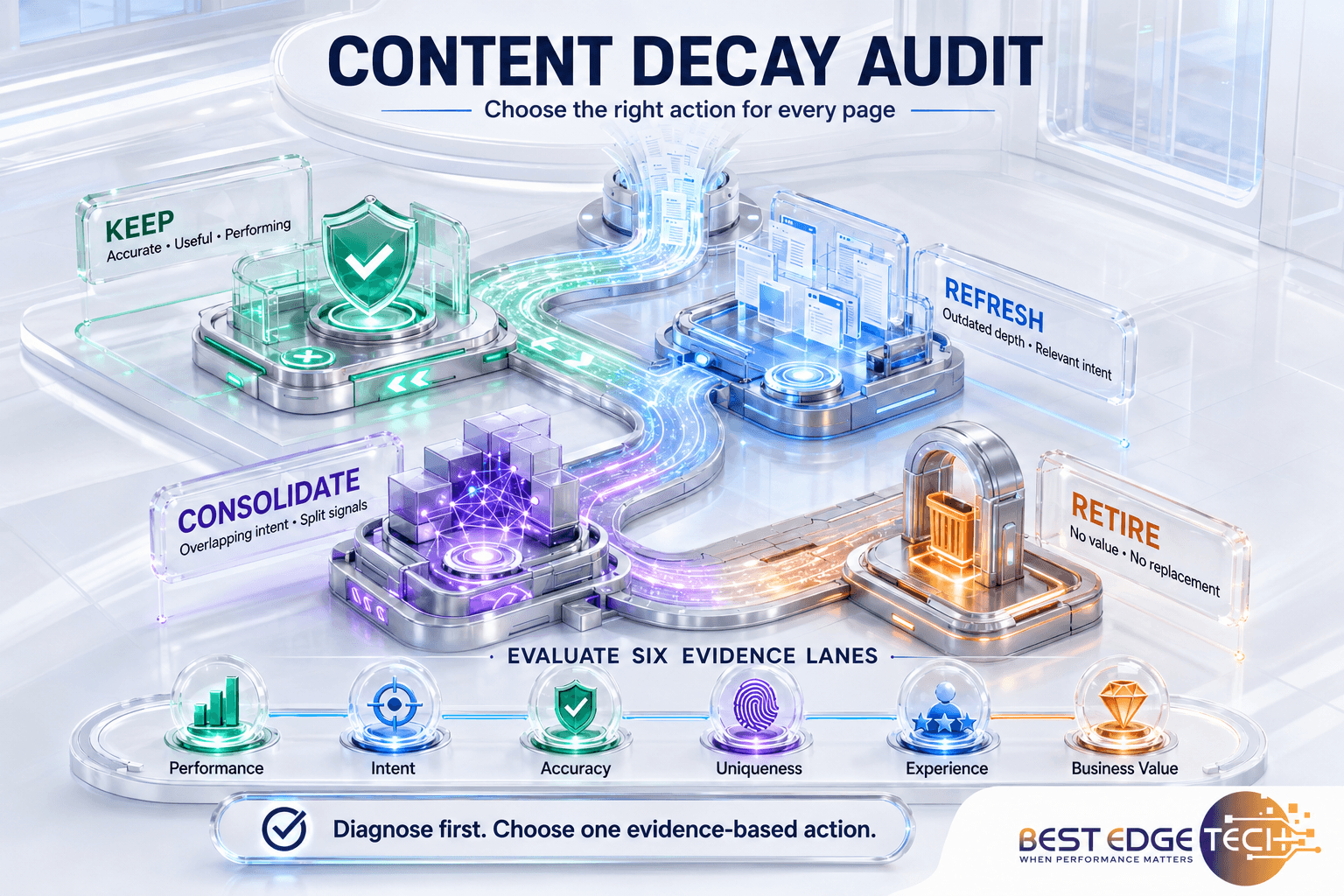
Content decay decision matrix: keep, refresh, consolidate, or retire
Use the evidence to select one primary action. Avoid assigning “refresh” to every page; that turns an audit into an endless rewriting queue and leaves duplication unresolved.
| Decision | Best fit | Core action | Main risk |
|---|---|---|---|
| Keep | Distinct intent, accurate information, useful experience, and stable or strategically acceptable performance | Preserve the page; fix only verified defects and set a future review trigger | Changing a healthy page without a clear reason |
| Refresh | The page still owns the right intent, but evidence, coverage, clarity, media, UX, or conversion support is weak | Improve the existing URL around the same core purpose | Expanding into adjacent intents and creating new cannibalization |
| Consolidate | Two or more URLs substantially overlap, divide useful information, or compete for the same task | Build one stronger primary page, preserve unique value, and route obsolete URLs appropriately | Redirecting to a page that is not a relevant substitute |
| Retire | No continuing user or business purpose, no meaningful unique value, and no relevant replacement | Remove cleanly, update links and sitemaps, and return an appropriate status | Deleting a page that still earns links, conversions, or serves a required purpose |
A practical tie-breaker
If a page could fit more than one outcome, ask this sequence:
- Does the intent still deserve a page? If no, evaluate retirement.
- Does another URL already serve substantially the same intent better? If yes, evaluate consolidation.
- Can the existing URL become the best version of that intent without changing its fundamental purpose? If yes, refresh it.
- Is the page already accurate, useful, distinct, and performing appropriately? If yes, keep it.
How to run a content decay audit step by step
1. Define the audit window and scope
Choose a page set before looking at individual winners and losers. You might audit all editorial URLs, one topic cluster, a product knowledge base, or pages that lost a defined share of clicks. Record exclusions, such as campaign pages, legal archives, or intentionally temporary content.
Use enough history to distinguish a durable decline from noise. Google recommends extending traffic-drop analysis to 16 months when appropriate and comparing periods to identify seasonality. A year-over-year comparison can be more informative than comparing a holiday-driven quarter with the months immediately before it.
2. Build a page-level evidence sheet
Create one row per canonical URL. Useful fields include:
- URL, title, content type, topic cluster, owner, and last substantive review date;
- primary intent and the customer decision the page supports;
- organic clicks, impressions, CTR, and average position by comparable period;
- landing-page sessions, conversions, assisted conversions, and qualified engagement;
- referring domains or strategically important backlinks;
- indexability, canonical target, response status, and internal-link count;
- accuracy issues, broken resources, obsolete screenshots, and unsupported claims;
- overlapping URLs and the recommended owner for each intent;
- decision, evidence, owner, deadline, and post-change review date.
Search Console and analytics measure different stages of the journey. Google explains that Search Console reports what happens before a person reaches the site, while analytics helps explain behavior after arrival. Use both when available; do not treat one as a complete substitute for the other.
3. Segment before comparing
Break the data down by page group, query cluster, device, country, search type, and conversion goal where relevant. A page may lose clicks because mobile rankings slipped, image visibility changed, branded demand fell, or a different page began ranking for the same queries. Aggregate traffic can hide each of those patterns.
4. Re-check the current intent
Review the live results and the language customers use now. Identify whether the query is primarily informational, comparative, transactional, navigational, or local—and whether the dominant result format has changed. Note the questions competitors answer well, but also record what they omit: decision criteria, limitations, implementation steps, examples, primary evidence, or a clear next action.
5. Diagnose the cause before choosing the treatment
Classify the primary cause of weakness. Common causes include:
- outdated or unsupported information;
- search intent drift;
- stronger competing content;
- internal cannibalization;
- thin or generic coverage;
- poor answer extraction or confusing structure;
- weak authorship, sourcing, or experience signals;
- technical indexing, canonical, rendering, or performance problems;
- a weak conversion path; or
- declining demand rather than a page-quality problem.
6. Assign one decision and one accountable owner
Document the evidence that supports the decision. “Traffic is down” is not enough. A useful recommendation might say: “Refresh the existing URL because year-over-year nonbrand impressions remain stable, CTR declined after the results page changed, the page still owns a distinct intent, and its screenshots and comparison criteria are outdated.”
7. Work in controlled batches
Avoid changing hundreds of URLs at once unless a safety or compliance issue requires it. Prioritize high-value pages, then measure a batch before expanding the program. Controlled releases make it easier to connect outcomes with specific changes and catch faulty redirects, links, canonicals, or templates.
How to refresh a decaying page without changing its purpose
A content refresh should preserve the page’s core intent while making the answer more accurate, complete, usable, and commercially helpful.
- Write a one-sentence intent contract. Define who the page serves, the question or decision it owns, and what the reader should be able to do afterward.
- Correct before expanding. Verify claims, replace obsolete screenshots, repair links, update examples, and remove unsupported statements.
- Improve the answer path. Lead with a direct answer where useful, then add criteria, steps, limitations, examples, tables, or checklists that help the reader act.
- Add genuine information gain. Use firsthand observations, an anonymized workflow, original data, decision logic, screenshots, templates, or expert review when those assets are real and approved.
- Strengthen entity clarity. Name organizations, products, services, people, locations, and relationships consistently. Link to authoritative source pages when a factual claim depends on them.
- Rebuild internal links deliberately. Link supporting pages to the refreshed primary page, and connect it to the next useful service, comparison, proof, or contact step.
- Update metadata and structured data. Make the title and description accurate, keep visible content aligned with schema, and remove properties that the page does not support.
- Use dates honestly. Change the modification date after a substantive review or update—not to simulate freshness after superficial edits.
- QA the published page. Check mobile rendering, headings, links, forms, images, indexability, canonical tags, schema validation, and analytics events.
Google’s people-first content guidance asks whether content provides original information, substantial value, clear sourcing, demonstrable expertise, and a satisfying experience. Those questions are a stronger refresh standard than adding paragraphs merely to make a page longer.
How to consolidate overlapping content safely
Consolidation is appropriate when multiple pages divide the same intent or force users to piece together one answer. It is not an automatic response to repeated words. Two pages can discuss the same entity while serving different tasks—for example, a service page for buyers and a diagnostic guide for researchers.
Consolidation workflow
- Select the primary URL. Prefer the URL that best matches the target intent and has the strongest combination of relevance, links, conversions, history, and maintainability.
- Inventory unique value. Preserve useful sections, examples, media, comments, data, and links from the secondary page before removing anything.
- Build one coherent page. Do not paste two articles together. Remove repetition and reorganize the combined material around one intent contract.
- Choose the correct consolidation signal. If an obsolete URL permanently moves to a relevant replacement, use an appropriate permanent server-side redirect. If duplicate versions must remain accessible, use consistent canonical signals where appropriate.
- Update internal links. Point links directly to the preferred URL instead of relying on redirect chains.
- Update the sitemap and navigation. Keep only canonical, indexable URLs in the XML sitemap and remove obsolete references from menus, related-post modules, and feeds.
- Monitor both URLs. Check response codes, selected canonicals, indexing, traffic, links, conversions, and crawl errors after release.
Google documents redirects and canonical annotations as strong signals for selecting a canonical URL, while sitemap inclusion is weaker. It also recommends linking internally to the canonical URL. Consistency across these signals reduces ambiguity.
How to retire content without creating a redirect graveyard
Retire a page only after checking its user purpose, traffic, conversions, backlinks, internal links, compliance value, and possible replacements.
- If a genuinely relevant replacement exists: move any unique value to that destination, use an appropriate permanent redirect, and update internal links.
- If no relevant replacement exists: return an appropriate not-found or gone response rather than sending every deleted URL to the homepage.
- If the page must remain available but should not appear in search: evaluate an index-control approach with technical oversight; do not treat robots.txt as a general removal tool.
- If urgent temporary removal is required: understand that Search Console’s Removals tool is temporary and does not replace a permanent site-side solution.
Keep a removal log containing the old URL, reason, redirect target or response status, affected links, approval, implementation date, and verification date. This makes future debugging far easier than relying on memory.
How content decay affects SEO, AEO, and GEO
Traditional organic performance is only one view of content health. Existing pages can also become harder to extract, summarize, verify, or attribute accurately in answer engines and generative search experiences.
SEO: preserve intent ownership and technical clarity
For SEO, the audit should confirm that each important intent has one clear primary page, the page remains crawlable and indexable, internal links reinforce the preferred URL, and content satisfies the current task. Diagnose technical and demand changes before rewriting.
AEO: improve answer integrity
For answer-oriented experiences, review whether important questions receive direct, self-contained answers and whether definitions, steps, comparisons, and limitations are easy to identify. Clear headings, concise passages, accessible lists, and properly labeled tables can improve comprehension for people and machines. They do not guarantee a featured result or citation.
GEO: strengthen evidence and entity consistency
For generative search, check whether the page names entities consistently, distinguishes facts from recommendations, cites authoritative evidence near claims, displays trustworthy authorship or review information, and agrees with current service and profile pages. If your organization tracks AI-generated answers, compare citation presence, brand mentions, source selection, and factual accuracy separately from traditional rankings.
Use Best Edge Tech’s guides to distinguish an AI search readiness audit from AI search visibility tracking. Readiness evaluates the foundation; visibility measures observable appearances. Neither guarantees rankings, citations, traffic, or leads.
What not to do for “freshness”
- Do not change dates without substantive review.
- Do not add generic AI-written sections that dilute the page’s intent.
- Do not manufacture expert quotes, case studies, statistics, or review claims.
- Do not add FAQ schema for questions that users cannot see on the page.
- Do not assume structured data makes weak or inaccurate content authoritative.
- Do not combine readiness, rankings, AI citations, and revenue into one opaque score.
If your content program needs coordinated SEO and AI-search improvements, review Best Edge Tech’s AI SEO and GEO services. The service page correctly states that no ethical agency can guarantee inclusion in AI-generated answers.
How to measure a content refresh, consolidation, or retirement
Record the baseline before implementation. Then measure the outcome against the page’s purpose, not a universal success metric.
| Decision | Early checks | Outcome measures |
|---|---|---|
| Keep | Indexability, accuracy, links, forms, and planned review trigger | Stability appropriate to demand, continued conversions or assists, and no unresolved defects |
| Refresh | Successful crawl, correct canonical, valid schema, intact events, and mobile QA | Relevant query coverage, qualified clicks, engagement, conversions, citations or mentions where measured, and factual accuracy |
| Consolidate | Redirects, links, canonicals, sitemap, response codes, and absence of chains | Combined intent ownership, retained qualified traffic and conversions, and reduced URL competition |
| Retire | Correct status, removed internal links, updated sitemap, and preserved required records | No harmful broken journeys, no loss of required information, and cleaner index or navigation where intended |
Do not judge a substantial change the next morning. Crawling, indexing, demand, and conversion volume vary by site and page. Establish monitoring checkpoints appropriate to your publishing frequency and risk, while investigating immediately if you see broken forms, server errors, unintended noindex rules, redirect failures, or incorrect canonicals.
Copyable content decay audit checklist
- Define the page set, date range, comparison period, exclusions, and owners.
- Export page and query data before making changes.
- Compare appropriate periods and account for seasonality or demand shifts.
- Segment by page group, query, device, country, search type, and conversion goal.
- Check response status, indexability, canonical, sitemap inclusion, rendering, and internal links.
- Write a one-sentence intent contract for every priority page.
- Identify competing internal URLs and name one preferred owner for each intent.
- Verify factual claims, links, screenshots, recommendations, products, people, and dates.
- Evaluate originality, firsthand evidence, source quality, authorship, and review needs.
- Review mobile usability, accessibility, readability, performance, and conversion paths.
- Assign keep, refresh, consolidate, or retire—with supporting evidence.
- Preserve valuable content and links before consolidating or retiring a URL.
- Update internal links, redirects, canonicals, sitemaps, metadata, and schema as needed.
- QA the live implementation and record the release date.
- Measure search, behavior, conversion, and AI-visibility outcomes separately.
- Document findings and schedule the next evidence-based review trigger.
Common content-audit mistakes
- Using a traffic threshold as the whole strategy: Low traffic does not mean low value, and high traffic does not prove accuracy or conversion value.
- Refreshing every old article: Some pages should remain untouched; others should be merged or retired.
- Writing before diagnosing: A technical fault, intent shift, or demand change will not be solved by adding copy.
- Consolidating by keyword alone: Pages that share terms can still serve different users and funnel stages.
- Redirecting unrelated pages to the homepage: A redirect should lead to a genuinely relevant replacement.
- Deleting without checking links and conversions: Historical value can disappear with the URL.
- Changing every variable at once: Uncontrolled releases make results difficult to interpret.
- Claiming a refresh is complete without review: Metadata, schema, images, forms, links, and internal references must match the new page.
Primary sources and further reading
- Google Search Central: Debug Google Search traffic drops
- Google Search Central: Using Search Console and Google Analytics data for SEO
- Google Search Central: Creating helpful, reliable, people-first content
- Google Search Central: Canonical URLs and duplicate-page consolidation
- Google Search Central: Redirects and Google Search
- Google Search Central: Removing site information from Google
- Google Search Central: AI features and your website
Frequently asked questions about content decay audits
What is a content decay audit?
A content decay audit evaluates existing pages to determine whether they remain accurate, useful, distinct, discoverable, and valuable. It uses search performance, intent, accuracy, uniqueness, user experience, and business evidence to assign one of four actions: keep, refresh, consolidate, or retire.
How can I tell whether traffic loss is content decay?
Confirm that the decline is sustained, then compare suitable periods and segment by page, query, device, country, and search type. Rule out seasonality, demand changes, analytics issues, technical faults, security problems, site migrations, and broader search changes before deciding that the content itself has decayed.
Should I refresh or completely rewrite an old article?
Refresh the existing page when its core intent and URL remain valid and much of the material is still useful. A substantial rewrite may be appropriate when the page keeps the same intent but its structure, evidence, and guidance are broadly inadequate. If the intended task has fundamentally changed, reconsider the page strategy before rewriting.
Does changing the publication date improve rankings?
Changing a date alone does not make content more helpful. Use a modification date only after a substantive review or update, and make sure the visible page, metadata, and structured data are consistent. Rankings depend on many systems and cannot be guaranteed by a date change.
Should low-traffic content be deleted?
Not automatically. A low-traffic page may support conversions, links, customer service, legal obligations, navigation, or a strategically important niche. Review its full purpose and evidence before choosing retirement. If a relevant replacement exists, preserve useful value and route users appropriately.
Can consolidating pages reduce keyword cannibalization?
It can reduce internal competition when several URLs serve substantially the same intent. First verify the overlap, choose one primary page, preserve unique value, use consistent canonical or redirect signals as appropriate, and update internal links. Pages that mention the same topic but serve different tasks should usually remain distinct.
How often should a content decay audit be performed?
Use a cadence based on publishing volume, topic volatility, business risk, and available resources. High-change or high-stakes content may need frequent review, while stable evergreen pages can use longer intervals. Trigger an earlier audit after sustained declines, major product changes, migrations, regulatory updates, or evidence of factual inaccuracy.
Can refreshing content improve AI-search visibility?
A substantive refresh can improve accuracy, entity clarity, sourcing, answer structure, and machine readability—all useful foundations for AI-search eligibility. It does not guarantee that an AI system will cite, mention, recommend, or send traffic to the page. Track those outcomes separately where measurement is available.
How long does a content refresh take to show results?
There is no fixed timeline. Search engines must recrawl and process the page, and demand, competition, site authority, change scope, and conversion volume affect measurement. Verify technical implementation immediately, then evaluate performance over an appropriate comparison window rather than relying on a universal number of days.
Turn your content inventory into an evidence-based action plan
Best Edge Tech helps organizations evaluate technical health, content intent, internal overlap, AI-search readiness, and conversion paths. The result should be a prioritized roadmap—not a generic instruction to rewrite everything.

Verified Strategic Review
Strategically Reviewed by Christopher A. Whitfield
Founder & CEO, Best Edge Tech
Christopher strategically reviewed this article for search-intent alignment, SEO and AI-search principles, content organization, technical considerations, source quality, internal-link relevance, and practical usefulness. Strategic review addresses digital marketing quality and does not replace legal, financial, medical, or other professional review.
SEO quality
AI search
Source quality