AI SEO & Generative Engine Optimization in North Carolina
Artificial intelligence is rapidly transforming the way people search for information online. Instead of browsing multiple web pages, users increasingly receive AI-generated summaries and direct answers produced by advanced search systems such as Google AI Overviews, ChatGPT, Gemini, and Perplexity.
For businesses in North Carolina, this shift represents one of the most significant changes in search marketing since the introduction of Google itself. Organizations that want to remain visible must adapt their digital strategies to focus on AI SEO and Generative Engine Optimization (GEO).
Companies implementing these strategies today are gaining a powerful competitive advantage in authority, search visibility, and qualified lead generation.
Businesses interested in implementing these strategies can learn more about AI SEO & Generative Engine Optimization Services.
What Is AI SEO and Generative Engine Optimization?
AI SEO and Generative Engine Optimization (GEO) are advanced search optimization strategies designed to help websites become trusted sources referenced by AI-powered search engines when generating answers.
Unlike traditional SEO, which focuses primarily on ranking web pages within search results, AI SEO focuses on ensuring that AI systems can interpret, trust, and cite your content when answering user questions.
Key elements of AI SEO include:
semantic topic authority
entity optimization
structured answer content
structured data markup
authoritative topical clusters
The objective is to transform a website from simply being a page within search results into a source that AI models rely on when generating answers.
How AI Search Engines Actually Work
Artificial intelligence search systems analyze queries using natural language processing, retrieve relevant sources across the web, evaluate authority and credibility, and generate summarized answers. Businesses that provide structured, authoritative content are more likely to be cited in these AI responses.
Below is a visual framework explaining how AI search engines evaluate websites and how Generative Engine Optimization strategies help businesses become cited sources in AI answers.
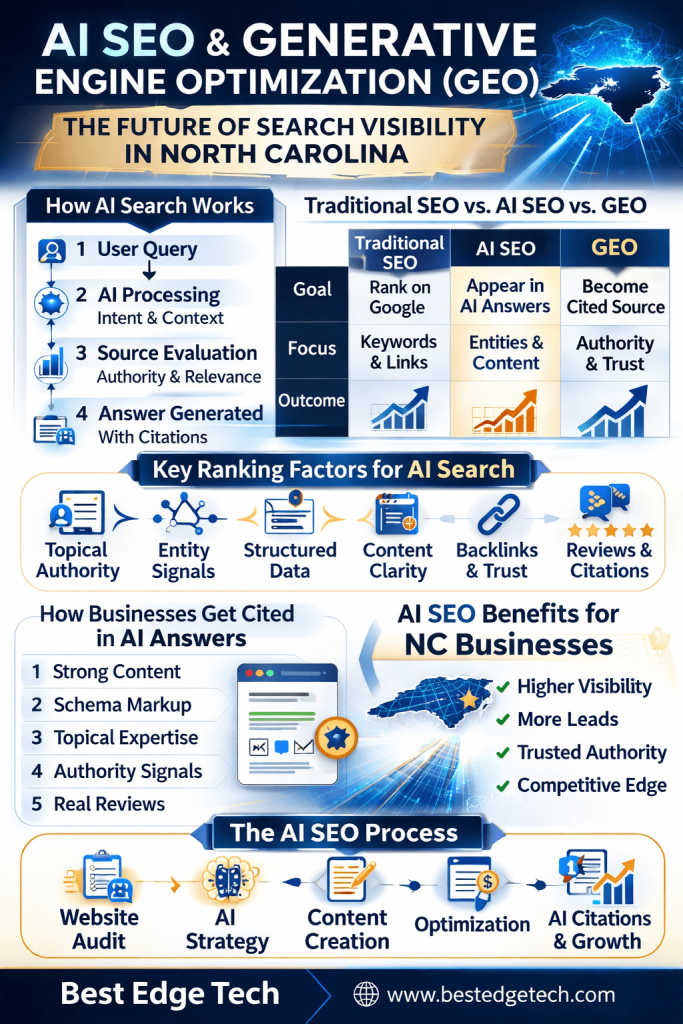

The infographic above illustrates the relationship between traditional SEO, AI SEO, and Generative Engine Optimization. It demonstrates how AI search engines analyze user intent, evaluate trusted sources, and generate answers by synthesizing information from authoritative websites. Businesses that build semantic topic authority, entity signals, and structured content are significantly more likely to be cited in AI-generated search results.
Modern AI search systems rely on large language models (LLMs) trained on massive datasets that include websites, research papers, and trusted knowledge sources.
When a user submits a question, the system typically follows a process similar to the following:
Step 1: Query Understanding
The AI system analyzes the user’s intent using natural language processing and contextual interpretation.
Step 2: Source Retrieval
The system retrieves relevant information from multiple sources across the web.
Step 3: Authority Evaluation
AI systems evaluate which sources demonstrate:
expertise
authority
topical relevance
factual consistency
Step 4: Answer Generation
The AI generates a summarized answer by synthesizing information from trusted sources.
Step 5: Citation and Attribution
Many AI platforms include references or citations pointing to the sources used to generate the response.
This means businesses must focus on becoming authoritative sources AI models trust when building answers.
Traditional SEO vs AI SEO vs Generative Engine Optimization
The evolution of search marketing can be understood through three distinct optimization models.
| Strategy | Primary Goal | Optimization Focus |
|---|---|---|
| Traditional SEO | Rank in search results | Keywords, backlinks, page optimization |
| AI SEO | Appear in AI answers | semantic authority and entity signals |
| Generative Engine Optimization | Become a cited source | structured answers and topic coverage |
Traditional SEO remains important, but modern digital visibility increasingly requires optimization specifically designed for AI search systems.
Why North Carolina Businesses Must Adapt to AI Search
Businesses across North Carolina operate in highly competitive digital markets. From healthcare providers in Raleigh to real estate firms in Charlotte and technology companies in the Research Triangle, online visibility plays a critical role in customer acquisition.
AI-driven search introduces several major changes that impact local businesses.
Reduced Visibility in Traditional Search Results
AI-generated answers often appear above traditional organic search results, which can reduce traffic to websites that are not referenced by the AI system.
Increased Authority for Cited Sources
When a company’s content is cited in AI answers, it gains strong credibility and trust.
Higher-Intent Traffic
Users interacting with AI search systems often receive answers earlier in their decision-making process, meaning businesses that appear in AI results often capture high-intent leads.
For companies in cities such as:
Raleigh
Durham
Chapel Hill
Charlotte
Greensboro
Wilmington
Asheville
AI SEO is rapidly becoming an essential component of digital marketing.
How Businesses Get Cited in AI Search Results
One of the most important questions businesses ask is how AI systems decide which sources to cite when generating answers.
Several factors play a critical role.
Topical Authority
Websites that cover an entire subject area comprehensively are far more likely to be referenced.
This is why topic clusters and pillar content strategies are critical.
Structured Answer Content
AI systems prefer content that includes clearly structured explanations, definitions, and step-by-step guidance.
Entity Recognition
Search engines increasingly rely on entity understanding to determine who a business is, what it specializes in, and where it operates.
Trust Signals
Signals that improve credibility include:
authoritative backlinks
consistent brand mentions
expert content
citations from trusted sources
Websites that combine these signals dramatically increase their probability of being referenced by AI-generated search systems.
Core AI SEO Strategies That Help Businesses Rank
Businesses that succeed in AI search typically implement several advanced strategies.
Semantic Topic Authority
AI search engines analyze entire topics rather than isolated keywords.
This means businesses must create comprehensive content that addresses related questions and concepts across a topic.
Example topic cluster:
Pillar Page
AI SEO Services
Supporting Articles
How Generative Engine Optimization Works
How AI Search Engines Rank Sources
AI SEO Strategies for Businesses
How to Appear in Google AI Overviews
This structure signals strong expertise to search engines.
Entity SEO
Entity SEO focuses on strengthening recognition of a business as a distinct entity within a particular industry or geographic region.
Important entity signals include:
consistent business name and contact information
structured data markup
brand mentions
authoritative content
For businesses targeting North Carolina markets, entity SEO should include strong geographic relevance.
Structured Data Implementation
Structured data helps search engines clearly understand the meaning of website content.
Examples of useful schema include:
FAQ schema
organization schema
service schema
article schema
Structured data improves visibility in:
AI Overviews
voice search
featured snippets
Content Designed for AI Extraction
AI systems extract information most easily from content that is clearly structured and easy to interpret.
Effective AI-friendly content often includes:
concise answer blocks
descriptive headings
semantic topic coverage
tables and frameworks
This structure significantly improves the probability that AI systems reference the content.
Industries in North Carolina That Benefit Most from AI SEO
While nearly every business can benefit from AI search optimization, several industries are particularly competitive online.
These include:
Healthcare providers
Medical practices
Legal services
Real estate firms
Home service companies
Financial services
Technology companies
Marketing agencies
In these industries, appearing in AI-generated search results can dramatically increase brand authority and lead generation.
How Best Edge Tech Helps Businesses Dominate AI Search
Best Edge Tech specializes in helping businesses implement advanced digital strategies designed specifically for the evolving AI search ecosystem.
The company focuses on several core areas.
AI Search Strategy
Developing comprehensive topic clusters designed to establish authority.
Technical SEO
Implementing structured data, entity signals, and optimized site architecture.
Authority Content Creation
Creating AI-extractable content engineered to be referenced by generative search systems.
AI Citation Optimization
Structuring content so that large language models can easily interpret and reference it.
Expert insight placeholder:
“Organizations that build structured topical authority today will dominate visibility in AI-driven search environments over the next decade.”
— Christopher A. Whitfield Digital Marketing Expert
Businesses interested in implementing these strategies can explore AI SEO & Generative Engine Optimization Services.
The Future of AI Search and Generative Optimization
AI-driven search systems will likely become the primary interface for information retrieval over the next decade.
Search engines are rapidly evolving toward systems that prioritize:
semantic understanding
entity relationships
trusted source citations
contextual knowledge graphs
Businesses that adapt their digital strategies to align with these systems today will be positioned to dominate digital visibility in the future.
Organizations that delay adoption may find it increasingly difficult to compete as AI search ecosystems mature.
Add Your Heading Text Here
How AI Models Choose Sources When Generating Answers
AI-powered search engines such as Google AI Overviews, ChatGPT, Gemini, and Perplexity do not simply pull random information from the internet. These systems analyze vast amounts of data and evaluate which sources demonstrate the strongest combination of expertise, authority, and relevance before generating an answer.
Understanding how AI systems evaluate sources is essential for businesses implementing AI SEO North Carolina strategies.
AI models typically evaluate several key factors when determining which content to reference.
Topical Authority
AI systems prefer sources that cover an entire subject area comprehensively rather than isolated articles focused on individual keywords.
For example, a website that publishes multiple articles about AI SEO, Generative Engine Optimization, AI search ranking signals, and AI marketing strategy demonstrates significantly more authority than a site with a single article.
This is why modern SEO strategies focus on building topic clusters and pillar pages.
Source Credibility
Search engines evaluate credibility signals such as:
authoritative backlinks
expert-level content
trusted citations
consistent brand mentions
Websites that consistently publish accurate, research-driven content are more likely to be trusted by AI models.
Entity Recognition
AI systems increasingly rely on entity recognition to understand organizations, industries, and geographic locations.
For example, when a search engine recognizes Best Edge Tech as a digital marketing authority connected to AI SEO and North Carolina, it becomes easier for the system to reference that source when generating answers.
Content Structure and Clarity
AI models favor content that is structured in a way that is easy to interpret.
This includes:
clear headings
direct answer blocks
structured explanations
well-organized sections
Content designed for clarity dramatically improves the likelihood of being extracted by AI systems.
AI SEO Strategy Framework for Businesses
Businesses that want to appear in AI-powered search results must implement a comprehensive strategy that aligns with how AI systems interpret and evaluate content.
Below is a simplified framework illustrating how companies can build a strong AI SEO foundation.
| Step | Strategy | Purpose |
|---|---|---|
| Topic Authority | Build pillar pages and supporting content clusters | Demonstrates expertise to search engines |
| Entity SEO | Strengthen brand recognition and industry relevance | Helps AI systems understand your business |
| Structured Content | Use answer blocks, headings, and clear explanations | Improves AI extraction |
| Authority Signals | Earn backlinks, citations, and brand mentions | Builds credibility |
| Structured Data | Implement schema markup | Helps search engines interpret content |
Businesses implementing these steps significantly increase their probability of appearing in AI-generated search results.
Organizations looking for guidance implementing this framework can explore AI SEO & Generative Engine Optimization Services.
Traditional SEO vs AI SEO vs Generative Engine Optimization
Search engine optimization has evolved dramatically over the past decade. While traditional SEO remains important, modern digital visibility increasingly requires strategies specifically designed for AI-powered search systems.
The differences between these approaches are illustrated below.
| Optimization Type | Primary Goal | Core Focus |
|---|---|---|
| Traditional SEO | Rank pages in search engine results | keywords, backlinks, on-page optimization |
| AI SEO | Help content appear in AI-generated answers | semantic authority, structured answers |
| Generative Engine Optimization | Become a trusted source cited by AI | topical expertise and entity signals |
Traditional SEO focuses primarily on rankings. AI SEO and Generative Engine Optimization focus on becoming trusted information sources that AI systems reference when generating answers.
Businesses adopting these strategies early often gain a major advantage as AI-driven search ecosystems continue to evolve.
Why Early Adoption of AI SEO Creates Competitive Advantage
The transition toward AI-powered search represents one of the most important shifts in digital marketing since the introduction of modern search engines.
Organizations that begin implementing AI SEO North Carolina strategies today often gain a significant advantage because the competitive landscape is still developing.
Early adopters benefit in several ways.
Greater Visibility in Emerging Search Systems
Businesses that publish structured, authoritative content early often become trusted sources referenced by AI models.
Stronger Authority Signals
Search engines reward websites that demonstrate consistent expertise within a subject area.
Long-Term Competitive Positioning
Companies that establish topical authority now are more likely to maintain visibility as AI search systems evolve.
In many ways, AI SEO today resembles the early days of traditional SEO when organizations that invested early gained lasting advantages.
Businesses interested in future-proofing their digital strategy can learn more about AI SEO & Generative Engine Optimization Services and how these strategies can help establish long-term search visibility.
Frequently Asked Questions
How do businesses appear in AI-generated search results?
Businesses appear in AI-generated search results when their content demonstrates strong topical authority, structured answers, and credible sources. AI systems evaluate expertise, entity signals, and content relevance when selecting information used to generate answers.
What is Generative Engine Optimization?
Generative Engine Optimization (GEO) is a strategy designed to optimize websites so that AI-powered search systems reference them when generating answers. GEO focuses on semantic authority, entity recognition, and AI-friendly content structures.
How is AI SEO different from traditional SEO?
Traditional SEO focuses on ranking pages in search engine results. AI SEO focuses on making content understandable and trustworthy for AI systems that generate answers directly within search interfaces.
How long does AI SEO take to produce results?
AI SEO strategies typically require several months to establish topical authority and trust signals. However, early adoption can provide a strong competitive advantage as AI search ecosystems continue to evolve.
Can small businesses compete in AI search results?
Yes. Small businesses can compete effectively by creating authoritative content, building strong entity signals, and covering topics comprehensively within their niche.
What types of content perform best in AI search?
Content that includes structured explanations, definitions, step-by-step processes, and well-organized headings tends to perform best in AI-driven search systems.
Does structured data help with AI search visibility?
Structured data improves how search engines interpret content, making it easier for AI systems to extract information and generate answers.
Why is AI SEO important for businesses in North Carolina?
Businesses in North Carolina operate in competitive digital markets. AI SEO helps companies maintain visibility as search engines shift toward AI-generated answers.