How to Audit Search Intent Before Publishing SEO Content
A search intent audit is a pre-publication decision process: define what the query means, inspect the current results page, compare your planned answer with existing URLs, check audience and business fit, and publish only if the page has a distinct useful purpose. For a small or midsized business, this prevents the common mistake of approving content because a keyword looks relevant while ignoring whether the page will actually answer the searcher’s need. The goal is not to predict rankings, traffic, leads, or AI citations. The goal is to decide whether a proposed page deserves to exist before your team spends time writing, designing, approving, and internally linking it.
Quick answer
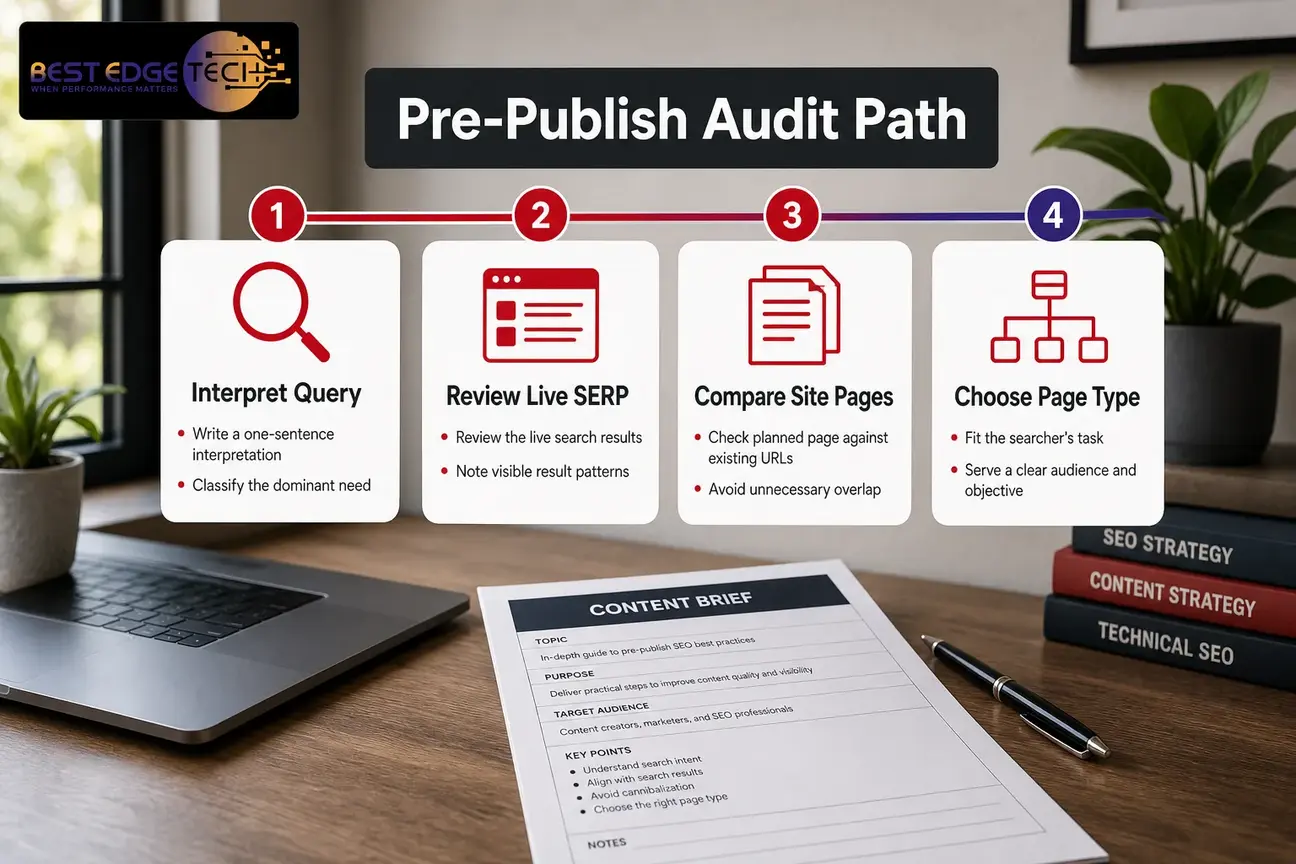
Before publishing SEO content, write a one-sentence interpretation of the query, classify the dominant need, review the live SERP, compare the planned page against your existing pages, and choose the page type that best fits the searcher’s task. Publish only when the page can serve a clear audience, answer a distinct question, support a real business objective, and avoid unnecessary overlap with an existing URL.
What is a search intent audit?
A search intent audit is a planning review that asks whether a proposed page matches the reason someone searches a query. It happens before content production, not after a page is already published. The audit should document the searcher’s likely goal, the visible result patterns, the right page type, the audience served, and the reason your page would add something useful.
This is different from an existing-page performance review. A keyword cannibalization audit investigates whether live pages overlap, compete, or send unclear signals after publication. A content decay audit looks at whether a published page has become outdated, less useful, or less aligned with current demand. Pre-publication intent validation is earlier and more preventive: it stops weak or duplicative ideas before they enter the content queue.
As of 2026, Google’s guidance supports this practical approach. Google Search Central recommends focusing on people-first content and says SEO can be helpful when applied to people-first content rather than search engine-first content. In an audit, that means the first question is not “Can we target this keyword?” It is “Can we create a page that helps a specific reader solve a real problem?”
A strong audit record also protects editorial focus. It gives the writer, editor, designer, and business owner the same page-level purpose before drafting begins. That matters for service businesses, healthcare practices, clinics, law firms, and agencies because content often has several stakeholders. Without a shared intent record, one person may expect an educational guide while another expects a sales page.
Use search intent analysis to define the query
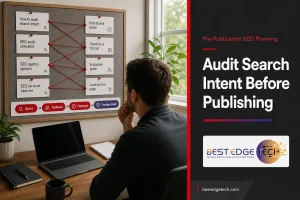
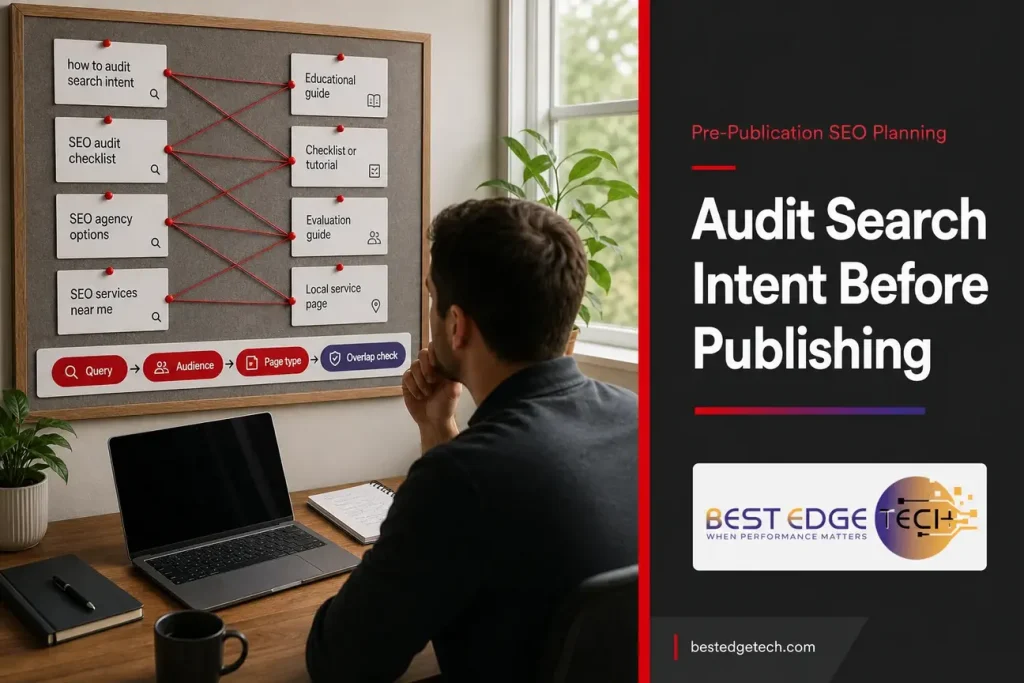
Search intent analysis starts before you look at competitors. If you inspect the results first, it is easy to copy the visible pattern without thinking through the customer’s actual problem. Start with the query itself and break it into pieces.
- Subject: What is the main topic, service, condition, problem, tool, or decision?
- Modifier: Does the query include words such as “how,” “cost,” “best,” “near me,” “template,” “service,” “comparison,” or “checklist”?
- Expected action: Is the searcher trying to learn, compare, choose, contact, buy, troubleshoot, or complete a task?
- Audience clue: Does the wording suggest a business owner, marketing lead, patient, legal client, agency, or technical user?
- Specificity: Is the query broad, narrow, local, branded, technical, or tied to a decision stage?
Then write one sentence: “The searcher wants [answer or task] so they can [next decision or action].” If your team cannot complete that sentence clearly, the query is not ready for production. That does not mean the topic is bad. It means the idea needs more search intent analysis before it becomes a brief.
For example, “SEO audit” can mean several things. A business owner may want to know what an audit includes. A marketing manager may be comparing vendors. An agency may need a white-label process. A developer may want a technical checklist. The same core words can point to different pages depending on the reader and the job to be done.
Good search intent analysis also keeps the business connection honest. A page should support a confirmed service, product, audience, or educational role. It should not exist only because a phrase appears related to the industry. For Best Edge Tech, this topic connects naturally to SEO audit services, SEO consulting, and content planning, but the article still needs to answer the educational question first.
Search intent analysis is also where your team should define what the page will not cover. That boundary keeps a simple guide from turning into a broad service pitch, a technical reference, and a buyer’s guide at the same time.
Classify query intent types without forcing one label
Query intent types are useful labels, not laws. They help your team describe the dominant need behind a search, but they do not promise that a page will perform. Many queries are mixed, and the live results can shift over time. Use the label to guide the page decision, then document any uncertainty.
| Intent type | What the searcher likely wants | Common page fit |
|---|---|---|
| Informational | An explanation, process, definition, example, or checklist | Educational guide, tutorial, checklist, glossary-style reference |
| Commercial investigation | Help comparing solutions, providers, approaches, or service options | Evaluation guide, comparison page, service explainer, buyer education page |
| Transactional | A way to complete an action | Product page, service page, quote page, booking page, signup page |
| Navigational | A known brand, website, account, or resource | Brand page, login page, official resource, support page |
| Local | A location-dependent provider, service, visit, or map result | Local service page, location page, Google Business Profile result, localized guide |
| Mixed | More than one plausible need | A page that clearly chooses one angle or separates intent into distinct pages |
For content planning, the most common tension is informational versus commercial investigation. A query such as “how to choose an SEO consultant” may need education, but the reader is also evaluating a service. A query such as “what is a canonical tag” is usually more educational. The audit should name the dominant purpose and decide how much service context belongs on the page.
Do not turn every informational query into a service page. If the searcher wants to learn a process, a sales-heavy page may miss the need. Likewise, do not publish a long guide when the query clearly suggests that the reader wants a local provider, a quote request, or a product action. The right use of query intent types is to keep format, scope, and call to action aligned.
Query intent types can also reveal when one keyword should become two briefs. If a query supports both beginner education and provider evaluation, your team may need one guide and one service-supporting page rather than one unfocused URL.
For regulated or sensitive industries, this classification also sets boundaries. A healthcare practice can publish marketing education about how patients search, but it should not give clinical advice unless qualified and reviewed through the right compliance process. A law firm can explain how legal-service search behavior works, but marketing content is not a substitute for legal advice. The audit should flag those boundaries before drafting.
Read SERP intent from current results, not assumptions
SERP intent means the pattern of needs and formats visible on the search engine results page at the time you review it. It is practical evidence, not a permanent rule. Search results can vary by location, device, personalization, freshness, and platform changes. Still, the SERP is one of the best planning inputs you have because it shows what the engine is currently surfacing for the query.
Review the exact query and a few close variants. Record the visible page types, titles, snippets, result features, and whether results are educational, local, commercial, video-heavy, forum-heavy, or mixed. If AI Overviews or other AI features appear, treat them as part of the visible search experience, but do not assume your page will appear there. As of 2026, Google’s AI features documentation explains how AI features can appear in Search, but it does not give a fixed formula for earning visibility in them.
During this step, avoid the “copy the top page” trap. The purpose of SERP intent review is not to clone headings, word count, or structure. It is to understand what searchers appear to be served. If most visible results are beginner guides, a highly technical developer reference may be mismatched. If most results are vendor comparison pages, a basic definition page may be too early-stage.
Use a simple review list:
- Are the visible results mostly guides, service pages, product pages, templates, videos, forums, local results, or comparison pages?
- Do the titles promise definitions, checklists, examples, providers, pricing, or step-by-step help?
- Do result snippets answer the query directly, or do they suggest deeper research is needed?
- Are there “People also ask” questions that reveal related concerns?
- Does the result set look consistent, or are several interpretations competing?
- Do close variants show the same pattern or a different SERP intent?
When the results are mixed, document the split instead of pretending the answer is obvious. A mixed SERP may justify narrowing the topic, changing the title, building two separate pages, or revising the content angle. This is where SEO consulting can be useful for teams that need an outside view on ambiguous page decisions.
Record SERP intent in plain language rather than screenshots alone. A short note such as “mostly educational checklists with some service pages” is easier for a writer to use than a folder of disconnected result captures.
Compare the planned answer with the current best answer
Once the SERP is documented, compare your planned page against the strongest visible answers and against your own existing content. The question is not “Can we make this longer?” Longer is not automatically more useful. The real question is: “What decision, explanation, or task will this page handle better, clearer, or more specifically for our audience?”
As of 2026, Google’s SEO Starter Guide says that creating content people find compelling and useful will likely influence a site’s presence in search results more than other suggestions in the guide, and it recommends content that is easy to read and well organized. Use that guidance carefully: Google Search Central’s SEO Starter Guide supports prioritizing usefulness and organization, but it does not promise that a specific page will rank or generate leads.
For each major visible result, record:
- The primary need the page addresses
- The likely audience
- The page type
- The scope and level of detail
- What it explains clearly
- What it leaves out
- Whether it assumes a specific business model, industry, or location
- Whether your planned page can add a distinct and useful perspective
Acceptable differentiation can come from a clearer decision process, a small-business implementation context, a specific audience such as agencies or healthcare practices, a distinct stage of the buyer journey, or a practical worksheet. It can also come from connecting the page to your site architecture in a more helpful way. For example, a page about internal linking should fit the site’s navigation and resource structure; if that is the issue, an internal linking audit may be the better next step.
Weak differentiation sounds like this: “We will make it more comprehensive,” “We will use our keyword more often,” or “Competitors have this, so we need one too.” Those are not enough. If your planned page cannot explain its unique usefulness in one or two sentences, revise the brief before assigning the draft.
This comparison should feed back into search intent analysis. If the visible results solve a different task than your planned page, the issue may be intent mismatch rather than content depth.
Check audience and business fit before assigning the brief
A page can match a query and still be wrong for your business. Audience fit asks whether the page is written for a reader you can credibly serve or educate. Business fit asks whether the topic supports a confirmed service, product, market, or trust-building purpose without stretching beyond evidence.
For small and midsized businesses, the audience-fit check should be specific. “Business owners” is usually too broad unless the query is broad. “Owners of local service businesses comparing SEO audit options” is clearer. “Marketing leads at clinics planning a new website content calendar” is clearer still. A defined reader makes the page more useful and helps the writer avoid generic advice.
For agencies, the same rule applies. If the intended reader is an agency looking for white-label fulfillment, the page may need more process detail, handoff clarity, and client-reporting language. If the reader is a law firm or healthcare practice, the page should stay within marketing guidance and avoid legal, medical, HIPAA, or regulatory advice. If compliance or professional judgment is involved, the business should consult the appropriate counsel or compliance team.
Business fit also includes geographic discipline. A North Carolina-based company may naturally mention service areas when location is relevant, such as local SEO. But national informational topics should not force a city into every paragraph. If the searcher’s problem is not location-dependent, keep the content focused on the task.
This is where search intent analysis and business strategy meet. A topic may be related to your industry but still not worth publishing if it does not support a real audience, a real service, or a credible educational role. Conversely, a modest query may be valuable if it helps the right reader make a better decision and connects naturally to your expertise.
Use content intent mapping to choose the page type
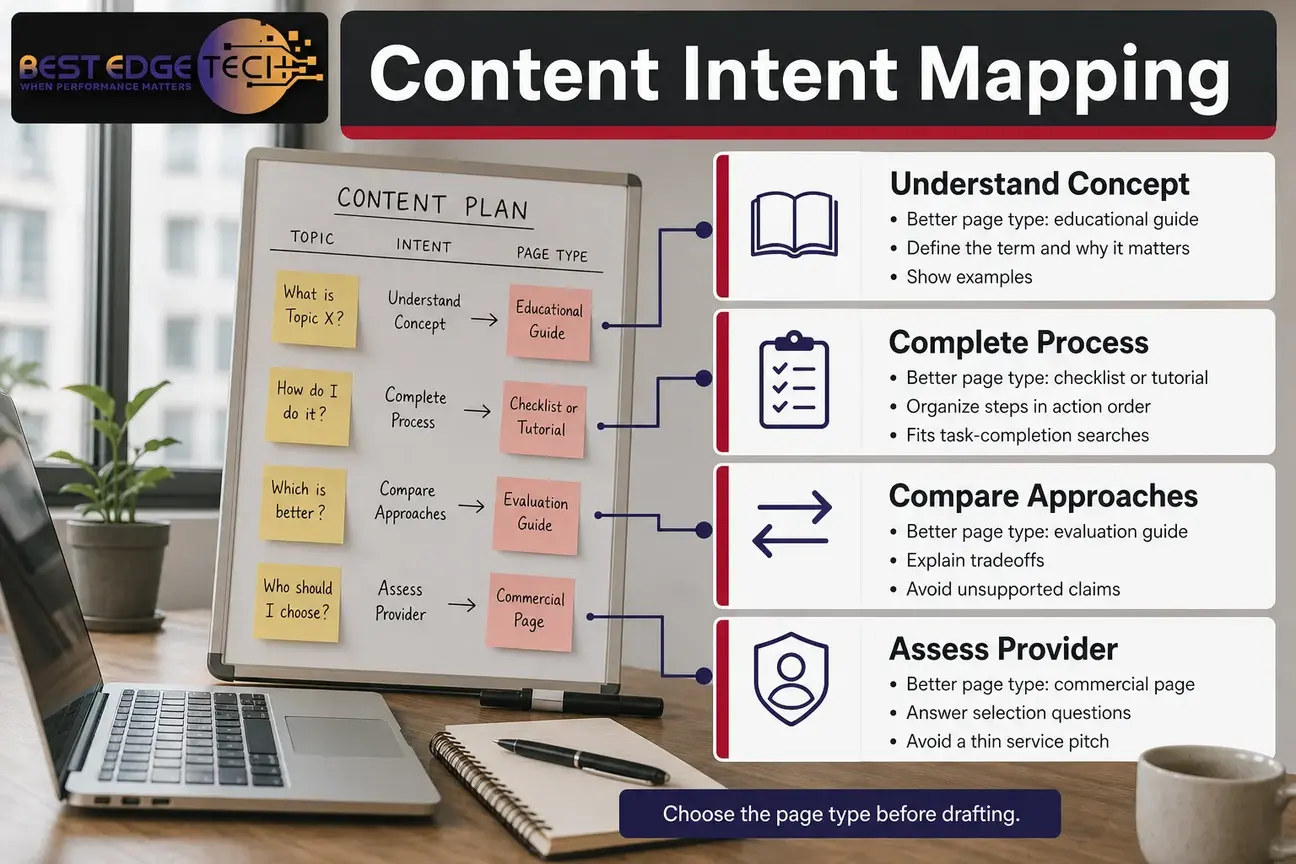
Content intent mapping connects the dominant search need to the page format. It is the step that keeps an informational query from becoming a sales page, a local query from becoming a generic guide, or a commercial investigation query from becoming a thin service pitch.
Use this mapping before drafting:
| Dominant need | Better page type | Planning note |
|---|---|---|
| Understand a concept | Educational guide | Define the term, explain why it matters, and show examples. |
| Complete a process | Checklist or tutorial | Organize steps in the order the reader should act. |
| Compare approaches | Evaluation guide | Explain tradeoffs without unsupported claims. |
| Assess a provider or service | Commercial investigation page | Answer selection questions and keep claims factual. |
| Take a local action | Local service page | Use location only when the query genuinely depends on geography. |
| Solve a narrow technical task | Reference or troubleshooting page | Keep the answer focused and precise. |
Content intent mapping should also define the role of calls to action. An educational guide can have a soft next step, but it should not interrupt the answer. A service page can be more direct because the searcher may be evaluating providers. A comparison page should help the reader decide what matters before asking them to contact you.
Good content intent mapping also limits unnecessary production work. If the map shows that the query needs a short reference page, do not assign a long guide just because the calendar needs another major article.
For this topic, the correct format is a practical educational guide with a decision checklist. A standalone service page would shift the article away from the reader’s informational need. If the reader later wants help applying the process, a contextual link to content marketing services or audit support is appropriate, but it should not replace the explanation.
Screen for overlap before publishing a new URL
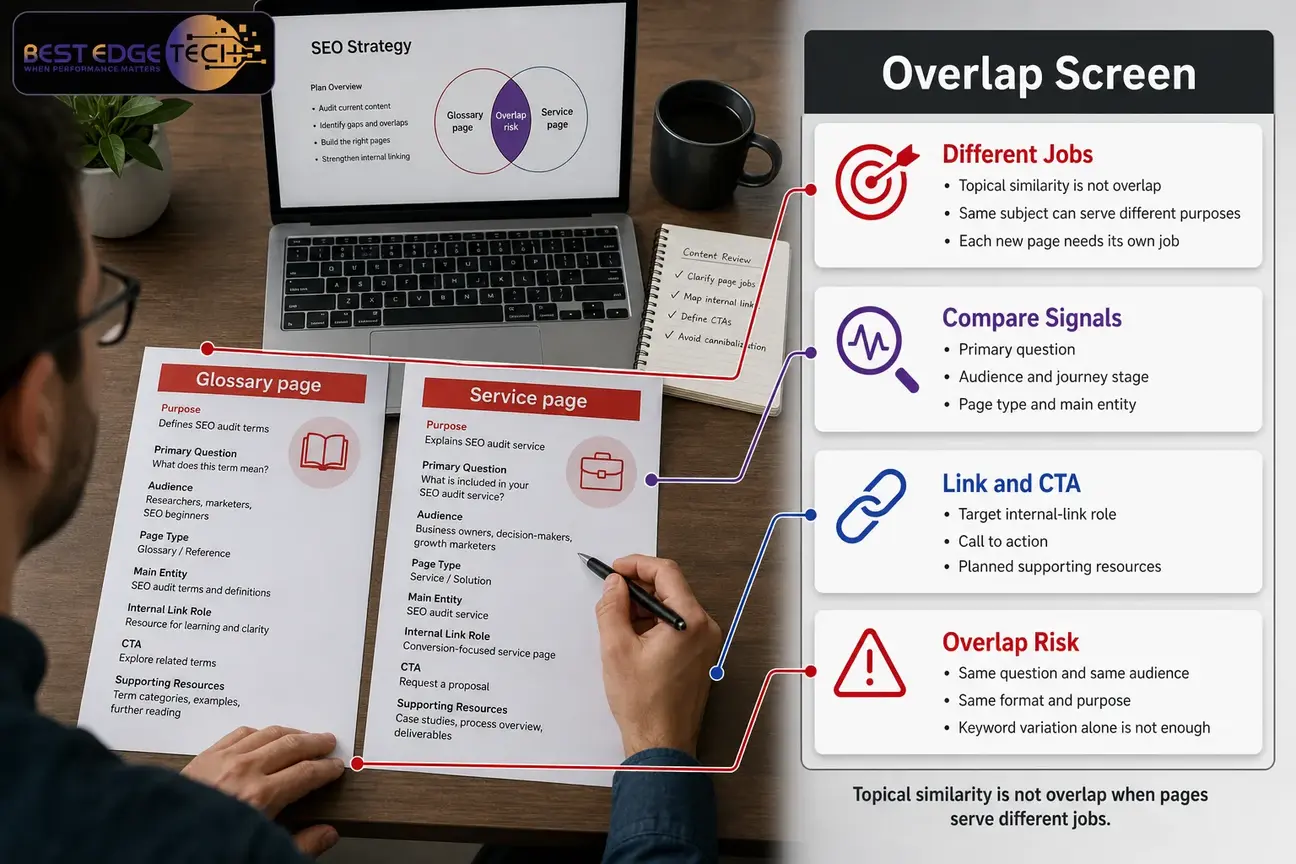
Overlap is not the same as topical similarity. Two pages can discuss the same broad subject and still serve different purposes. A glossary page, a service page, a case-neutral checklist, and a migration guide may all mention SEO audits, but they may answer different questions. The pre-publication screen should decide whether the planned page has its own job.
Compare the proposed page with existing URLs by:
- Primary question
- Audience
- Journey stage
- Page type
- Main entity, service, or problem
- Target internal-link role
- Call to action
- Planned supporting resources
A page is a likely overlap risk when it would answer the same primary question, target the same audience, use the same format, repeat the same explanation, and compete for the same internal links. A page is more likely to be distinct when it serves a different task, reader, decision stage, or format.
As of 2026, Google’s canonical documentation explains that canonical URLs can help consolidate signals for similar or duplicate pages. That supports taking overlap seriously, but it does not mean every related page is a problem. Use Google Search Central’s canonicalization documentation as a technical reference when pages are genuinely similar or duplicate; use editorial judgment first to decide whether the planned page should exist at all.
This distinction matters. A canonical tag is not a content strategy. If a planned page is unnecessary, do not publish it and hope technical implementation will sort it out. If an existing page partially answers the need, revise or expand the existing page. If the new page has a separate purpose, define that purpose clearly and plan internal links that explain the relationship.
Use query intent types and SERP intent together during this screen. If two planned URLs share the same audience, format, and dominant intent, they may belong in one stronger page rather than separate thin pages.
Build an audit worksheet your team can reuse
A reusable worksheet turns content intent mapping from opinion into a documented process. It does not need to be complicated. It needs to be consistent enough that the team can compare ideas fairly.
| Audit field | What to record | Decision value |
|---|---|---|
| Target query | Main query and close variants | Prevents vague topic approval |
| Searcher-need sentence | What the searcher wants and why | Clarifies the page’s job |
| Intent label | Informational, commercial investigation, transactional, navigational, local, or mixed | Guides page type |
| SERP intent notes | Visible result patterns, features, and page types | Tests assumptions against current results |
| Audience | Role, knowledge level, market, and next step | Prevents generic content |
| Business fit | Confirmed service or educational reason | Keeps the topic credible |
| Existing-page comparison | URLs with similar purpose or internal-link role | Flags overlap before production |
| Page type | Guide, checklist, service page, comparison, reference, or local page | Aligns structure with need |
| Final decision | Publish, revise, merge, redirect, or reject | Creates accountability |
If your organization assigns formal reviewers or dates, add those fields to the worksheet. Do not invent approvals after the fact. The value of the worksheet is that it records the reasoning that actually happened.
For agencies, this record is especially useful when multiple strategists, writers, editors, and client stakeholders are involved. It gives everyone a neutral reference when someone asks why a topic was approved, merged into another page, or rejected.
Keep the worksheet short enough to use. If search intent analysis, query intent types, SERP intent, and content intent mapping become a long form nobody completes, the process will not protect the content calendar.
Make the publish, revise, or reject decision
The final decision should be direct. If the page is approved, the brief should state why. If it needs revision, the brief should identify exactly what is unclear. If it should not be published, the team should know whether the topic belongs inside an existing page, should be postponed, or does not fit the business.
Publish when the evidence is strong enough
Publish when the query interpretation is clear, the dominant intent is documented, the page type matches the observed need, the audience is specific, and the page has a defensible useful distinction. Also confirm that existing pages do not already serve the same purpose and that the claims can be supported without invented statistics, outcome promises, awards, credentials, or case-study results.
Revise when the idea is promising but unclear
Revise when the query is ambiguous, informational and commercial needs are mixed, the audience is too broad, the SERP suggests a different format, or the proposed differentiation is only “more comprehensive.” Revise also when a current page partially satisfies the need and could be strengthened instead of creating a new URL.
Reject or merge when the new page has no distinct job
Do not publish a new page when an existing page already answers the same question for the same audience, when the only justification is a keyword variation, or when the topic depends on unsupported claims. Merge the idea into an existing page if it improves that page’s usefulness. Reject it if it does not fit the site’s confirmed domain, audience, or editorial standards.
Use the audit to support broader SEO analysis
A pre-publication intent check is one part of SEO analysis, not a replacement for technical auditing, content review, internal-link review, or measurement. It helps your team avoid producing pages that are misaligned from the start. That makes later optimization more disciplined because the page begins with a clear purpose.
For example, a technical audit may uncover crawl, indexing, structured data, or performance issues. A content audit may identify outdated pages. An AI search readiness review may look at whether the site presents clear entities, helpful answers, and trustworthy information for AI-assisted discovery. A pre-publication intent audit sits earlier: it asks whether the planned page should enter the system at all.
If your team is planning a larger content program, connect this process to keyword mapping, editorial calendars, and internal linking plans. Do not approve thirty topics just because each has a related phrase. Approve topics because each one has a distinct reader, purpose, page type, and relationship to the rest of the site.
Best Edge Tech works with businesses and agencies on search visibility, SEO analysis, SEO consulting, content marketing, and AI search strategy. If you want help applying this process to your site, you can contact Best Edge Tech or call 252-303-0074. Share your website URL, goals, markets served, current traffic or Search Console access if available, recent site changes, and the service you are considering. A conversation can help clarify scope, but results depend on your site, market, competition, and execution.
Final checklist for a practical search intent audit
Use this checklist before a topic becomes a writing assignment:
- Write the target query and close variants.
- Complete the searcher-need sentence.
- Identify the likely audience and decision stage.
- Classify the dominant query intent types and note any mixed signals.
- Review SERP intent for the exact query and close variants.
- Compare the planned answer with visible results and existing site pages.
- Confirm that the topic fits a real business or educational purpose.
- Use content intent mapping to choose the right page type.
- Decide to publish, revise, merge, or reject the idea.
The best outcome is not always a new page. Sometimes the right decision is to improve an existing URL, adjust a service page, strengthen internal links, or narrow a topic before writing. That discipline is what makes a search intent audit useful: it protects your site from clutter and keeps your content plan focused on pages that serve a clear purpose.
Search engines and AI products change often. Check current platform documentation before acting, and treat any result as dependent on your site, market and competition.
Frequently Asked Questions
What is a search intent audit?
A search intent audit is a pre-publication review of what a query means, what the current SERP appears to satisfy, and whether a proposed page has a distinct useful purpose.
How is a search intent audit different from a keyword cannibalization audit?
A search intent audit evaluates a planned page before publication. A keyword cannibalization audit evaluates overlap among pages that already exist.
Is search intent the same as a keyword’s meaning?
No. The same keyword can support different interpretations depending on modifiers, context, audience, and the result formats shown in the SERP.
What is commercial investigation intent?
Commercial investigation intent describes a searcher who is comparing or evaluating possible solutions, providers, products, or approaches before taking action.
Should every SERP feature determine the page format?
No. SERP features are observations about the results shown for a query at a given time. They should inform the page decision but should not be treated as permanent requirements or promises.
When should a planned page be revised instead of published?
Revise it when the query is ambiguous, the page type does not match the observed need, the differentiation is weak, or an existing page already covers much of the same purpose.
Can a new page target a query related to an existing page?
Yes, if the new page serves a meaningfully different audience, question, task, stage, or page purpose. Similar wording alone does not prove that a separate page is justified.