
Local SEO Service Area Business Guide Without a Storefront
For local SEO service area business planning, the first rule is accuracy: represent how customers actually work with you. A service-area business serves customers at their locations or delivers to them instead of receiving customers at a public storefront. Google’s Business Profile representation guidelines explain how businesses should represent locations, service areas, names, and customer-facing access.
Quick Answer: A business without a storefront can still pursue local visibility, but it should not publish a fake public address or imply an office that customers cannot visit. Build visibility around an accurate Business Profile, clear website information, useful service and location pages, and legitimate trust signals. A service area communicates where you operate; it does not create automatic map visibility in every place you name.
Local SEO Service Area Business Basics
A service-area business is not “less local” because customers do not walk into a public office. Plumbers, mobile repair providers, home-service contractors, delivery-based companies, and appointment-based professionals may all serve a local market without receiving customers at a counter or waiting room. The SEO issue is not whether the business is real; the issue is whether the business represents its operating model honestly.
This distinction matters because Google Business Profile, your website, and your local landing pages should tell the same story. If customers call you, book an appointment, and you travel to them, your profile and site should say that. If customers visit your staffed location, your profile can reflect that only when the location is eligible and customer-facing. If both are true, you may be a hybrid business.
Good service-area SEO starts with classification before keywords. If the profile is built on the wrong business model, every later tactic becomes riskier: city pages may exaggerate coverage, review requests may point customers to the wrong entity, and contact pages may publish information that conflicts with the profile. That inconsistency can hurt trust even when it does not trigger a platform issue.
For a business serving North Carolina or any other regional market, the same principle applies: describe the real service model first, then optimize around it. Local search is not a loophole for creating locations. It is a way to make a legitimate local operation easier to understand, evaluate, and contact.
Storefront, Hybrid, and Service-Area Models Compared
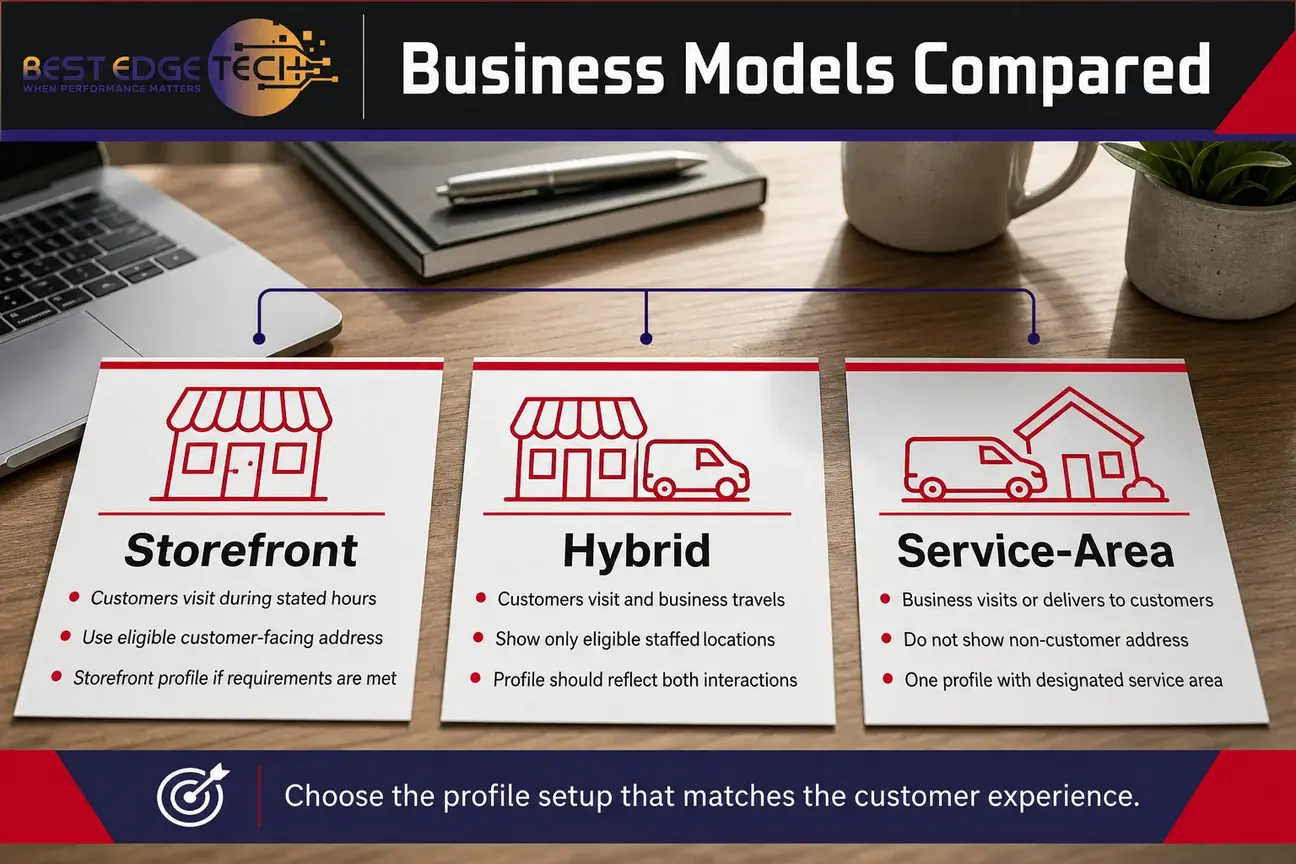
Before working on local SEO without storefront pages, separate the three common business models. The words sound simple, but the profile implications are different. Google’s Business Profile guidelines explain how businesses should represent locations and service areas, including the rule that service-area businesses should generally have one profile for the central office or location with a designated service area.
| Business model | How customers interact | Address treatment | Profile approach |
|---|---|---|---|
| Storefront | Customers visit the business location during stated hours. | Use only an eligible customer-facing location. | Storefront profile when the location meets the applicable requirements. |
| Hybrid | Customers can visit the location, and the business also visits or delivers to customers. | Address and service area may both apply when eligible. | Hybrid profile that reflects both customer-facing access and service coverage. |
| Service-area business | The business visits or delivers to customers and does not serve customers at its business address. | Do not present a non-customer-facing address as a public storefront. | Service-area profile with accurate service coverage. |
A storefront needs a real customer-facing location. A hybrid business needs a real customer-facing location plus legitimate off-site service. A service-area operation needs accurate coverage information without turning a private, virtual, or administrative address into a public office.
The common mistake is trying to solve visibility by changing the business model on paper. For example, a contractor may believe that publishing a home address will make the business look more local. A professional service firm may rent a mailbox and treat it like a branch. A remote team may create a separate page for every nearby city even when the service process is identical and no local evidence exists. Those moves create inconsistency instead of trust.
Service area business SEO should not begin with “How many cities can we add?” It should begin with “What is true, useful, and clear for the customer?” That question keeps the profile, website, and local pages aligned.
Service Area Business Listing Eligibility Questions to Answer First
A service area business listing should begin with eligibility, not layout. Ask whether the business has in-person contact with customers, how customers receive service, and whether any location is truly staffed and customer-facing. If the business never meets customers in person and operates entirely online, do not assume that a local Business Profile is automatically the right channel. The profile strategy should match the current platform rules and the actual customer experience.
For businesses that do meet customers in person at the customer’s location, the next question is address visibility. If customers do not come to the business address, do not try to make that address act like a storefront. A hidden or non-public operating base can still support a legitimate service-area model, but it should not be promoted as a walk-in location.
A service area business listing also needs category discipline. Choose categories that describe what the business actually does, not every service the owner hopes to rank for. The primary category should reflect the main customer need. Supporting categories should be accurate and defensible.
Virtual offices require special caution. Google’s representation guidance says service-area businesses cannot list a virtual office unless that office is staffed during business hours. A mailbox, reception-only address, or occasional meeting room is not the same as an eligible customer-facing operation. If the address is not staffed and does not reflect how customers actually receive service, building a profile around it can create risk.
Separate profiles also require caution. A single operation that serves multiple towns should not create duplicate profiles just because it wants visibility in each place. Additional profiles should be based on genuinely separate eligible locations, staff, and operations, not on desired keyword coverage. When in doubt, document the real-world setup before editing the profile.
This is where an audit mindset helps. Evaluate the business model, customer journey, phone number, website, service categories, address treatment, and service-area settings as one system. Best Edge Tech offers local SEO services for businesses that need help aligning their profile, website, and local content without relying on fake locations or inflated claims.
How to Describe Service Areas Without Overstating Coverage
The service area should describe where the business actually provides its products or services. It should not be a wish list, a statewide keyword target, or a substitute for proof of operations. Google’s service-area guidance for Business Profiles explains service-area settings and distinguishes businesses that serve customers at a business address from those that visit or deliver to customers.
Service area business SEO works best when the profile and website use consistent language. If the profile says the business serves a defined region, the website should explain what that means in customer terms: where appointments are available, what service types are offered, whether travel or delivery limits apply, and how a prospect can confirm availability. The goal is not to repeat city names. The goal is to reduce confusion.
A service area business listing should also separate coverage from location claims. A business can say it serves a city or region without saying it has an office there. “We provide in-home service in this area” is a service statement. “Our local office in this area” is a location claim. If the office is not real and customer-facing, do not publish it.
Also avoid city lists that are written only for search engines. A list can be useful if it helps customers understand coverage, but it should not become the main content. A better approach is to group nearby service areas logically, explain service boundaries, and give the customer a clear next step to confirm whether their location is covered.
A service area is not a ranking promise. Google’s local ranking guidance describes local results as based mainly on relevance, distance, and prominence. Naming a service area can help represent coverage accurately, but it does not remove the effect of distance or make one profile visible everywhere in the same way.
Service area business SEO is stronger when service-area language sounds like operations, not advertising copy. Use wording a customer can understand: where the business travels, what services are available, what limits may apply, and how to ask about a specific address.
For local SEO without storefront confusion, keep the distinction visible on every key page: coverage is where service happens, while a storefront is where customers can visit. That simple separation protects customers from bad assumptions and helps the business avoid unsupported location claims.
What Your Website Should Say When There Is No Storefront
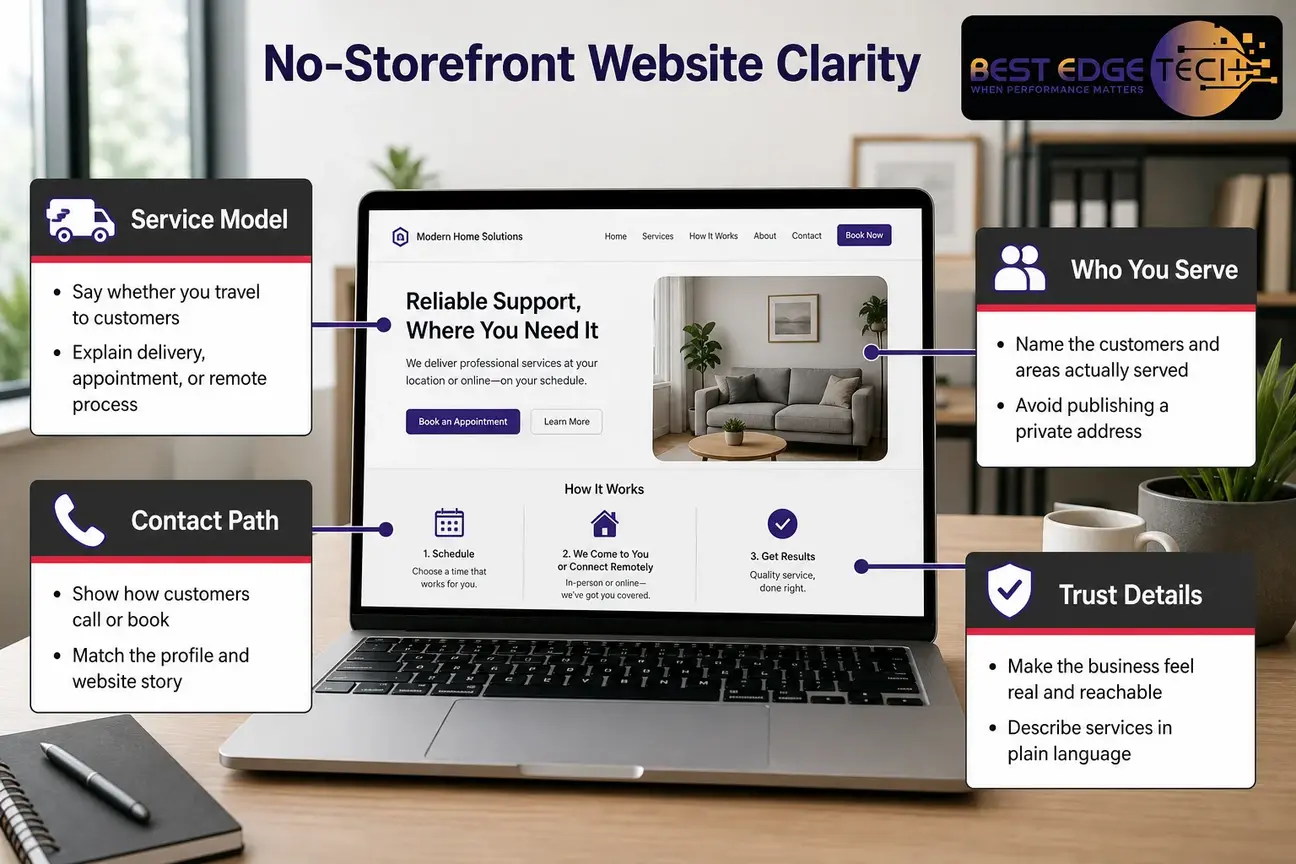
Local SEO without storefront support depends heavily on website clarity. If your profile hides a non-customer-facing address, the website should still make the business feel real, reachable, and specific. That does not mean publishing a private address. It means explaining who you serve, what you do, how the service is delivered, and how customers can contact you.
A strong service-area page or main local page should include a plain-language service model. For example, say whether the business travels to customer locations, provides delivery, works by appointment, operates remotely with in-person service when needed, or uses another clear process. This helps customers understand what will happen after they call or submit a form.
Local SEO without storefront content should answer practical questions before it tries to persuade. Where is service available? How does scheduling work? What information should the customer provide? Are some services limited by geography, appointment type, or staffing? Clear answers make the business easier to evaluate.
The page should also explain the geographic area actually served. This can be a region, county, metro area, or list of communities when the list is useful for customers. Keep the wording factual. Do not turn the page into a long block of place names. If a customer would not find the geography explanation useful, it probably exists only for SEO.
Contact consistency matters. Use the same business name and primary phone number across the website and profile where appropriate. Make contact options easy to find. If the business uses appointment windows, service request forms, intake calls, or route-based scheduling, explain the process without promising availability or response times you cannot support.
Service-specific explanations are also important. A local page that says “we serve your area” but does not explain the service is weak. Describe the customer problem, what the service includes, what information the customer should have ready, and what factors affect scope. For a healthcare practice, clinic, law firm, or medical-tourism provider, keep the page focused on marketing and search visibility; confirm advertising, privacy, legal, medical, and regulatory requirements with your own counsel or compliance team.
Google’s helpful content guidance is a useful lens here: create pages for people first, with original, useful information that helps visitors accomplish their task. For service-area businesses, that means answering practical questions a real customer would ask before calling.
If the website itself is hard to use, unclear, or built around thin local pages, profile accuracy alone will not fix the problem. Best Edge Tech’s SEO-focused web design work is relevant when a business needs a site structure that supports local pages, service pages, crawlable navigation, and clear calls to action.
Local SEO Without Storefront Landing Pages That Are Actually Useful
Local landing pages can help when each page has a real purpose. They become a problem when the only difference is the city name. A page for “service in City A” and another for “service in City B” should not be near-identical copies with swapped headings. That pattern is easy for users to spot, and it does not build confidence.
For local SEO without storefront locations, create a market page only when the business genuinely serves that market and can add useful information. Useful information might include service availability, common customer needs in that market, how scheduling works, travel or delivery considerations, service limitations, proof of real operations, and links to relevant service pages.
Local SEO without storefront pages should make the service model clearer than a generic city page would. If there is no lobby, counter, or waiting room, the page needs to explain how the customer receives service. A useful page can still be local without pretending there is a walk-in address.
A good local page should answer these questions:
- What service is available in this area?
- How does the business deliver the service without a storefront?
- Who is the service for?
- What should a customer expect after contacting the business?
- What information should the customer provide?
- What makes the business credible, without inventing claims?
- How does this page connect to the main service page?
Local pages should avoid fake local proof. Do not invent testimonials, staff, offices, awards, local partnerships, or case studies. Do not use “near me” language as if it is a location. Do not add a map pin for an address that customers cannot visit. If you cannot say something truthfully and support it, leave it out.
Internal links help users and search engines understand the page hierarchy. A local landing page should usually link to the main service page, relevant supporting services, and the contact page. It should not become an orphan page created only for search engines. If your local pages are already published and you are unsure whether they help or dilute visibility, an SEO audit services engagement can identify thin pages, conflicting location claims, and internal-linking gaps.
Local SEO without storefront planning should also include consolidation decisions. If several pages target similar areas but give customers the same information, a stronger regional page may be more useful than many weak pages. The right choice depends on real service coverage, search intent, and the amount of distinct helpful information available.
Service Area Business SEO Trust Signals That Support Visibility
Trust signals are evidence that helps customers and platforms understand who the business is, what it does, and whether its claims are credible. They are not magic ranking switches. For a service-area business, trust signals matter because there may be no storefront sign, lobby, or public address to reassure customers. The website and profile must carry more of that explanation.
Identity signals include a consistent business name, phone number, service description, and brand presentation. Consistency does not mean forcing the same sentence everywhere. It means a customer should not wonder whether the profile, website, and contact form refer to the same business.
Operational clarity explains how service is delivered. If technicians travel to customers, say that. If consultations begin remotely and then move to in-person service, explain the sequence. If certain services are available only in part of the service area, make that clear. Clarity helps customers self-qualify before contacting the business.
Website quality includes helpful service pages, readable content, fast enough access for users, clear navigation, and visible contact options. A local business does not need to publish everything about its operations, but it should publish enough for a reasonable prospect to understand the next step.
Third-party corroboration can include legitimate mentions, links, professional profiles, and reviews. These should be earned or accurately maintained, not manufactured. If your market depends on professional credentials, licenses, memberships, or practitioner information, present only what is current and supportable.
Customer experience signals include review practices, service explanations, and post-service communication. Google says reviews and positive ratings can help local ranking, but review activity should not be treated as a standalone visibility plan. The FTC Endorsement Guides also matter when businesses discuss endorsements, incentives, and consumer reviews.
Do not buy reviews, offer incentives for reviews, write reviews for customers, ask only satisfied customers, or use a private screening process to decide who receives a review request. Ask honestly, make it easy for customers to share real feedback, and accept that review programs are about trust as much as search.
Service area business SEO also depends on how well these signals connect. A clear profile, a thin website, and inconsistent contact information still create doubt. A cleaner system has the same business identity, service model, contact path, and local explanation across the profile and website.
Best Edge Tech also covers trust signals and AI rankings for businesses that want to understand how local credibility, entity clarity, and website evidence can support broader search visibility. No agency can promise a particular local ranking or AI citation, but a cleaner evidence trail makes the business easier to understand.
For service area business SEO, trust signals should support the service model rather than decorate the page. Accurate categories, clear service descriptions, transparent review practices, and consistent contact paths all help reinforce the same real-world story.
What Not to Do With a Service-Area Profile or Website
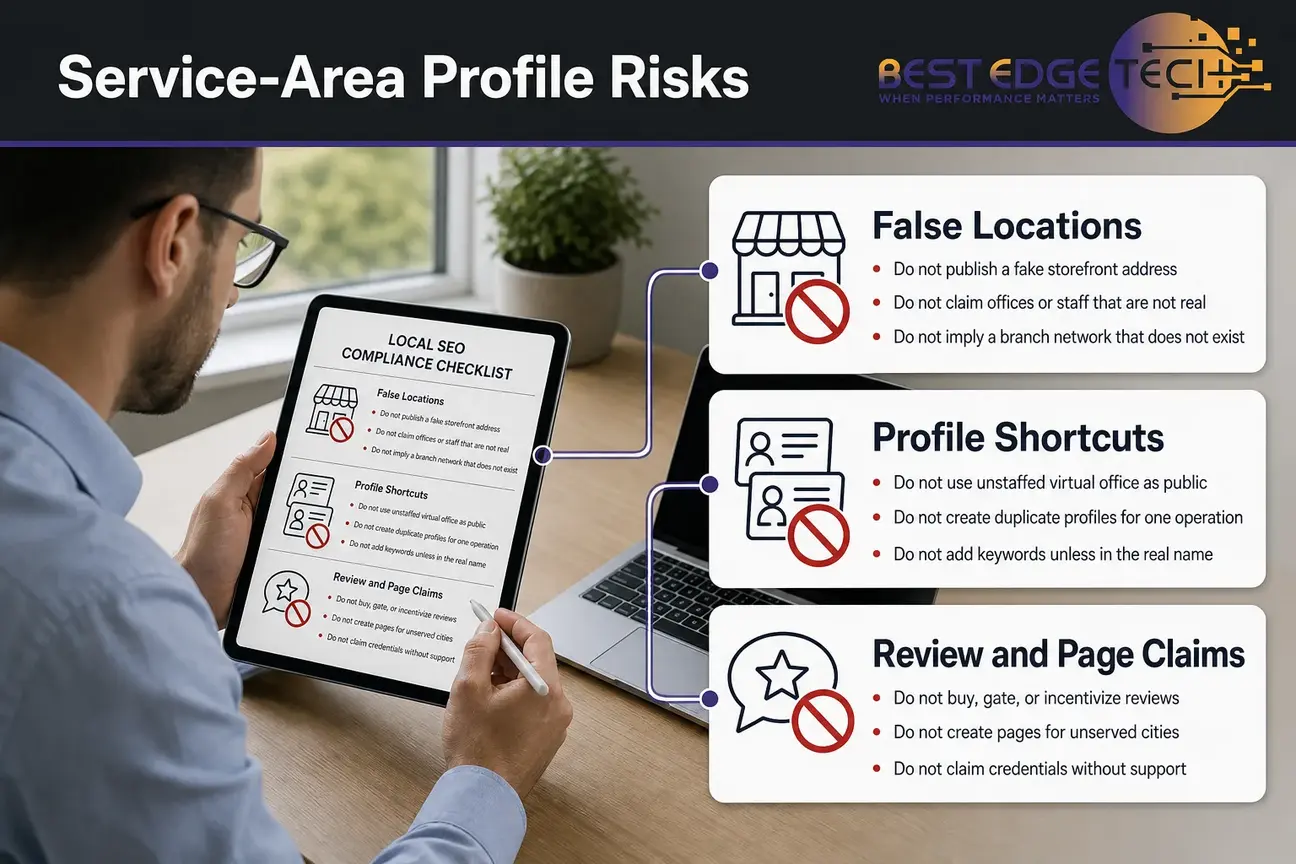
The fastest way to weaken a local strategy is to make claims that are not true. Local search rewards clarity over shortcuts. A service area business listing should not be used to create the appearance of a storefront, branch network, or local team that does not exist.
- Do not publish a fake storefront address.
- Do not use an unstaffed virtual office as if it were a public location.
- Do not create duplicate profiles for one service-area operation.
- Do not add keywords to the business name unless they are part of the real-world business name.
- Do not buy, gate, or incentivize reviews.
- Do not create city pages for places the business does not actually serve.
- Do not claim offices, staff, credentials, or testimonials that cannot be supported.
- Do not treat service-area settings, reviews, links, or content as a single-factor solution.
- Do not promise map placement, traffic, leads, revenue, or time to results.
These mistakes often happen because the business is trying to close a distance gap. If the searcher is far from the business’s real operating base, a fake address may look tempting. It is still the wrong move. A better approach is to strengthen relevance and prominence honestly: clarify services, improve page quality, earn legitimate trust signals, and make the site easier to use.
Local SEO without storefront risk is mostly about restraint. If a claim would confuse a customer, it probably does not belong on the profile or local page. If a page exists only to target a city but says nothing useful about service delivery, it needs to be improved, consolidated, or removed.
A service area business listing should also avoid keyword-stuffed business names. The business name on the profile should reflect the real-world name, not a phrase built to include every service and city the business wants to target.
A Practical Audit Checklist for Local SEO Without Storefront Risk
Use this checklist when reviewing service area business SEO. It is designed for owners, marketing leads, agencies, healthcare practices, clinics, and law firms that need a practical way to spot profile and website issues before they become larger problems.
1. Confirm the Business Model
Write down how customers receive service. Do they visit you, do you visit them, do you deliver, or is the process hybrid? Do not start with what you want Google to show. Start with the customer journey.
2. Check Profile Eligibility
Confirm whether the business has in-person contact with customers during stated hours and whether any listed location is actually staffed and customer-facing. If the operation is entirely remote, check current platform documentation before building a profile strategy around local visibility.
3. Review the Service Area Business Listing
Look at the service area business listing as a customer would. Does it accurately explain the business name, category, service area, hours, website, and phone path? Does it imply walk-in access where none exists? Does it match the website’s service model?
4. Check Address Handling
If customers do not visit the business address, do not use it as a public storefront. Make sure the website does not contradict the profile by implying walk-in access, branch offices, or locations that are not real.
5. Validate Service-Area Accuracy
Compare the service area in the profile with the areas described on the website. Remove places that are not genuinely served. If service availability varies by service type, explain the difference in customer-friendly language.
6. Compare Name, Phone, and Service Descriptions
The business name, primary phone number, core services, and customer process should be consistent. Minor wording differences are normal. Conflicting claims are not. A profile that says one thing and a website that says another creates friction for both users and audits.
7. Evaluate Local Landing-Page Quality
Look for thin city-swapped pages, unsupported “near me” language, fake local testimonials, and pages with no real service detail. Improve or consolidate pages that do not help customers make a decision.
8. Audit Client Service-Area Claims Before Publishing
For agencies handling local pages or white-label SEO for agencies, do not accept a client’s city list at face value. Ask for the real service process, areas actually served, location eligibility, phone path, and any industry-specific claim review needed before publishing pages or editing a profile. This protects the client, the agency, and the customer from unsupported location claims.
9. Check Trust Signals
Confirm that credentials, licenses, professional affiliations, staff claims, service claims, and review language are accurate. Remove anything outdated or unsupported. For regulated industries, route claims through the appropriate legal, medical, privacy, or compliance process.
10. Inspect Internal Links
Make sure important service pages, local pages, and contact pages are reachable through crawlable links. A strong local page should not sit disconnected from the rest of the site. If you publish educational content, connect it where it helps users continue their research; for example, Best Edge Tech’s SEO and AI search guides collect related search strategy topics.
11. Monitor Visibility Without Overreading It
Measure profile interactions, calls, form submissions, qualified inquiries, and Search Console trends where available. Do not judge the whole strategy by one keyword from one location on one day. Local visibility changes with relevance, distance, prominence, competition, searcher context, and platform changes.
12. Recheck Documentation Periodically
Google Business Profile rules and search documentation change. Schedule periodic checks for profile settings, website claims, review practices, and service-area language. This is especially important after a relocation, rebrand, merger, new service launch, or website redesign.
For service-area local visibility, repeat this audit after major operational changes. A new phone system, added service line, changed intake process, or updated coverage area can create profile and website inconsistencies even when no one intended to mislead customers.
How Best Edge Tech Approaches Service-Area Local Visibility
Best Edge Tech is a North Carolina-based digital marketing agency that works on SEO, local SEO, AI search optimization, content, technical audits, and SEO-focused website strategy. For service-area businesses, the practical work usually starts with alignment: profile classification, service-area wording, website structure, local landing-page quality, trust signals, and measurement.
The scope depends on the site and market. A small service business with one core service may need profile cleanup, service-page improvements, and clearer contact paths. A multi-service company may need content consolidation, internal-linking changes, and a more careful local-page structure. A healthcare practice or law firm may also need marketing claims checked by its own counsel or compliance team before publication.
If you need help evaluating a service-area profile and website, you can contact Best Edge Tech or call 252-303-0074. Share your website URL, goals, markets served, recent site changes, current Search Console access if available, and the service you are considering. That information helps frame the conversation without promising a specific result or timeline.
Conclusion: Build Local Trust Without Pretending to Be a Storefront
The right local SEO service area business strategy is not about hiding who you are or creating extra locations. It is about representing the business accurately, explaining where and how you serve customers, and giving both users and search platforms consistent evidence to work with.
For local SEO without storefront visibility, focus on the fundamentals: eligible profile setup, accurate service areas, useful website content, honest local pages, clear contact options, and legitimate trust signals. Service area business SEO works best when the profile, website, and customer experience all support the same real-world story. A service area business listing should reduce confusion, not create a storefront claim that customers cannot use.
Search engines and AI products change often. Check current platform documentation before acting, and treat any result as dependent on your site, market and competition.
Frequently Asked Questions
Can a service-area business have a Google Business Profile without a storefront?
Potentially, yes. A business without a storefront may be eligible when it meets Google’s requirements and serves customers in person at their locations or through delivery. The profile should represent the business as a service-area business rather than implying a public storefront customers can visit.
Should a service-area business publish its address?
If customers are not served at that address, the business should not present it as a customer-facing storefront. The website can still explain the real service area, contact process, and operating model without publishing a private or non-customer-facing address.
What is the difference between a storefront and a service-area business?
A storefront receives customers at a business location during stated hours. A service-area business visits or delivers to customers and does not serve customers at its business address. A hybrid business does both when the customer-facing location is eligible.
Can a virtual office be used for a service-area Business Profile?
Use caution. Google says service-area businesses cannot list a virtual office unless it is staffed during business hours. A mailbox, occasional meeting room, or unstaffed office should not be treated as a public storefront.
How many Business Profiles should a service-area business create?
Most service-area businesses should use one profile for the central office or location with a designated service area. Separate profiles should be based on genuinely separate eligible locations, staff, and service areas, not on a desire to rank in more cities.
Do local service-area pages make a business visible in every city?
No. A local page can help explain a real service area, but it does not promise map placement or visibility in every city. Local results depend on multiple factors, including how relevant, nearby, and prominent the business appears for a given search.
Can a business ask customers for reviews?
Yes, businesses can ask customers for honest feedback, but they should not buy reviews, offer incentives, write reviews for customers, ask only happy customers, or use review gating. Reviews should support trust, not manipulate local visibility.
Sources
- Google Business Profile Help: Guidelines for representing your business on Google
- Google Business Profile Help: Set your service area
- Google Business Profile Help: Tips to improve your local ranking on Google
- Google Search Central: Creating helpful, reliable, people-first content
- Federal Trade Commission: Endorsement Guides — What People Are Asking